

17
Identify need and
establish authority
Obtain financial
support
Organize
stakeholder
participation
Organize the
process through
pre-planning
Define and analyze
existing conditions
Define and analyze
future conditions
Prepare and
approve the spatial
management plan
Implement and
enforce the spatial
management plan
measures
Monitor and
evaluate
performance
Adapt the spatial
management
process
3.3. MSP Steps
While there is no single model for MSP, there is a common planning process that involves
establishing a vision, setting goals, and determining measurable objectives, from which
allocation of space, and resources within that space can flow, as well as the area-specific
management needed to sustain the ecosystems that stakeholders collectively value (UNEP/CBD).
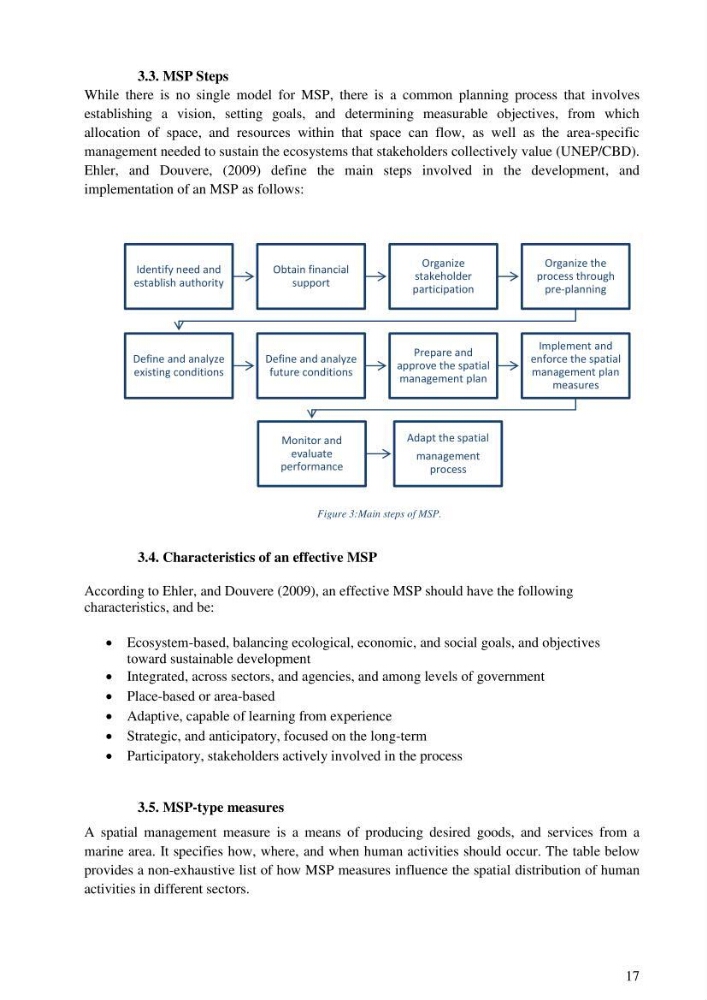
Ehler, and Douvere, (2009) define the main steps involved in the development, and
implementation of an MSP as follows:
3.4. Characteristics of an effective MSP
According to Ehler, and Douvere (2009), an effective MSP should have the following
characteristics, and be:
Ecosystem-based, balancing ecological, economic, and social goals, and objectives
toward sustainable development
Integrated, across sectors, and agencies, and among levels of government
Place-based or area-based
Adaptive, capable of learning from experience
Strategic, and anticipatory, focused on the long-term
Participatory, stakeholders actively involved in the process
3.5. MSP-type measures
A spatial management measure is a means of producing desired goods, and services from a
marine area. It specifies how, where, and when human activities should occur. The table below
provides a non-exhaustive list of how MSP measures influence the spatial distribution of human
activities in different sectors.
Figure 3:Main steps of MSP.
Identify need and
establish authority
Obtain financial
support
Organize
stakeholder
participation
Organize the
process through
pre-planning
Define and analyze
existing conditions
Define and analyze
future conditions
Prepare and
approve the spatial
management plan
Implement and
enforce the spatial
management plan
measures
Monitor and
evaluate
performance
Adapt the spatial
management
process
3.3. MSP Steps
While there is no single model for MSP, there is a common planning process that involves
establishing a vision, setting goals, and determining measurable objectives, from which
allocation of space, and resources within that space can flow, as well as the area-specific
management needed to sustain the ecosystems that stakeholders collectively value (UNEP/CBD).
Ehler, and Douvere, (2009) define the main steps involved in the development, and
implementation of an MSP as follows:
3.4. Characteristics of an effective MSP
According to Ehler, and Douvere (2009), an effective MSP should have the following
characteristics, and be:
Ecosystem-based, balancing ecological, economic, and social goals, and objectives
toward sustainable development
Integrated, across sectors, and agencies, and among levels of government
Place-based or area-based
Adaptive, capable of learning from experience
Strategic, and anticipatory, focused on the long-term
Participatory, stakeholders actively involved in the process
3.5. MSP-type measures
A spatial management measure is a means of producing desired goods, and services from a
marine area. It specifies how, where, and when human activities should occur. The table below
provides a non-exhaustive list of how MSP measures influence the spatial distribution of human
activities in different sectors.
Figure 3:Main steps of MSP.