

II. ENVIRONMENTAL IMPACTS AND RISKS EVALUATION OF OFFSHORE DRILLING
_____________________________________________________________________________
56
The characterization factor takes into account the chemical fate of toxic substances in the various
receiving environments and their effects on the exposed targets. The level of risk is determined
by the exposure doses of species and humans in relation to tolerance thresholds specific to each
toxic substance which are set by toxicologists and the World Health Organization (WHO). Thus,
the severity of the damage to human health is expressed in DALYs (disability-adjusted life
years) according to the WHO. It is a cost of illness scale that measures life expectancy in good
health, by subtracting the number of years "lost" due to illness, disability or early death.
On the other hand, the damage on the quality of the ecosystem is expressed in pdf.m2.yr where
the loss of biodiversity is considered as a potentially disappeared fraction of species in a certain
area (m2) during a certain time (years).
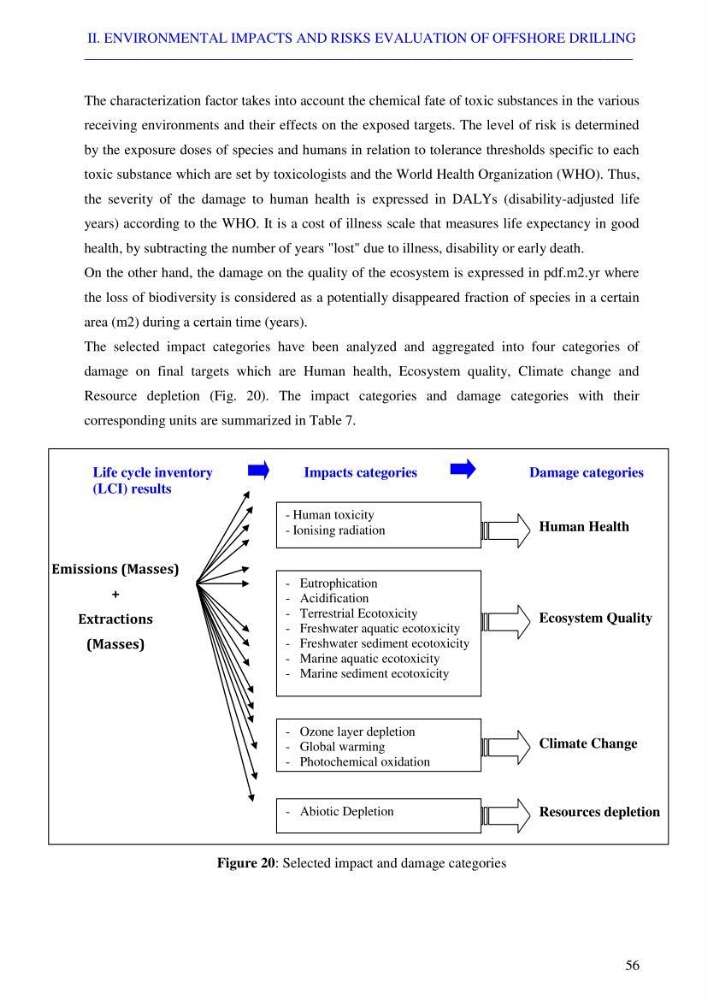
The selected impact categories have been analyzed and aggregated into four categories of
damage on final targets which are Human health, Ecosystem quality, Climate change and
Resource depletion (Fig. 20). The impact categories and damage categories with their
corresponding units are summarized in Table 7.
Figure 20: Selected impact and damage categories
Ecosystem Quality
Climate Change
Resources depletion
Human Health
- Ozone layer depletion
- Global warming
- Photochemical oxidation
- Eutrophication
- Acidification
- Terrestrial Ecotoxicity
- Freshwater aquatic ecotoxicity
- Freshwater sediment ecotoxicity
- Marine aquatic ecotoxicity
- Marine sediment ecotoxicity
- Human toxicity
- Ionising radiation
- Abiotic Depletion
Life cycle inventory
(LCI) results
Impacts categories
Damage categories
Emissions (Masses)
+
Extractions
(Masses)
_____________________________________________________________________________
56
The characterization factor takes into account the chemical fate of toxic substances in the various
receiving environments and their effects on the exposed targets. The level of risk is determined
by the exposure doses of species and humans in relation to tolerance thresholds specific to each
toxic substance which are set by toxicologists and the World Health Organization (WHO). Thus,
the severity of the damage to human health is expressed in DALYs (disability-adjusted life
years) according to the WHO. It is a cost of illness scale that measures life expectancy in good
health, by subtracting the number of years "lost" due to illness, disability or early death.
On the other hand, the damage on the quality of the ecosystem is expressed in pdf.m2.yr where
the loss of biodiversity is considered as a potentially disappeared fraction of species in a certain
area (m2) during a certain time (years).
The selected impact categories have been analyzed and aggregated into four categories of
damage on final targets which are Human health, Ecosystem quality, Climate change and
Resource depletion (Fig. 20). The impact categories and damage categories with their
corresponding units are summarized in Table 7.
Figure 20: Selected impact and damage categories
Ecosystem Quality
Climate Change
Resources depletion
Human Health
- Ozone layer depletion
- Global warming
- Photochemical oxidation
- Eutrophication
- Acidification
- Terrestrial Ecotoxicity
- Freshwater aquatic ecotoxicity
- Freshwater sediment ecotoxicity
- Marine aquatic ecotoxicity
- Marine sediment ecotoxicity
- Human toxicity
- Ionising radiation
- Abiotic Depletion
Life cycle inventory
(LCI) results
Impacts categories
Damage categories
Emissions (Masses)
+
Extractions
(Masses)