

II. ENVIRONMENTAL IMPACTS AND RISKS EVALUATION OF OFFSHORE DRILLING
_____________________________________________________________________________
55
II.2.2.3
Environmental impacts and risks assessment
The life cycle impact assessment was carried out using SIMAPRO7 which is an LCA software
developed by PRé Consultant in the Netherlands. It makes it possible to evaluate the
environmental impacts of a defined system with Life Cycle Impact Assessment models
integrated to several LCA methods as Eco-Indicator99, EDIP, Impact 2002+, CML2001 and
ReCiPe. The figure 20 shows the general structure of SIMAPRO7 software used in
For this study, the LCA method chosen was CML2001 to analyze the environmental impacts of
the life cycle of the offshore drilling system. It is developed by the Institute of Environmental
Sciences, Leiden University, Netherlands (Frischknecht et al. 2007; Crettaz et al., 2002) . The
modeling of environmental impacts in this method is based on mathematical analysis models
which are more suited to the characterization of toxic emissions from this system in different
environmental compartments, in particular marine waters and sediments. The figure 19 below
presents the conceptual framework of CML2001 method which was adopted and completed in
this study.
In this LCA method, environmental impacts are analyzed up to the midpoint only, but in this
study the analysis continued down to the damage level. The latter represent the risks on the final
targets which are: human health, the quality of the ecosystem, climate change and the depletion
of resources. The conversion of emissions and extractions from the system life cycle into
potential impacts is carried out by characterization factors from mathematical models integrated
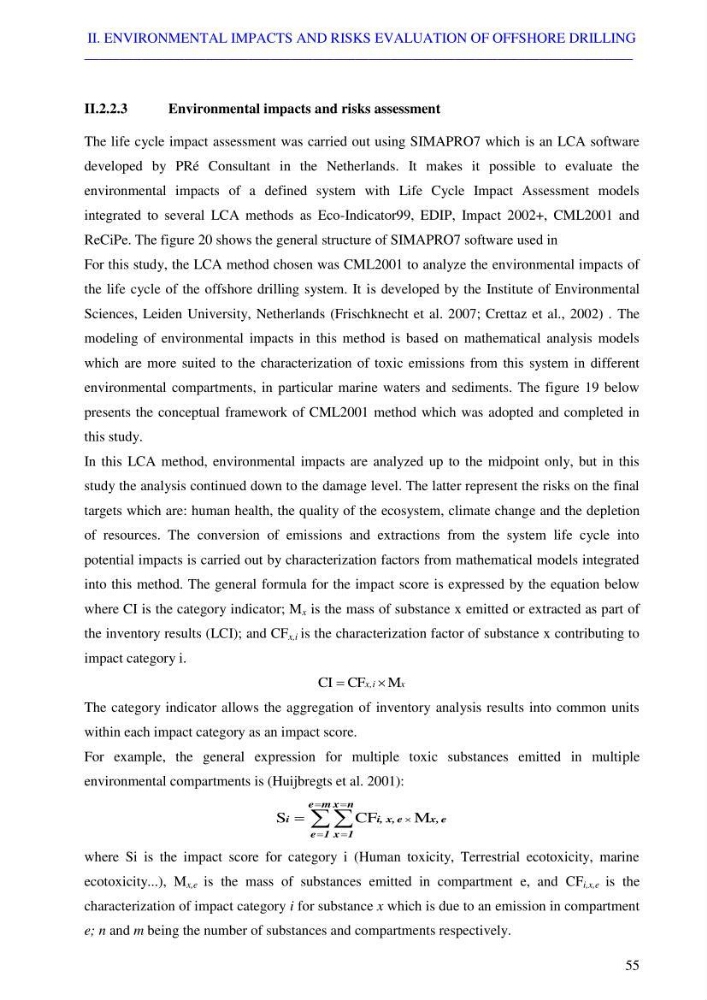
into this method. The general formula for the impact score is expressed by the equation below
where CI is the category indicator; M x is the mass of substance x emitted or extracted as part of
the inventory results (LCI); and CF x,i is the characterization factor of substance x contributing to
impact category i.
x
i
x,
M
CF
CI
The category indicator allows the aggregation of inventory analysis results into common units
within each impact category as an impact score.
For example, the general expression for multiple toxic substances emitted in multiple
environmental compartments is (Huijbregts et al. 2001):
m
e
1
e
n
x
1
x
e
x,
e
x,
i,
i
M
CF
S
where Si is the impact score for category i (Human toxicity, Terrestrial ecotoxicity, marine
ecotoxicity...), M x,e is the mass of substances emitted in compartment e, and CF i,x,e is the
characterization of impact category i for substance x which is due to an emission in compartment
e; n and m being the number of substances and compartments respectively.
_____________________________________________________________________________
55
II.2.2.3
Environmental impacts and risks assessment
The life cycle impact assessment was carried out using SIMAPRO7 which is an LCA software
developed by PRé Consultant in the Netherlands. It makes it possible to evaluate the
environmental impacts of a defined system with Life Cycle Impact Assessment models
integrated to several LCA methods as Eco-Indicator99, EDIP, Impact 2002+, CML2001 and
ReCiPe. The figure 20 shows the general structure of SIMAPRO7 software used in
For this study, the LCA method chosen was CML2001 to analyze the environmental impacts of
the life cycle of the offshore drilling system. It is developed by the Institute of Environmental
Sciences, Leiden University, Netherlands (Frischknecht et al. 2007; Crettaz et al., 2002) . The
modeling of environmental impacts in this method is based on mathematical analysis models
which are more suited to the characterization of toxic emissions from this system in different
environmental compartments, in particular marine waters and sediments. The figure 19 below
presents the conceptual framework of CML2001 method which was adopted and completed in
this study.
In this LCA method, environmental impacts are analyzed up to the midpoint only, but in this
study the analysis continued down to the damage level. The latter represent the risks on the final
targets which are: human health, the quality of the ecosystem, climate change and the depletion
of resources. The conversion of emissions and extractions from the system life cycle into
potential impacts is carried out by characterization factors from mathematical models integrated
into this method. The general formula for the impact score is expressed by the equation below
where CI is the category indicator; M x is the mass of substance x emitted or extracted as part of
the inventory results (LCI); and CF x,i is the characterization factor of substance x contributing to
impact category i.
x
i
x,
M
CF
CI
The category indicator allows the aggregation of inventory analysis results into common units
within each impact category as an impact score.
For example, the general expression for multiple toxic substances emitted in multiple
environmental compartments is (Huijbregts et al. 2001):
m
e
1
e
n
x
1
x
e
x,
e
x,
i,
i
M
CF
S
where Si is the impact score for category i (Human toxicity, Terrestrial ecotoxicity, marine
ecotoxicity...), M x,e is the mass of substances emitted in compartment e, and CF i,x,e is the
characterization of impact category i for substance x which is due to an emission in compartment
e; n and m being the number of substances and compartments respectively.