

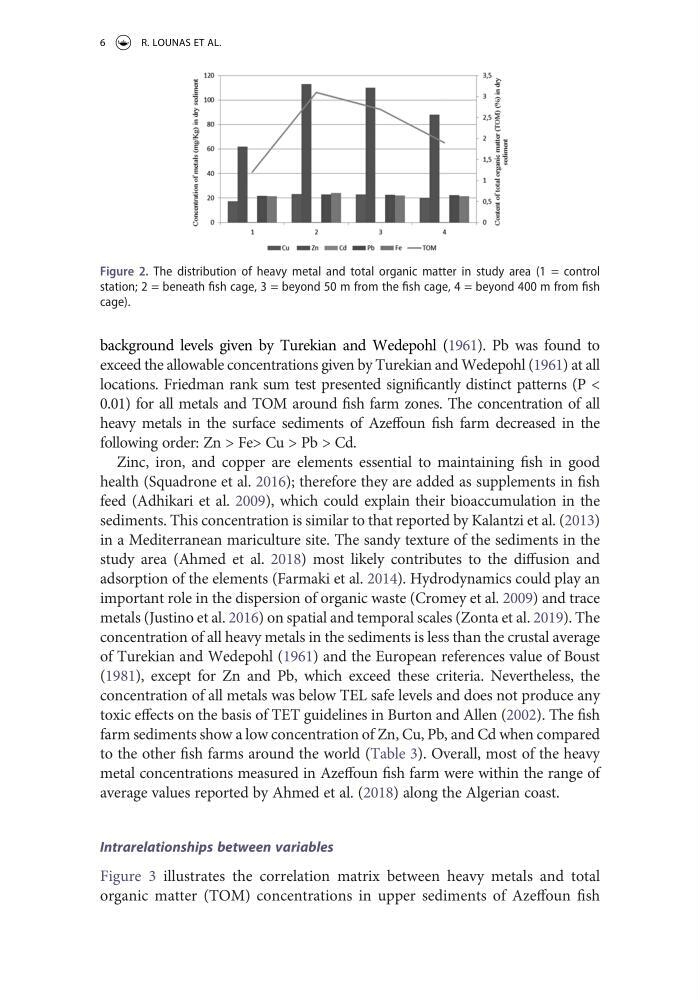
background levels given by Turekian and Wedepohl (1961). Pb was found to
exceed the allowable concentrations given by Turekian and Wedepohl (1961) at all
locations. Friedman rank sum test presented significantly distinct patterns (P <
0.01) for all metals and TOM around fish farm zones. The concentration of all
heavy metals in the surface sediments of Azeffoun fish farm decreased in the
following order: Zn > Fe> Cu > Pb > Cd.
Zinc, iron, and copper are elements essential to maintaining fish in good
health (Squadrone et al. 2016); therefore they are added as supplements in fish
feed (Adhikari et al. 2009), which could explain their bioaccumulation in the
sediments. This concentration is similar to that reported by Kalantzi et al. (2013)
in a Mediterranean mariculture site. The sandy texture of the sediments in the
study area (Ahmed et al. 2018) most likely contributes to the diffusion and
adsorption of the elements (Farmaki et al. 2014). Hydrodynamics could play an
important role in the dispersion of organic waste (Cromey et al. 2009) and trace
metals (Justino et al. 2016) on spatial and temporal scales (Zonta et al. 2019). The
concentration of all heavy metals in the sediments is less than the crustal average
of Turekian and Wedepohl (1961) and the European references value of Boust
(1981), except for Zn and Pb, which exceed these criteria. Nevertheless, the
concentration of all metals was below TEL safe levels and does not produce any
toxic effects on the basis of TET guidelines in Burton and Allen (2002). The fish
farm sediments show a low concentration of Zn, Cu, Pb, and Cd when compared
to the other fish farms around the world (Table 3). Overall, most of the heavy
metal concentrations measured in Azeffoun fish farm were within the range of
average values reported by Ahmed et al. (2018) along the Algerian coast.
Intrarelationships between variables
Figure 3 illustrates the correlation matrix between heavy metals and total
organic matter (TOM) concentrations in upper sediments of Azeffoun fish
Figure 2. The distribution of heavy metal and total organic matter in study area (1 = control
station; 2 = beneath fish cage, 3 = beyond 50 m from the fish cage, 4 = beyond 400 m from fish
cage).
6
R. LOUNAS ET AL.
exceed the allowable concentrations given by Turekian and Wedepohl (1961) at all
locations. Friedman rank sum test presented significantly distinct patterns (P <
0.01) for all metals and TOM around fish farm zones. The concentration of all
heavy metals in the surface sediments of Azeffoun fish farm decreased in the
following order: Zn > Fe> Cu > Pb > Cd.
Zinc, iron, and copper are elements essential to maintaining fish in good
health (Squadrone et al. 2016); therefore they are added as supplements in fish
feed (Adhikari et al. 2009), which could explain their bioaccumulation in the
sediments. This concentration is similar to that reported by Kalantzi et al. (2013)
in a Mediterranean mariculture site. The sandy texture of the sediments in the
study area (Ahmed et al. 2018) most likely contributes to the diffusion and
adsorption of the elements (Farmaki et al. 2014). Hydrodynamics could play an
important role in the dispersion of organic waste (Cromey et al. 2009) and trace
metals (Justino et al. 2016) on spatial and temporal scales (Zonta et al. 2019). The
concentration of all heavy metals in the sediments is less than the crustal average
of Turekian and Wedepohl (1961) and the European references value of Boust
(1981), except for Zn and Pb, which exceed these criteria. Nevertheless, the
concentration of all metals was below TEL safe levels and does not produce any
toxic effects on the basis of TET guidelines in Burton and Allen (2002). The fish
farm sediments show a low concentration of Zn, Cu, Pb, and Cd when compared
to the other fish farms around the world (Table 3). Overall, most of the heavy
metal concentrations measured in Azeffoun fish farm were within the range of
average values reported by Ahmed et al. (2018) along the Algerian coast.
Intrarelationships between variables
Figure 3 illustrates the correlation matrix between heavy metals and total
organic matter (TOM) concentrations in upper sediments of Azeffoun fish
Figure 2. The distribution of heavy metal and total organic matter in study area (1 = control
station; 2 = beneath fish cage, 3 = beyond 50 m from the fish cage, 4 = beyond 400 m from fish
cage).
6
R. LOUNAS ET AL.