

African Journal of Aquatic Science 2021: 1–9
5
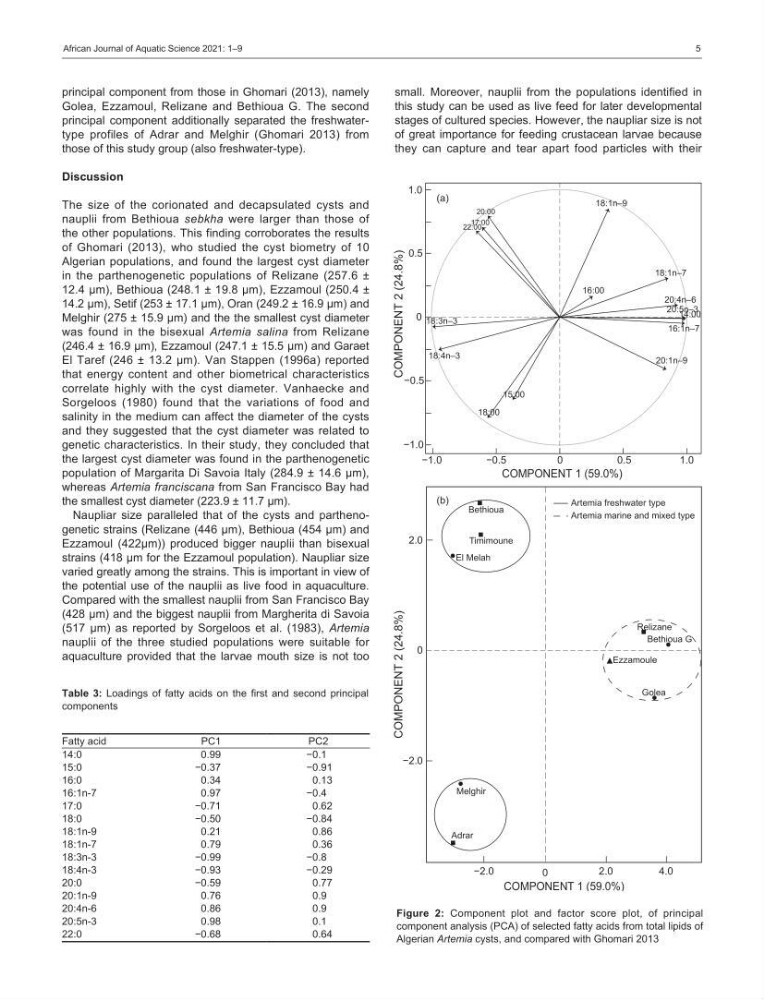
principal component from those in Ghomari (2013), namely
Golea, Ezzamoul, Relizane and Bethioua G. The second
principal component additionally separated the freshwatertype profiles of Adrar and Melghir (Ghomari 2013) from
those of this study group (also freshwater-type).
Discussion
The size of the corionated and decapsulated cysts and
nauplii from Bethioua sebkha were larger than those of
the other populations. This finding corroborates the results
of Ghomari (2013), who studied the cyst biometry of 10
Algerian populations, and found the largest cyst diameter
in the parthenogenetic populations of Relizane (257.6 ±
12.4 µm), Bethioua (248.1 ± 19.8 µm), Ezzamoul (250.4 ±
14.2 µm), Setif (253 ± 17.1 µm), Oran (249.2 ± 16.9 µm) and
Melghir (275 ± 15.9 µm) and the the smallest cyst diameter
was found in the bisexual Artemia salina from Relizane
(246.4 ± 16.9 µm), Ezzamoul (247.1 ± 15.5 µm) and Garaet
El Taref (246 ± 13.2 µm). Van Stappen (1996a) reported
that energy content and other biometrical characteristics
correlate highly with the cyst diameter. Vanhaecke and
Sorgeloos (1980) found that the variations of food and
salinity in the medium can affect the diameter of the cysts
and they suggested that the cyst diameter was related to
genetic characteristics. In their study, they concluded that
the largest cyst diameter was found in the parthenogenetic
population of Margarita Di Savoia Italy (284.9 ± 14.6 µm),
whereas Artemia franciscana from San Francisco Bay had
the smallest cyst diameter (223.9 ± 11.7 µm).
Naupliar size paralleled that of the cysts and parthenogenetic strains (Relizane (446 µm), Bethioua (454 µm) and
Ezzamoul (422µm)) produced bigger nauplii than bisexual
strains (418 µm for the Ezzamoul population). Naupliar size
varied greatly among the strains. This is important in view of
the potential use of the nauplii as live food in aquaculture.
Compared with the smallest nauplii from San Francisco Bay
(428 µm) and the biggest nauplii from Margherita di Savoia
(517 µm) as reported by Sorgeloos et al. (1983), Artemia
nauplii of the three studied populations were suitable for
aquaculture provided that the larvae mouth size is not too
small. Moreover, nauplii from the populations identified in
this study can be used as live feed for later developmental
stages of cultured species. However, the naupliar size is not
of great importance for feeding crustacean larvae because
they can capture and tear apart food particles with their
Fatty acid
PC1
PC2
14:0
0.99
−0.1
15:0
−0.37
−0.91
16:0
0.34
0.13
16:1n-7
0.97
−0.4
17:0
−0.71
0.62
18:0
−0.50
−0.84
18:1n-9
0.21
0.86
18:1n-7
0.79
0.36
18:3n-3
−0.99
−0.8
18:4n-3
−0.93
−0.29
20:0
−0.59
0.77
20:1n-9
0.76
0.9
20:4n-6
0.86
0.9
20:5n-3
0.98
0.1
22:0
−0.68
0.64
Table 3: Loadings of fatty acids on the first and second principal
components
−1.0
−0.5
0
0.5
1.0
−0.5
0
0.5
COMPONENT 1 (59.0%)
COMPONENT 2 (24.8%)
20:00
−1.0
1.0
17:00
22:00
18:1n–9
16:1n–7
20:5n–3
20:4n–6
18:1n–7
16:00
14:00
20:1n–9
18:00
15:00
18:4n–3
18:3n–3
(a)
0
0
COMPONENT 1 (59.0%)
COMPONENT 2 (24.8%)
−2.0
2.0
(b)
−2.0
2.0
4.0
Artemia freshwater type
Artemia marine and mixed type
Bethioua
Timimoune
El Melah
Relizane
Bethioua G
Ezzamoule
Golea
Melghir
Adrar
Figure 2: Component plot and factor score plot, of principal
component analysis (PCA) of selected fatty acids from total lipids of
Algerian Artemia cysts, and compared with Ghomari 2013
5
principal component from those in Ghomari (2013), namely
Golea, Ezzamoul, Relizane and Bethioua G. The second
principal component additionally separated the freshwatertype profiles of Adrar and Melghir (Ghomari 2013) from
those of this study group (also freshwater-type).
Discussion
The size of the corionated and decapsulated cysts and
nauplii from Bethioua sebkha were larger than those of
the other populations. This finding corroborates the results
of Ghomari (2013), who studied the cyst biometry of 10
Algerian populations, and found the largest cyst diameter
in the parthenogenetic populations of Relizane (257.6 ±
12.4 µm), Bethioua (248.1 ± 19.8 µm), Ezzamoul (250.4 ±
14.2 µm), Setif (253 ± 17.1 µm), Oran (249.2 ± 16.9 µm) and
Melghir (275 ± 15.9 µm) and the the smallest cyst diameter
was found in the bisexual Artemia salina from Relizane
(246.4 ± 16.9 µm), Ezzamoul (247.1 ± 15.5 µm) and Garaet
El Taref (246 ± 13.2 µm). Van Stappen (1996a) reported
that energy content and other biometrical characteristics
correlate highly with the cyst diameter. Vanhaecke and
Sorgeloos (1980) found that the variations of food and
salinity in the medium can affect the diameter of the cysts
and they suggested that the cyst diameter was related to
genetic characteristics. In their study, they concluded that
the largest cyst diameter was found in the parthenogenetic
population of Margarita Di Savoia Italy (284.9 ± 14.6 µm),
whereas Artemia franciscana from San Francisco Bay had
the smallest cyst diameter (223.9 ± 11.7 µm).
Naupliar size paralleled that of the cysts and parthenogenetic strains (Relizane (446 µm), Bethioua (454 µm) and
Ezzamoul (422µm)) produced bigger nauplii than bisexual
strains (418 µm for the Ezzamoul population). Naupliar size
varied greatly among the strains. This is important in view of
the potential use of the nauplii as live food in aquaculture.
Compared with the smallest nauplii from San Francisco Bay
(428 µm) and the biggest nauplii from Margherita di Savoia
(517 µm) as reported by Sorgeloos et al. (1983), Artemia
nauplii of the three studied populations were suitable for
aquaculture provided that the larvae mouth size is not too
small. Moreover, nauplii from the populations identified in
this study can be used as live feed for later developmental
stages of cultured species. However, the naupliar size is not
of great importance for feeding crustacean larvae because
they can capture and tear apart food particles with their
Fatty acid
PC1
PC2
14:0
0.99
−0.1
15:0
−0.37
−0.91
16:0
0.34
0.13
16:1n-7
0.97
−0.4
17:0
−0.71
0.62
18:0
−0.50
−0.84
18:1n-9
0.21
0.86
18:1n-7
0.79
0.36
18:3n-3
−0.99
−0.8
18:4n-3
−0.93
−0.29
20:0
−0.59
0.77
20:1n-9
0.76
0.9
20:4n-6
0.86
0.9
20:5n-3
0.98
0.1
22:0
−0.68
0.64
Table 3: Loadings of fatty acids on the first and second principal
components
−1.0
−0.5
0
0.5
1.0
−0.5
0
0.5
COMPONENT 1 (59.0%)
COMPONENT 2 (24.8%)
20:00
−1.0
1.0
17:00
22:00
18:1n–9
16:1n–7
20:5n–3
20:4n–6
18:1n–7
16:00
14:00
20:1n–9
18:00
15:00
18:4n–3
18:3n–3
(a)
0
0
COMPONENT 1 (59.0%)
COMPONENT 2 (24.8%)
−2.0
2.0
(b)
−2.0
2.0
4.0
Artemia freshwater type
Artemia marine and mixed type
Bethioua
Timimoune
El Melah
Relizane
Bethioua G
Ezzamoule
Golea
Melghir
Adrar
Figure 2: Component plot and factor score plot, of principal
component analysis (PCA) of selected fatty acids from total lipids of
Algerian Artemia cysts, and compared with Ghomari 2013