

Annual Amount
Annual Global Production
Reaching the Sea
Chemical
(in metric tons)
(in metric tons)
DDT
100,000
25,000
Aldrin-Toxaphene
(aldrin is rapidly converted
to dielclrin)
100,000
25,000
Benzene Hexachloride
more than
(BHC)
100,000
50,000
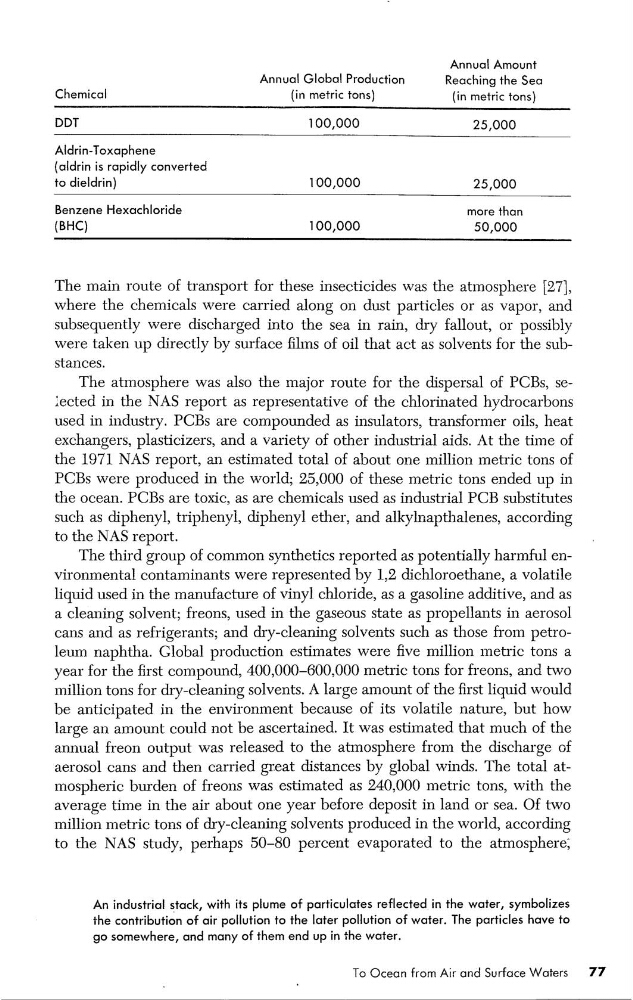
The main route of transport for these insecticides was the atmosphere [27],
where the chemicals were carried along on dust particles or as vapor, and
subsequently were discharged into the sea in rain, dry fallout, or possibly
were taken up directly by surface lms of oil that act as solvents for the sub—
stances.
The atmosphere was also the major route for the dispersal of PCBS, selected in the NAS report as representative of the chlorinated hydrocarbons
used in industry. PCBs are compounded as insulators, transformer oils, heat
exchangers, plasticizers, and a variety of other industrial aids. At the time of
the 1971 NAS report, an estimated total of about one million metric tons of
PCBS were produced in the world; 25,000 of these metric tons ended up
in
the ocean. PCBS are toxic, as are chemicals used as industrial PCB substitutes
such as diphenyl, triphenyl, diphenyl ether, and alkylnapthalenes, according
to the NAS report.
The third group
of common synthetics reported as potentially harmful en—
vironmental contaminants were represented by 1,2 dichloroethane, a volatile
liquid used in the manufacture of vinyl chloride, as a gasoline additive, and as
a cleaning solvent; freons, used in the gaseous
state as propellants in aerosol
cans and as refrigerants; and dry—cleaning solvents such as those from petro—
leum naphtha. Global production estimates were ve million metric tons a
year for the rst compound, 400,000—600,000 metric tous for freons, and two
million tons for dry—cleaning solvents. A large amount of the rst liquid would
be anticipated in the environment because of its volatile nature, but how
large an amount could not be ascertained. It was estimated that much of the
annual freon output was released to the atmosphere from the discharge of
aerosol cans and then carried great distances by global winds. The total at—
mospheric burden of freons was estimated as 240,000 metric tons, with the
average time in the air about one year before deposit in land or sea. Of two
million metric tons of dry—cleaning solvents produced in the world, according
to the NAS study, perhaps 50—80 percent evaporated to the atmosphere;
An industrial stack, with its plume of particulates reflected in the water, symbolizes
the contribution of air pollution to the later pollution of water. The particles have to
go somewhere, and many of them end up in the water.
To Ocean from Air anal Surface Waters
77
Annual Global Production
Reaching the Sea
Chemical
(in metric tons)
(in metric tons)
DDT
100,000
25,000
Aldrin-Toxaphene
(aldrin is rapidly converted
to dielclrin)
100,000
25,000
Benzene Hexachloride
more than
(BHC)
100,000
50,000
The main route of transport for these insecticides was the atmosphere [27],
where the chemicals were carried along on dust particles or as vapor, and
subsequently were discharged into the sea in rain, dry fallout, or possibly
were taken up directly by surface lms of oil that act as solvents for the sub—
stances.
The atmosphere was also the major route for the dispersal of PCBS, selected in the NAS report as representative of the chlorinated hydrocarbons
used in industry. PCBs are compounded as insulators, transformer oils, heat
exchangers, plasticizers, and a variety of other industrial aids. At the time of
the 1971 NAS report, an estimated total of about one million metric tons of
PCBS were produced in the world; 25,000 of these metric tons ended up
in
the ocean. PCBS are toxic, as are chemicals used as industrial PCB substitutes
such as diphenyl, triphenyl, diphenyl ether, and alkylnapthalenes, according
to the NAS report.
The third group
of common synthetics reported as potentially harmful en—
vironmental contaminants were represented by 1,2 dichloroethane, a volatile
liquid used in the manufacture of vinyl chloride, as a gasoline additive, and as
a cleaning solvent; freons, used in the gaseous
state as propellants in aerosol
cans and as refrigerants; and dry—cleaning solvents such as those from petro—
leum naphtha. Global production estimates were ve million metric tons a
year for the rst compound, 400,000—600,000 metric tous for freons, and two
million tons for dry—cleaning solvents. A large amount of the rst liquid would
be anticipated in the environment because of its volatile nature, but how
large an amount could not be ascertained. It was estimated that much of the
annual freon output was released to the atmosphere from the discharge of
aerosol cans and then carried great distances by global winds. The total at—
mospheric burden of freons was estimated as 240,000 metric tons, with the
average time in the air about one year before deposit in land or sea. Of two
million metric tons of dry—cleaning solvents produced in the world, according
to the NAS study, perhaps 50—80 percent evaporated to the atmosphere;
An industrial stack, with its plume of particulates reflected in the water, symbolizes
the contribution of air pollution to the later pollution of water. The particles have to
go somewhere, and many of them end up in the water.
To Ocean from Air anal Surface Waters
77