

.
a
/
/“°
?
!“ @
°
‘,
‘
Î*
’
°
,
m
“"
;
’
r
0
««
'
°
,
'
’
"';
…
—
n
.
3
_
’v‘l
;
)
-—
?
_ggä'ä
N
_V'
‘:
'
__
'
…
”…Ë I —2
)
!'Ïîg
'
-…,«3‘“m
??
.
‘î*
.
«
_
’
\
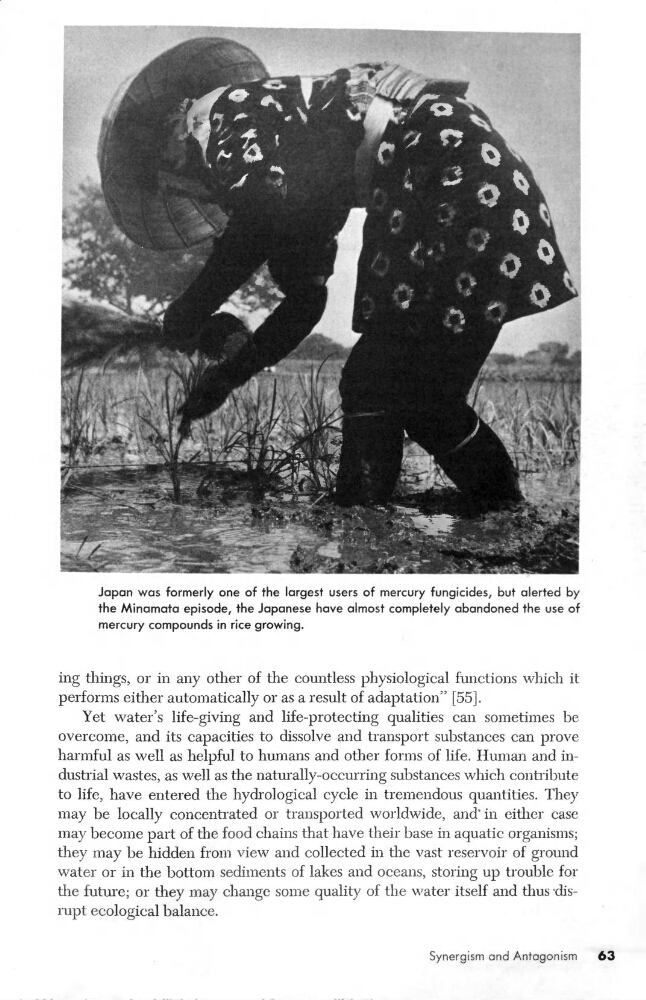
Japan was formerly one of the largest users of mercury fungicides, but alerted by
the Minamata episode, the Japanese have almost completely abandoned the use of
mercury compounds in rice growing.
ing things, or in any other of the countless physiological functions which it
performs either automatically or as a result of adaptation” [55].
Yet water’s life—giving and life—protecting qualities _can
sometimes be
overcome, and its capacities to dissolve and transport substances can prove
harmful as well as helpful to humans and other forms of life. Human and in—
dustrial wastes, as well as the naturally—occurrùrg substances which contribute
to life, have entered the hydrological cycle in tremendous quantities. They
may be locally concentrated or transported worldwide, and“ in either case
may become part of the food chains that have their base in aquatic organisms;
they may be hidden from view and collected in the vast reservoir of ground
water or in the bottom sediments of lakes and oceans, storing up trouble for
the future; or they may change some quality of the water itself and thus dis—
rupt ecological balance.
_
Synergism and Antagonism
63
a
/
/“°
?
!“ @
°
‘,
‘
Î*
’
°
,
m
“"
;
’
r
0
««
'
°
,
'
’
"';
…
—
n
.
3
_
’v‘l
;
)
-—
?
_ggä'ä
N
_V'
‘:
'
__
'
…
”…Ë I —2
)
!'Ïîg
'
-…,«3‘“m
??
.
‘î*
.
«
_
’
\
Japan was formerly one of the largest users of mercury fungicides, but alerted by
the Minamata episode, the Japanese have almost completely abandoned the use of
mercury compounds in rice growing.
ing things, or in any other of the countless physiological functions which it
performs either automatically or as a result of adaptation” [55].
Yet water’s life—giving and life—protecting qualities _can
sometimes be
overcome, and its capacities to dissolve and transport substances can prove
harmful as well as helpful to humans and other forms of life. Human and in—
dustrial wastes, as well as the naturally—occurrùrg substances which contribute
to life, have entered the hydrological cycle in tremendous quantities. They
may be locally concentrated or transported worldwide, and“ in either case
may become part of the food chains that have their base in aquatic organisms;
they may be hidden from view and collected in the vast reservoir of ground
water or in the bottom sediments of lakes and oceans, storing up trouble for
the future; or they may change some quality of the water itself and thus dis—
rupt ecological balance.
_
Synergism and Antagonism
63