

The increased mineral content in the Cane Branch reects the accelerated
weathering process which results from high acidity.
As shown on the preceding maps, both the Helton and Cane branches
meet to form Beaver Creek three miles downstream. (Data for Beaver Creek
also appears
in the table opposite.) Chemically and biologically, Beaver
Creek approached the control situation—pH was normal there because the
stream’s acidity had been diluted and neutralized by the bicarbonate alka—
linity of incoming tributaries. Sulfate and hardness were only slightly higher
than the contributing streams.
Increased acidity and mineral content also affected Wildlife. A number of
biological parameters were investigated. Bottom fauna (animal life) in the
two branches of the creek were compared: the Helton Branch contained an
average of 178 bottom organisms per square foot; the Cane Branch contained
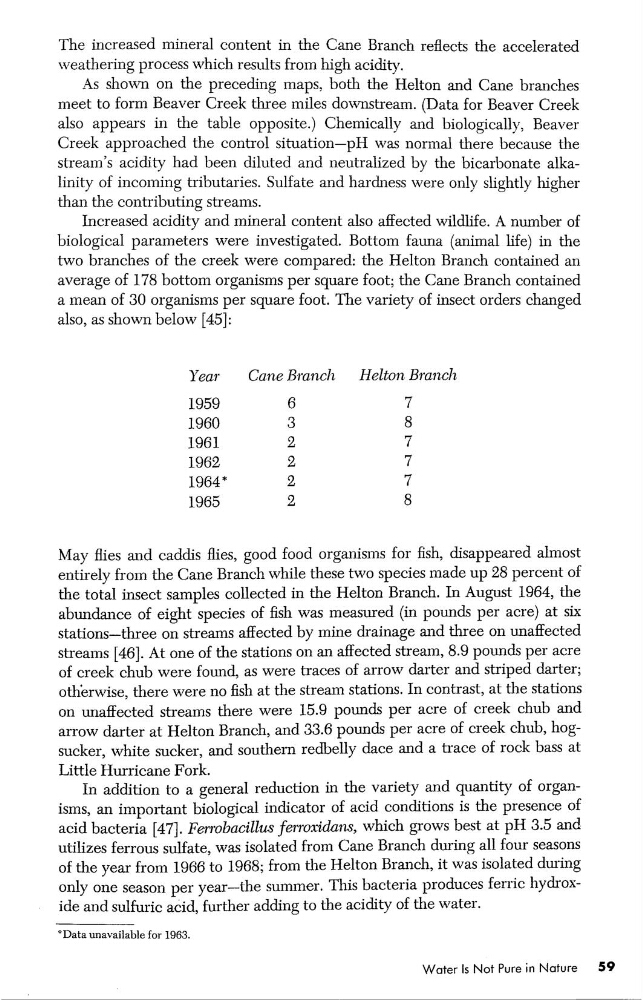
a mean of 30 organisms per square foot. The variety of insect orders changed
also, as shown below [45]:
Year
Cane Branch
Helton Branch
1959
6
7
1960
3
8
1961
2
7
1962
2
7
1964*
2
7
1965
2
8
May ics and caddis ies, good food organisms for sh, disappeared almost
entirely from the Cane Branch while these two species made up 28 percent of
the total insect samples collected in the Helton Branch. In August 1964, the
abundance of eight species of sh was measured (in pounds per acre) at six
Stations—tluee on streams affected by mine drainage and three on unaffected
streams [46]. At one of the stations on an affected stream, 8.9 pounds per acre
of creek chub were found, as were traces of arrow darter and striped darter;
otherwise, there were no sh at the stream stations. In contrast, at the stations
on unaffected streams there were 15.9 pounds per acre of creek chub and
arrow darter at Helton Branch, and 33.6 pounds per acre of creek chub, bogSuCker, white sucker, and southern redbelly dace and a trace of rock bass at
Little Hurricane Fork.
in addition to a general reduction in the variety and quantity of organ—
isms, an important biological indicator of acid conditions is the presence
of
acid bacteria [47]. Ferrobacillus ferroxidans, Which grows best at pH 3.5 and
utilizes ferrous sulfate, was isolated from Cane Branch during all four seasons
of the year from 1966 to 1968; from the Helton Branch, it was isolated during
only one season per year—the summer. This bacteria produces ferric hydrox—
ide and sulfuric acid, further adding to the acidity of the water.
°Data unavailable for 1963.
Water Is Not Pure in Nature
59
weathering process which results from high acidity.
As shown on the preceding maps, both the Helton and Cane branches
meet to form Beaver Creek three miles downstream. (Data for Beaver Creek
also appears
in the table opposite.) Chemically and biologically, Beaver
Creek approached the control situation—pH was normal there because the
stream’s acidity had been diluted and neutralized by the bicarbonate alka—
linity of incoming tributaries. Sulfate and hardness were only slightly higher
than the contributing streams.
Increased acidity and mineral content also affected Wildlife. A number of
biological parameters were investigated. Bottom fauna (animal life) in the
two branches of the creek were compared: the Helton Branch contained an
average of 178 bottom organisms per square foot; the Cane Branch contained
a mean of 30 organisms per square foot. The variety of insect orders changed
also, as shown below [45]:
Year
Cane Branch
Helton Branch
1959
6
7
1960
3
8
1961
2
7
1962
2
7
1964*
2
7
1965
2
8
May ics and caddis ies, good food organisms for sh, disappeared almost
entirely from the Cane Branch while these two species made up 28 percent of
the total insect samples collected in the Helton Branch. In August 1964, the
abundance of eight species of sh was measured (in pounds per acre) at six
Stations—tluee on streams affected by mine drainage and three on unaffected
streams [46]. At one of the stations on an affected stream, 8.9 pounds per acre
of creek chub were found, as were traces of arrow darter and striped darter;
otherwise, there were no sh at the stream stations. In contrast, at the stations
on unaffected streams there were 15.9 pounds per acre of creek chub and
arrow darter at Helton Branch, and 33.6 pounds per acre of creek chub, bogSuCker, white sucker, and southern redbelly dace and a trace of rock bass at
Little Hurricane Fork.
in addition to a general reduction in the variety and quantity of organ—
isms, an important biological indicator of acid conditions is the presence
of
acid bacteria [47]. Ferrobacillus ferroxidans, Which grows best at pH 3.5 and
utilizes ferrous sulfate, was isolated from Cane Branch during all four seasons
of the year from 1966 to 1968; from the Helton Branch, it was isolated during
only one season per year—the summer. This bacteria produces ferric hydrox—
ide and sulfuric acid, further adding to the acidity of the water.
°Data unavailable for 1963.
Water Is Not Pure in Nature
59