

»
,;
_
,
a;
,
—
«
_
_
—
_
_
."'
_
.
win»
.
_
.
'
_
w
_\
,
—
,
«
œ;
-—
*
_
'
»
_
.
__
/
f; - _Î _
.
s; '
«
-
q
_
.
! ‘
_
‘—-‘
î
*…
:
:
‘
'
“‘t—\;
—'
"
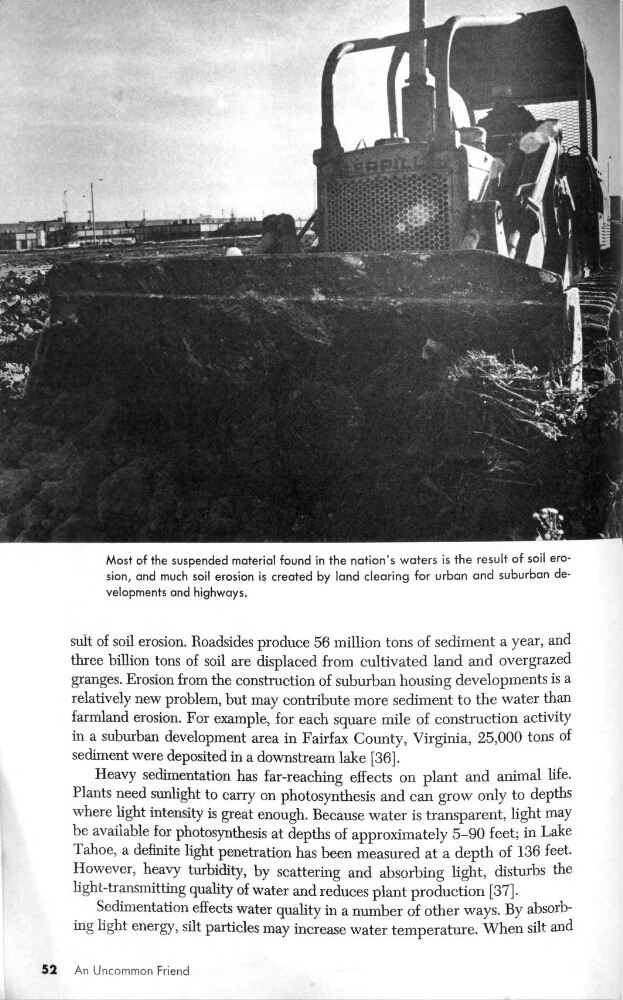
Most of the suspended material found in the nation's waters is the result of soil erosion, and much soil erosion is created by land clearing for urban and suburban clevelopments and highways.
sult of soil erosion. Roadsides produce 56 million tons of sediment a year,
and
three billion tons of soil are displaced from cultivated land and overgraaed
granges. Erosion from the construction of suburban housing developments 18 a
relatively new problem, but may contribute more sediment to the water than
farmland erosion. For example, for each square mile of construction act1wty
in a submban development area in Fairfax County, Virginia, 25,000 tons of
sediment were deposited in a downstream lake [36].
Heavy sedimentaüon has far—reaching effects on plant and animal hfe.
Plants need sunlight to carry on photosynthesis and can grow only to depths
where light intensity is great enough. Because water is transparent light may
be available for photosynthesis at depths of approximately 5—90 feet; in Lake
Tahoe, a denite light penetration has been measured at a depth of 186 feet.
However, heavy turbidity, by scattering and absorbing light, disturbs the
light—transmitüng quality of water and reduces plant production [37].
Sedimentation eects water quality in a number of other ways. By absorbing light energy, silt particles may increase water temperature.
When silt and
52
An Uncommon Friend
—
,;
_
,
a;
,
—
«
_
_
—
_
_
."'
_
.
win»
.
_
.
'
_
w
_\
,
—
,
«
œ;
-—
*
_
'
»
_
.
__
/
f; - _Î _
.
s; '
«
-
q
_
.
! ‘
_
‘—-‘
î
*…
:
:
‘
'
“‘t—\;
—'
"
Most of the suspended material found in the nation's waters is the result of soil erosion, and much soil erosion is created by land clearing for urban and suburban clevelopments and highways.
sult of soil erosion. Roadsides produce 56 million tons of sediment a year,
and
three billion tons of soil are displaced from cultivated land and overgraaed
granges. Erosion from the construction of suburban housing developments 18 a
relatively new problem, but may contribute more sediment to the water than
farmland erosion. For example, for each square mile of construction act1wty
in a submban development area in Fairfax County, Virginia, 25,000 tons of
sediment were deposited in a downstream lake [36].
Heavy sedimentaüon has far—reaching effects on plant and animal hfe.
Plants need sunlight to carry on photosynthesis and can grow only to depths
where light intensity is great enough. Because water is transparent light may
be available for photosynthesis at depths of approximately 5—90 feet; in Lake
Tahoe, a denite light penetration has been measured at a depth of 186 feet.
However, heavy turbidity, by scattering and absorbing light, disturbs the
light—transmitüng quality of water and reduces plant production [37].
Sedimentation eects water quality in a number of other ways. By absorbing light energy, silt particles may increase water temperature.
When silt and
52
An Uncommon Friend
—