

"
.«
Hydrogen
(+)
_
.
_
,
Hydrogen
than the simple factthat each water molecule is composed of two hydrogen
-
atoms and one oxygen atom.“—The nature of the bond that holds these atoms
together is important, and even more important is the nature of the bond that
is formed between molecules of water, for this bond determines water’s special properties.
The nucleus of each hydrogen atom contains one proton and is orbited by
one electron; the nucleus of each oxygen atom contains eight protons and is
orbited by eight electrons. (Protons carry a positive electrical charge and
electrons carry a negative charge.) When two hydrogen atoms and an oxygen
atom react, forming a water molecule, the atoms become united by sharing a
pair of electrons. This is called a covalent bond. (The valence, or combining
.
capacity of an atom, is determined by its outer electron shell—the paths of the
electrons at the-greatest distance from the nucleus. This outer shell is sometimes called the valence shell. When two atoms share electrons, their valence
shells are thus joined by a covalent bond.) In the resulting water molecule,
however, the electrons are not'shared equally; the oxygen nucleus, with its
eight protons is more attractive to the negatively—charged electrons than the
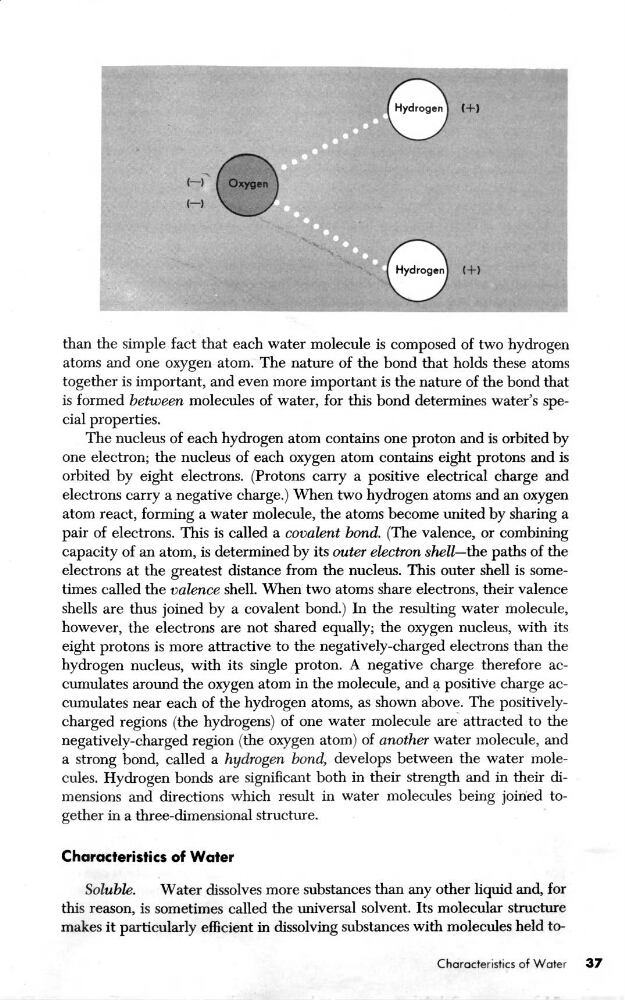
hydrogen nucleus, with its single proton. A negative charge therefore ac—
cumulates around the oxygen
atom in the molecule, and a positiVe charge accumulates near each of the hydrogen atoms, as shown above. The positively—
charged regions (the hydrogens) of one water molecule
to the
negatively—charged region (the oxygen atom) of another water molecule, and
a strong bond, called a hydrogen bond, develops between the water mole—
cules. Hydrogen bonds are signicant both in their strength and in their dimensions and directions which result in water molecules being joined together in a three-dimensional structure.
_
.
°
Characteristics of Water
'
Soluble.
Water dissolves more substances than any other liquid and, for
this reason, is sometimes called the universal solvent. Its molecular structure
makes it particularly efcient in dissolving substances with molecules held to—
_
.
'
_
Characteristics of Water
37
.«
Hydrogen
(+)
_
.
_
,
Hydrogen
than the simple factthat each water molecule is composed of two hydrogen
-
atoms and one oxygen atom.“—The nature of the bond that holds these atoms
together is important, and even more important is the nature of the bond that
is formed between molecules of water, for this bond determines water’s special properties.
The nucleus of each hydrogen atom contains one proton and is orbited by
one electron; the nucleus of each oxygen atom contains eight protons and is
orbited by eight electrons. (Protons carry a positive electrical charge and
electrons carry a negative charge.) When two hydrogen atoms and an oxygen
atom react, forming a water molecule, the atoms become united by sharing a
pair of electrons. This is called a covalent bond. (The valence, or combining
.
capacity of an atom, is determined by its outer electron shell—the paths of the
electrons at the-greatest distance from the nucleus. This outer shell is sometimes called the valence shell. When two atoms share electrons, their valence
shells are thus joined by a covalent bond.) In the resulting water molecule,
however, the electrons are not'shared equally; the oxygen nucleus, with its
eight protons is more attractive to the negatively—charged electrons than the
hydrogen nucleus, with its single proton. A negative charge therefore ac—
cumulates around the oxygen
atom in the molecule, and a positiVe charge accumulates near each of the hydrogen atoms, as shown above. The positively—
charged regions (the hydrogens) of one water molecule
to the
negatively—charged region (the oxygen atom) of another water molecule, and
a strong bond, called a hydrogen bond, develops between the water mole—
cules. Hydrogen bonds are signicant both in their strength and in their dimensions and directions which result in water molecules being joined together in a three-dimensional structure.
_
.
°
Characteristics of Water
'
Soluble.
Water dissolves more substances than any other liquid and, for
this reason, is sometimes called the universal solvent. Its molecular structure
makes it particularly efcient in dissolving substances with molecules held to—
_
.
'
_
Characteristics of Water
37