

Results of Interactions with:
.
Possuble Sources
Oxygen
Other Chemicals
of Pollutant
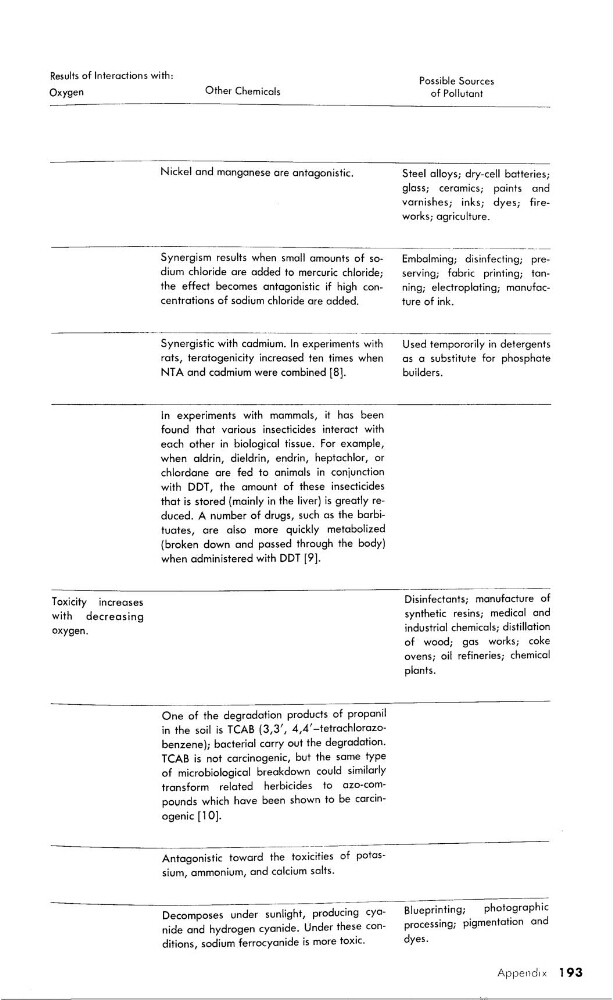
Nickel and manganese are antagonistic.
Steel alloys; dry-cell batteries;
glass; ceramics,— points and
varnishes; inks; dyes; fireworks; agriculture.
Synergism results when small amounts of soEmbalming; disinfecting; predium chloride are added to mercuric chloride;
serving; fabric printing; tanthe effect becomes antagonistic if high conning; electroplating; manufaccentrations of sodium chloride are added.
ture of ink.
Synergistic with cadmium. ln experiments with
Used temporarily in detergents
rats, teratogenicity increased ten times when
as
a
substitute for phosphate
NTA and cadmium were combined [8].
builders.
ln experiments with mammals, it has been
found that various insecticides interact with
each other in biological tissue. For example,
when aldrin, dieldrin, endrin, heptachlor, or
chlordane are fed to animals in coniunction
with BDT, the amount of these insecticides
that is stored (mainly in the liver) is greatly reduced. A number of drugs, such as the barbituates, are also more quickly metabolized
(broken down and passed through the body)
when a‘dministered with DDT [9].
Toxicity
increases
Disinfectants; manufacture of
with
decreasing
synthetic resins; medical and
oxygen.
industrial chemicals; distillation
of
wood; gas works; coke
ovens; oil refineries; chemical
plants.
One of the degradation products of propanil
in the soil is TCAB (3,3’, 4,4’—tetrachlorazobenzene); bacterial carry out the degradation.
TCAB is not carcinogenic, but the same type
of microbiological breakdown could similarly
transform
related
herbicides
to
azo-compounds which have been shown to be carcin—
ogenic [10].
Antagonistic toward the toxicities of potassium, ammonium, and calcium salts.
Decomposes under sunlight, producing cyaPh°l°_gmphlc
nide and hydrogen cyanide. Under these conprocessmg; p|gmentation
°nd
ditions, sodium ferrocyanide is more toxic.
dyes.
Appendm
193
.
Possuble Sources
Oxygen
Other Chemicals
of Pollutant
Nickel and manganese are antagonistic.
Steel alloys; dry-cell batteries;
glass; ceramics,— points and
varnishes; inks; dyes; fireworks; agriculture.
Synergism results when small amounts of soEmbalming; disinfecting; predium chloride are added to mercuric chloride;
serving; fabric printing; tanthe effect becomes antagonistic if high conning; electroplating; manufaccentrations of sodium chloride are added.
ture of ink.
Synergistic with cadmium. ln experiments with
Used temporarily in detergents
rats, teratogenicity increased ten times when
as
a
substitute for phosphate
NTA and cadmium were combined [8].
builders.
ln experiments with mammals, it has been
found that various insecticides interact with
each other in biological tissue. For example,
when aldrin, dieldrin, endrin, heptachlor, or
chlordane are fed to animals in coniunction
with BDT, the amount of these insecticides
that is stored (mainly in the liver) is greatly reduced. A number of drugs, such as the barbituates, are also more quickly metabolized
(broken down and passed through the body)
when a‘dministered with DDT [9].
Toxicity
increases
Disinfectants; manufacture of
with
decreasing
synthetic resins; medical and
oxygen.
industrial chemicals; distillation
of
wood; gas works; coke
ovens; oil refineries; chemical
plants.
One of the degradation products of propanil
in the soil is TCAB (3,3’, 4,4’—tetrachlorazobenzene); bacterial carry out the degradation.
TCAB is not carcinogenic, but the same type
of microbiological breakdown could similarly
transform
related
herbicides
to
azo-compounds which have been shown to be carcin—
ogenic [10].
Antagonistic toward the toxicities of potassium, ammonium, and calcium salts.
Decomposes under sunlight, producing cyaPh°l°_gmphlc
nide and hydrogen cyanide. Under these conprocessmg; p|gmentation
°nd
ditions, sodium ferrocyanide is more toxic.
dyes.
Appendm
193