

.
.
……
\
……
\
……
\\l\\\\\\
\U\\\\\\
\
\\
,
… \
\
\\\\\\l\
… \
\ \
\_
…
_î*
.‘.:‘*
._
_
‘.«
.
…Ï…—::r::
‘_ 1.5‘« ‘
“
{.
_
.._
.
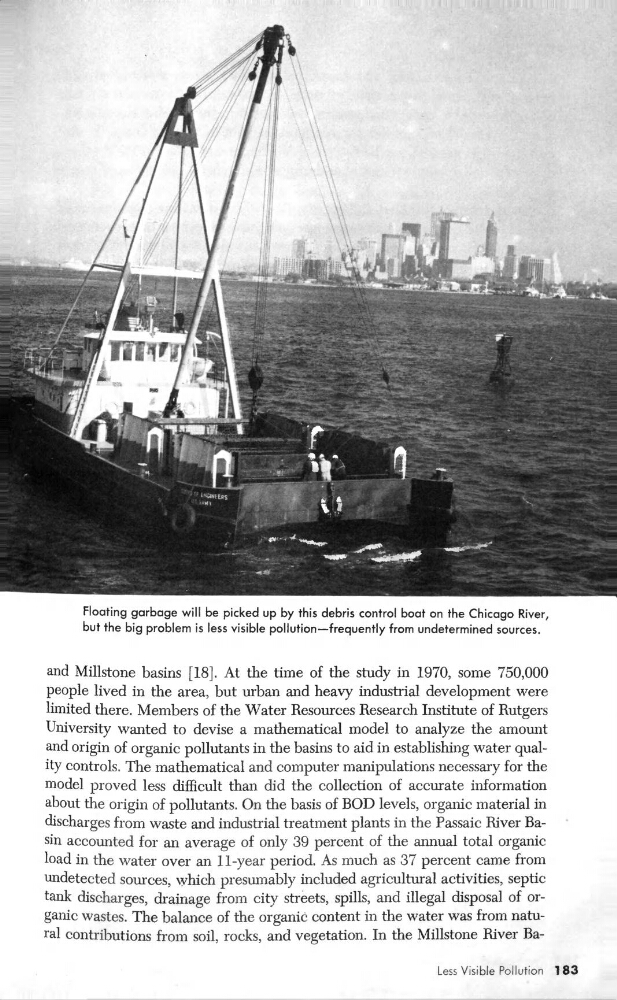
Floating garbage will be picked up by this debris control boat on the Chicago River,
but the big problem is less visible pollution—frequently from undetermined sources.
and Millstone basins [18]. At the time of the study in 1970, some 750,000
people lived in the area, but urban and heavy industrial development were
limited there. Members of the Water Resources Research Institute of Rutgers
University wanted to devise a mathematical model to analyze the amount
and origin of organic pollutants in the basins to aid in establishing water quality controls. The mathematical and computer manipulations necessary for the
model proved less diicult than did the collection of accurate information
about the origin of pollutants. On the basis of BCD levels, organic material in
discharges from waste and industrial treatment plants in the Passaic Biver Ba—
"
sin accounted for an average
of only 39 percent of the annual total organic
load in the water over an ll-year period. As much as 37 percent came from
undetected sources, which presumably included agricultural activities, septic
tank discharges, drainage from city streets, spills, and illegal disposal of or—
ganic wastes. The balance of the organic“; content in the water was from natu—
ral contributions from soil, rocks, and vegetation. In the Millstone
River Ba—
.
.
‘
Less Visible Pollution
183
.
……
\
……
\
……
\\l\\\\\\
\U\\\\\\
\
\\
,
… \
\
\\\\\\l\
… \
\ \
\_
…
_î*
.‘.:‘*
._
_
‘.«
.
…Ï…—::r::
‘_ 1.5‘« ‘
“
{.
_
.._
.
Floating garbage will be picked up by this debris control boat on the Chicago River,
but the big problem is less visible pollution—frequently from undetermined sources.
and Millstone basins [18]. At the time of the study in 1970, some 750,000
people lived in the area, but urban and heavy industrial development were
limited there. Members of the Water Resources Research Institute of Rutgers
University wanted to devise a mathematical model to analyze the amount
and origin of organic pollutants in the basins to aid in establishing water quality controls. The mathematical and computer manipulations necessary for the
model proved less diicult than did the collection of accurate information
about the origin of pollutants. On the basis of BCD levels, organic material in
discharges from waste and industrial treatment plants in the Passaic Biver Ba—
"
sin accounted for an average
of only 39 percent of the annual total organic
load in the water over an ll-year period. As much as 37 percent came from
undetected sources, which presumably included agricultural activities, septic
tank discharges, drainage from city streets, spills, and illegal disposal of or—
ganic wastes. The balance of the organic“; content in the water was from natu—
ral contributions from soil, rocks, and vegetation. In the Millstone
River Ba—
.
.
‘
Less Visible Pollution
183