

'
'. '
.Î’; ’…‘W
,
i
«‘
/_
:
J
.
"
:;—
'
_.x%
.
.
'
‘
?
…
_
.<,
.
_
'—
_.
,a
_
…
_
,—
—
"
,v
/
_
‘-.
.
\,
.
,
»
_;
”
”
gg;
rr
*
".
\
'
'
.
w
.
s
\
.
__
‘
'
.
}
«
,'
äf—ËΑ
«…
»—
‘
'
'
_
….
_
;,
:
,
.
..
;
_
.
'
_
=
:_
-
_
.
;
'
'
‘
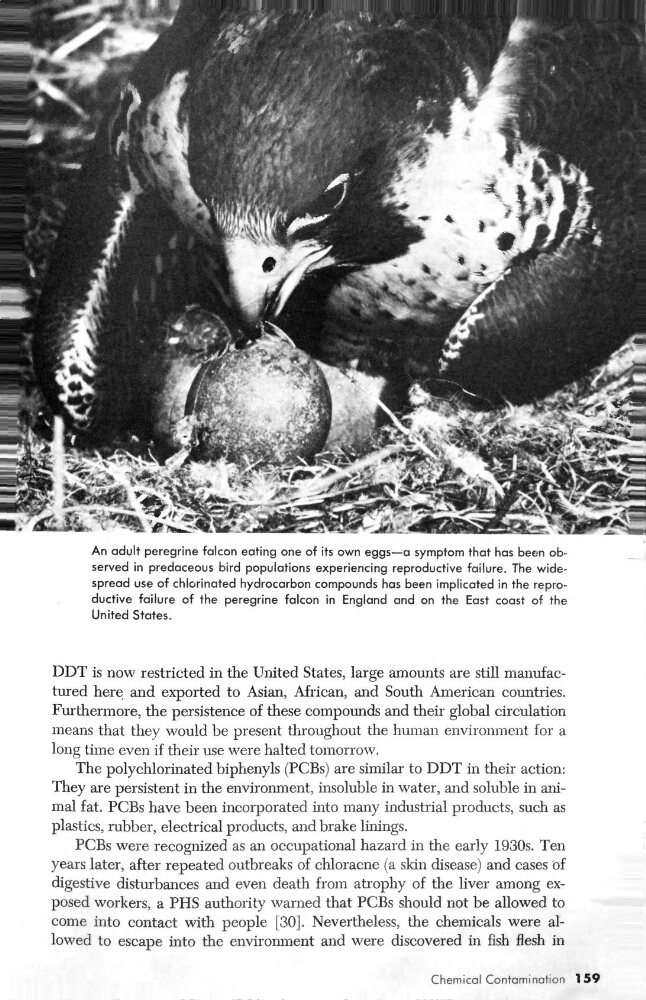
An adult peregrine falcon eating one of its own eggs—a symptom that has been ob-_
served in predaceous bird populations experiencing reproductive failure. The widespread use of chlorinated hydrocarbon compounds has been implicated in the repro—
.
ductive failure of the peregrine falcon in England cmd on the East coast of the
United States.
DDT is now restricted in the United States, large amounts are still manufactured here and exported to Asian, African, and South American countries.
F urthermore, the persistence of these compounds and their global circulation
means that they would be present throughout the human environment for a
long time even if their use were halted tomorrow.
The polychlorinated biphenyls (PCBS) are similar to DDT in their action:
They are persistent in the environment, insoluble in water, and soluble in ani—
mal fat. PCBS have been incorporated into many industrial products, such as
plastics, rubber, electrical products, and brake linings.
PCBs were recognized as an occupational hazard in the early 19305. Ten
years later, after repeated outbreaks of chloracne (a skin disease) and cases of
digestive disturbances and even death from atrophy of the liver among ex—
posed workers, a PHS authority warned that PCBs should not be allowed to
.
come into contact with people [30]. Nevertheless, the chemicals were al—
lowed to escape into the environment and were discovered in sh esh in
Chemical Contamination 159
'. '
.Î’; ’…‘W
,
i
«‘
/_
:
J
.
"
:;—
'
_.x%
.
.
'
‘
?
…
_
.<,
.
_
'—
_.
,a
_
…
_
,—
—
"
,v
/
_
‘-.
.
\,
.
,
»
_;
”
”
gg;
rr
*
".
\
'
'
.
w
.
s
\
.
__
‘
'
.
}
«
,'
äf—ËΑ
«…
»—
‘
'
'
_
….
_
;,
:
,
.
..
;
_
.
'
_
=
:_
-
_
.
;
'
'
‘
An adult peregrine falcon eating one of its own eggs—a symptom that has been ob-_
served in predaceous bird populations experiencing reproductive failure. The widespread use of chlorinated hydrocarbon compounds has been implicated in the repro—
.
ductive failure of the peregrine falcon in England cmd on the East coast of the
United States.
DDT is now restricted in the United States, large amounts are still manufactured here and exported to Asian, African, and South American countries.
F urthermore, the persistence of these compounds and their global circulation
means that they would be present throughout the human environment for a
long time even if their use were halted tomorrow.
The polychlorinated biphenyls (PCBS) are similar to DDT in their action:
They are persistent in the environment, insoluble in water, and soluble in ani—
mal fat. PCBS have been incorporated into many industrial products, such as
plastics, rubber, electrical products, and brake linings.
PCBs were recognized as an occupational hazard in the early 19305. Ten
years later, after repeated outbreaks of chloracne (a skin disease) and cases of
digestive disturbances and even death from atrophy of the liver among ex—
posed workers, a PHS authority warned that PCBs should not be allowed to
.
come into contact with people [30]. Nevertheless, the chemicals were al—
lowed to escape into the environment and were discovered in sh esh in
Chemical Contamination 159