

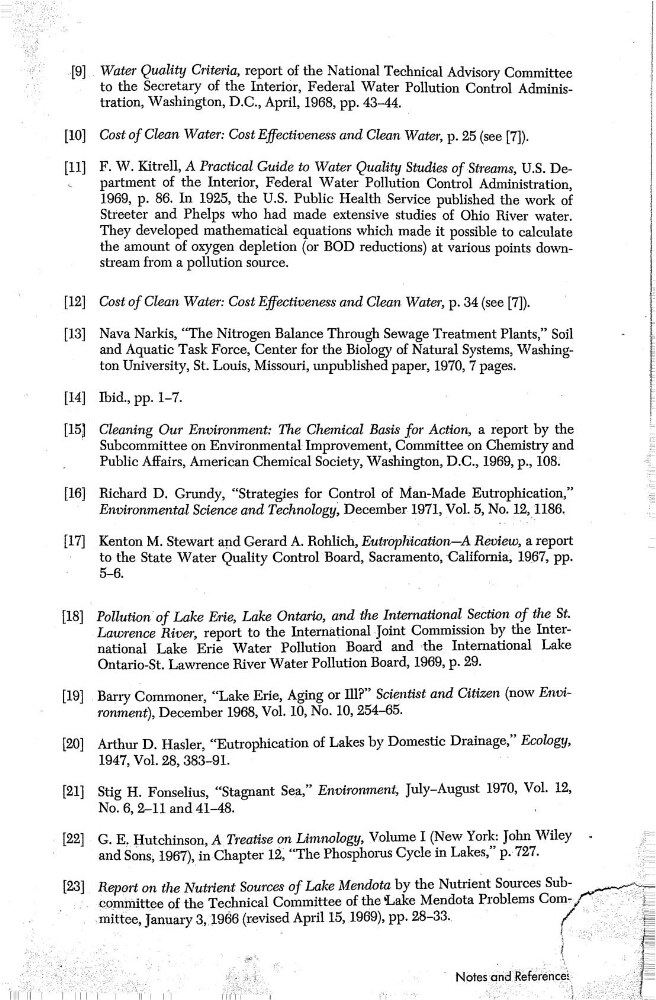
[9] Water Quality Criteria, report of the National Technical Advisory Committee
*
‘
to the Secretary of the Interi0r, Federal Water Pollution Control Adminis—
;
tration, Washington, D.C., April, 1968, pp. 48—44.
;
,
[10] Cost of Clean Water: Cost Eectiveness and Clean Water, p. 25 (see [7]).
[11] F. W. Kitrell, A Practical Guide to Water Quality Studies of Stream, U.S. De—
..
partment of the Interior, Federal Water Pollution Control Administration,
1969, p. 86. In 1925, the US. Public Health Service published the work of
Str6eter and Phelps who had made extensive studies of Ohio River water.
They developed mathematical equations which made it possible to calculate
the amount of oxygen depletion (or BOD reductions) at various points downstream from a pollution source.
Ï
[12] Cost of Clean Water: Cost Eectiveness and Clean Water, p. 34 (see [7]).
[13] Nava Narkis, “The Nitrogen Balance Through Sewage Treatment Plants,” Soil
-
‘
and Aquatic Task Force, Center for the Biology of Natural Systems, Washing—
ton University, St. Louis, Missouri, unpublished paper, 1970, 7 pages.
[14] Ibid., pp. 14.
[15] Cleaning Our Environment: The Chemical Basis for Action, a report by the
Subcommittee on Environmental Improvement, Committee on Chemistry and
_
Public Affairs, American Chemical Society, Washington, DC., 1969, p., 108.
[16] Richard D. Grundy, “Strategies for Control of Man—Made Eutrophication,”
'
Environmental Science and Technology, December 1971, Vol. 5, No. 121186.
,
[17] Kenton M. Stewart and Gerard A. Rohlich, Eutr‘0phication—A Review, a report
-
to the State Water Quality Control Board, Sacramento, California, 1967, pp.
5—6.
[18] Pollution0f Lake Erie, Lake Ontario, and the International Section of the St.
Lawrence River, report to the International Joint Commission by the Inter—
national Lake Erie Water Pollution Board and the International Lake
Ontario-St. Lawrence River Water Pollution Board, 1969, p. 29.
[19] Barry Commoner, “Lake Eric, Aging or 111?” Scientist and Citizen (now Envi'
ronment), December 1968, Vol. 10, No. 10, 254—65.
[20] Arthur D. Hasler, “Eutrophication of Lakes by Domestic Drainage,” Ecology,
1947, Vol. 28, 2383—91.
’
’
[21] Stig H. Fonselius, “Stagnant Sea,” Environment, [y—August 1970, Vol. 12,
No. 6, 2—11 and 41—48.
.
[22] G. E, Hutchinson, A Treatise on Limnology, Volume I (New York: john Wiley «
'
and Sons, 1967), inChapter 12, “The Phosphorus Cycle in Lakes, p.727.
[23]
.
Report on the Nutrient Sources of Lake Mendota by the Nutrieht Sources Sub—
,
_
…
committee of the Technical Committee of the ‘Lake Mendota Problems
.
‘
]anuary 3,.j1966 (revised April 15,
pp. 28—33.
]… ”][ ‘\ ‘
\
H
\ ‘\
[
.w
ï“
],
*
‘
to the Secretary of the Interi0r, Federal Water Pollution Control Adminis—
;
tration, Washington, D.C., April, 1968, pp. 48—44.
;
,
[10] Cost of Clean Water: Cost Eectiveness and Clean Water, p. 25 (see [7]).
[11] F. W. Kitrell, A Practical Guide to Water Quality Studies of Stream, U.S. De—
..
partment of the Interior, Federal Water Pollution Control Administration,
1969, p. 86. In 1925, the US. Public Health Service published the work of
Str6eter and Phelps who had made extensive studies of Ohio River water.
They developed mathematical equations which made it possible to calculate
the amount of oxygen depletion (or BOD reductions) at various points downstream from a pollution source.
Ï
[12] Cost of Clean Water: Cost Eectiveness and Clean Water, p. 34 (see [7]).
[13] Nava Narkis, “The Nitrogen Balance Through Sewage Treatment Plants,” Soil
-
‘
and Aquatic Task Force, Center for the Biology of Natural Systems, Washing—
ton University, St. Louis, Missouri, unpublished paper, 1970, 7 pages.
[14] Ibid., pp. 14.
[15] Cleaning Our Environment: The Chemical Basis for Action, a report by the
Subcommittee on Environmental Improvement, Committee on Chemistry and
_
Public Affairs, American Chemical Society, Washington, DC., 1969, p., 108.
[16] Richard D. Grundy, “Strategies for Control of Man—Made Eutrophication,”
'
Environmental Science and Technology, December 1971, Vol. 5, No. 121186.
,
[17] Kenton M. Stewart and Gerard A. Rohlich, Eutr‘0phication—A Review, a report
-
to the State Water Quality Control Board, Sacramento, California, 1967, pp.
5—6.
[18] Pollution0f Lake Erie, Lake Ontario, and the International Section of the St.
Lawrence River, report to the International Joint Commission by the Inter—
national Lake Erie Water Pollution Board and the International Lake
Ontario-St. Lawrence River Water Pollution Board, 1969, p. 29.
[19] Barry Commoner, “Lake Eric, Aging or 111?” Scientist and Citizen (now Envi'
ronment), December 1968, Vol. 10, No. 10, 254—65.
[20] Arthur D. Hasler, “Eutrophication of Lakes by Domestic Drainage,” Ecology,
1947, Vol. 28, 2383—91.
’
’
[21] Stig H. Fonselius, “Stagnant Sea,” Environment, [y—August 1970, Vol. 12,
No. 6, 2—11 and 41—48.
.
[22] G. E, Hutchinson, A Treatise on Limnology, Volume I (New York: john Wiley «
'
and Sons, 1967), inChapter 12, “The Phosphorus Cycle in Lakes, p.727.
[23]
.
Report on the Nutrient Sources of Lake Mendota by the Nutrieht Sources Sub—
,
_
…
committee of the Technical Committee of the ‘Lake Mendota Problems
.
‘
]anuary 3,.j1966 (revised April 15,
pp. 28—33.
]… ”][ ‘\ ‘
\
H
\ ‘\
[
.w
ï“
],