

\
\
\
.
\\\
Î ë‘ Î
,
“
\‘î
\
îâ
ï.
‘
.
\
\
îÊ
“.
Î
“‘ËÊÂl‘
'
:
l
|
.
t
|
:
l
l
ll |
i
't |
,
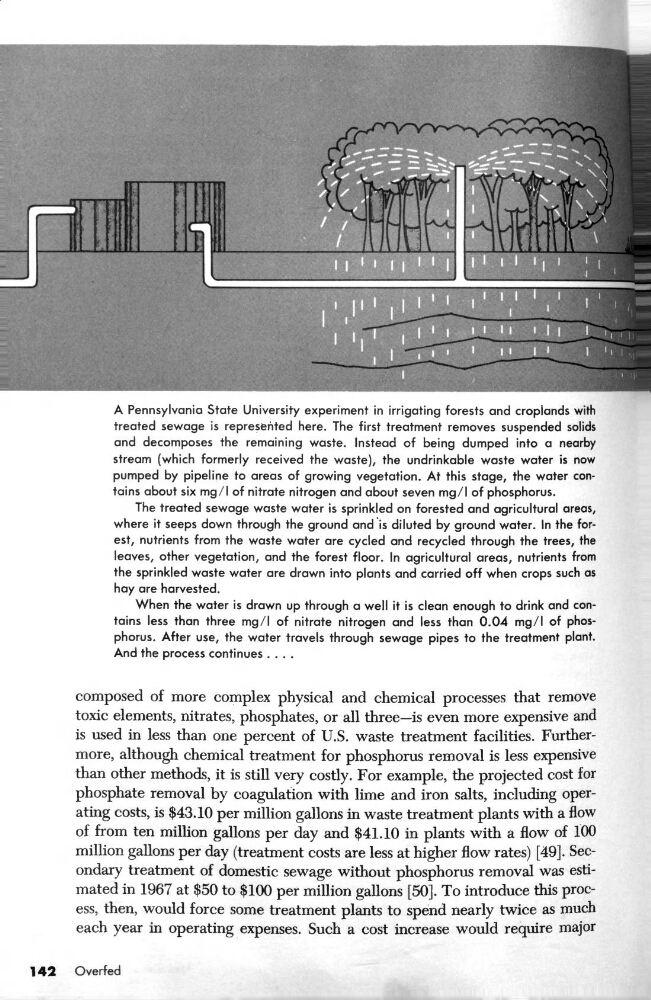
A Pennsylvania State University experiment in irrigating forests and croplands with
treated sewage is represented here. The first treatment removes suspended solids
and decomposes the remaining waste. lnstead of being dumped into a nearby
stream (which formerly received the waste), the undrinkable waste water is now
pumped by pipeline to areas of growing vegetation. At this stage, the water con—
tains about six r_ng/l of nitrate nitrogen and about seven mg/ l of phosphorus.
The treated sewage waste water is sprinkled on forested and agricultural areas,
where it seeps down through the ground and
diluted by ground water. ln the forest, nutrients from the waste water are cycled and recycled through the trees, the
leaves, other vegetation, and the forest floor. ln agricultural areas, nutrients from
the sprinkled waste water are drawn into plants and carried off when crops such as
hay are harvested.
When the water is drawn up through a well it is clean enough to drink and contains less than three mg/l of nitrate nitrogen and less than 0.04 mg/l of phos—
phorus. After use, the water travels through sewage pipes to the treatment plant.
And the process continues
.
.
.
.
composed of more complex physical and chemical processes
that remove
toxic elements, nitrates, phosphates, or all three—is even more expensive
and
is used in less than one percent of U.S. “waste treatment facilities. Further—
more, although chemical treatment for phosphorus removal is less expensive
than other methods, it is still very costly. For example, the projected cost for
phosphate removal by coagulation With lime and iron salts, including oper—
ating costs, is $43.10 per million gallons in waste treatment plants With a ow
of from ten million gallons per day and $41.10 in plants With a ow of 100
million gallons per day (treatment costs are less at higher ow rates) [49]. Sec—
ondary treatment of domestic sewage without phosphoru$ removal was estimated in 1967 at $50 to $100 per million gallons [50]. To introduce this proc—
ess, then, would force some treatment plants to spend nearly twice as much
_
each year in operating expenses. Such a cost increase would require maj0r
142
Overfed
\
\
.
\\\
Î ë‘ Î
,
“
\‘î
\
îâ
ï.
‘
.
\
\
îÊ
“.
Î
“‘ËÊÂl‘
'
:
l
|
.
t
|
:
l
l
ll |
i
't |
,
A Pennsylvania State University experiment in irrigating forests and croplands with
treated sewage is represented here. The first treatment removes suspended solids
and decomposes the remaining waste. lnstead of being dumped into a nearby
stream (which formerly received the waste), the undrinkable waste water is now
pumped by pipeline to areas of growing vegetation. At this stage, the water con—
tains about six r_ng/l of nitrate nitrogen and about seven mg/ l of phosphorus.
The treated sewage waste water is sprinkled on forested and agricultural areas,
where it seeps down through the ground and
diluted by ground water. ln the forest, nutrients from the waste water are cycled and recycled through the trees, the
leaves, other vegetation, and the forest floor. ln agricultural areas, nutrients from
the sprinkled waste water are drawn into plants and carried off when crops such as
hay are harvested.
When the water is drawn up through a well it is clean enough to drink and contains less than three mg/l of nitrate nitrogen and less than 0.04 mg/l of phos—
phorus. After use, the water travels through sewage pipes to the treatment plant.
And the process continues
.
.
.
.
composed of more complex physical and chemical processes
that remove
toxic elements, nitrates, phosphates, or all three—is even more expensive
and
is used in less than one percent of U.S. “waste treatment facilities. Further—
more, although chemical treatment for phosphorus removal is less expensive
than other methods, it is still very costly. For example, the projected cost for
phosphate removal by coagulation With lime and iron salts, including oper—
ating costs, is $43.10 per million gallons in waste treatment plants With a ow
of from ten million gallons per day and $41.10 in plants With a ow of 100
million gallons per day (treatment costs are less at higher ow rates) [49]. Sec—
ondary treatment of domestic sewage without phosphoru$ removal was estimated in 1967 at $50 to $100 per million gallons [50]. To introduce this proc—
ess, then, would force some treatment plants to spend nearly twice as much
_
each year in operating expenses. Such a cost increase would require maj0r
142
Overfed