

ll
‘
“
:
.
..
».
_
.
—
—_
_}-V
Ï'_
—
-
….
_
_
;. ;;
…—
…
‘
:
.
_.‘
'ñÎ
“
'
$
»
——_:Ç.Ï:—»—
:
_
W
—“"'
…
J«e’;Œ‘î“ »
.
__
_
/
-
‘
‘
—
_ ‘
_.
_.
.
_
\
_
»
_
.
:
.
.
.
.»
—
.—
’
â
.
î
?
'.
g
Ï
_
:j_
…«
‘
—
â
—
._
>3%
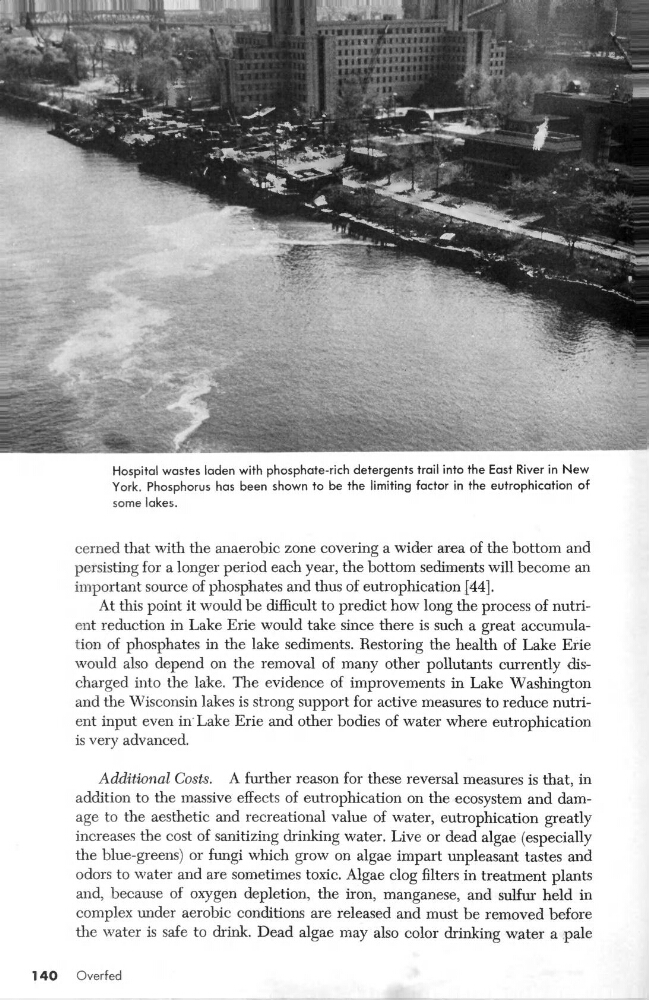
Hospital wostes lucien with phosphate-rich detergents trail into the East River in New
York. Phosphorus has been shown to be the limitîng factor in the eutrophication of
some lakes.
cerned that with the anaerobic zone covering a wider area of the bottom and
persisting for a longer period each year, the bottom sediments will become an
important source of phosphates and thus of eutrophication [44].
At this point it would be difcult to predict how long the process of nutri—
ent reduction in Lake Erie would take since there is such a great accumulation of phosphates in the lake sediments. Restoring the health of Lake Eric
would also depend on the removal of many other pollutants currently dis—
charged into the lake. The evidence of improvements in Lake Washington
and the Wisconsin lakes is strong support for active measures to reduce nutri—
ent input even in'Lake Eric and other bodies of water where eutrophication
is very advanced.
Additional Costs.
A further reason for these reversal measures is that, in
addition to the massive effects of eutrophication on the ecosystem and damage
to the aesthetic and recreational value of water, eutrophication greatly
increases the cost of sanitizing drinking water. Live or dead algae’(especially
the blue-greens) or fungi which grow on algae impart unpleasant tastes and
odors to water and are sometimes toxic. Algae clog lters in treatment plants
and, because of oxygen depletion, the iron, manganese, and sulfur held in
complex under aerobic conditions are released and must be removed before
the water is safe to drink. Dead algae may also color drinking water a pale
'
140
Overfed
‘
“
:
.
..
».
_
.
—
—_
_}-V
Ï'_
—
-
….
_
_
;. ;;
…—
…
‘
:
.
_.‘
'ñÎ
“
'
$
»
——_:Ç.Ï:—»—
:
_
W
—“"'
…
J«e’;Œ‘î“ »
.
__
_
/
-
‘
‘
—
_ ‘
_.
_.
.
_
\
_
»
_
.
:
.
.
.
.»
—
.—
’
â
.
î
?
'.
g
Ï
_
:j_
…«
‘
—
â
—
._
>3%
Hospital wostes lucien with phosphate-rich detergents trail into the East River in New
York. Phosphorus has been shown to be the limitîng factor in the eutrophication of
some lakes.
cerned that with the anaerobic zone covering a wider area of the bottom and
persisting for a longer period each year, the bottom sediments will become an
important source of phosphates and thus of eutrophication [44].
At this point it would be difcult to predict how long the process of nutri—
ent reduction in Lake Erie would take since there is such a great accumulation of phosphates in the lake sediments. Restoring the health of Lake Eric
would also depend on the removal of many other pollutants currently dis—
charged into the lake. The evidence of improvements in Lake Washington
and the Wisconsin lakes is strong support for active measures to reduce nutri—
ent input even in'Lake Eric and other bodies of water where eutrophication
is very advanced.
Additional Costs.
A further reason for these reversal measures is that, in
addition to the massive effects of eutrophication on the ecosystem and damage
to the aesthetic and recreational value of water, eutrophication greatly
increases the cost of sanitizing drinking water. Live or dead algae’(especially
the blue-greens) or fungi which grow on algae impart unpleasant tastes and
odors to water and are sometimes toxic. Algae clog lters in treatment plants
and, because of oxygen depletion, the iron, manganese, and sulfur held in
complex under aerobic conditions are released and must be removed before
the water is safe to drink. Dead algae may also color drinking water a pale
'
140
Overfed