

-
_
_
—
.
..—
.
!
ii!!!
.
—
,...—…
-a—…. > —
1. —
.
a... ,
!
,
"_
,
‘
,.
.
-
.
“a? '”.“W
"
,
'
_“
_
"
‘.
’
l
—
…aä ,,_æa:f
«'
'
'
"
!
‘
Î
‘
.:,
.,
;
Î%
Ï
1-«
,
…
…
i
_
,
.
.
,
,
:
—
‘
_
.
'
“È
—
=
=
.,…
.…
\
»
»
__
_
,
..
,
i
:
,
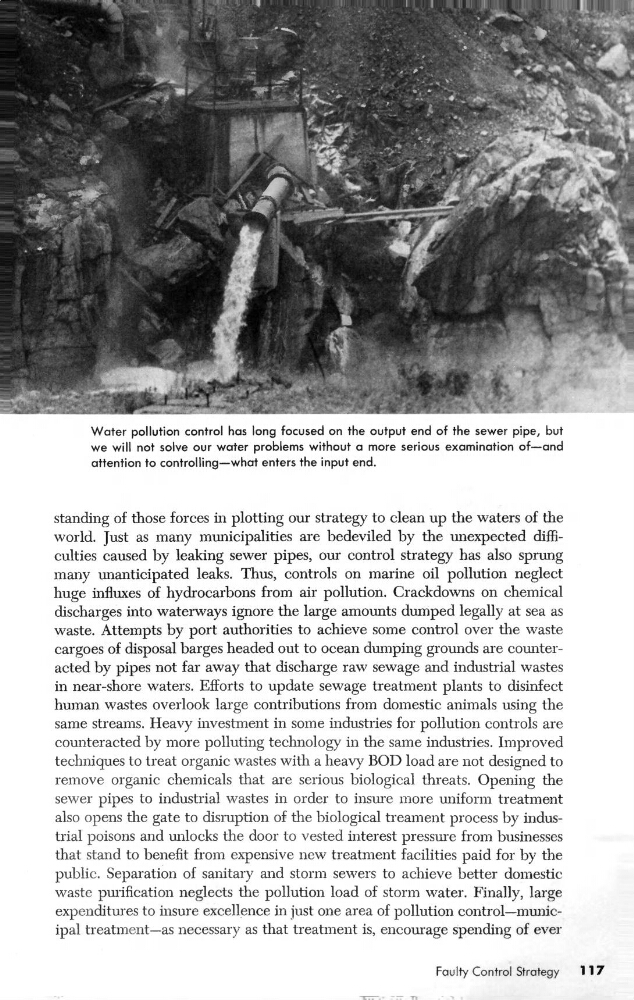
Water pollution control has long focused on the output end of the sewer pipe, but
we will not solve our water problems without a more serious examination of—and
attention to controlling—what enters the input end.
standing of those forces in plotting our strategy to clean up the waters of the
world. just as many municipalities are bedeviled by the unexpected diffi—
culties caused by leaking sewer pipes, our control strategy has also sprung
many unanticipated leaks. Thus, controls on marine oil pollution neglect
huge inuxes of hydrocarbons from air pollution. Crackdowns on chemical
dischargés into waterways ignore the large amounts durped legally at sea as
waste. Attempts by port authorities to achieve some control over the waste
cargoes of disposal barges headed out to ocean dumping grounds are counter—
acted by pipes not far away that discharge raw sewage and industrial wastes
in near—shore waters. Efforts to update sewage
treatment plants to disinfect
human wastes overlook large contributions from domestic animals using the
same streams. Heavy investment in some industries for pollution controls are
counteracted by more polluting technology in the same industries. Improved
techniques to treat organic wastes with & heavy BOD load are not designed to
remove organic chemicals that are serious biological threats. Opening the
sewer pipes to industrial wastes in order to insure more uniform treatment
also opens
the gate to disruption of the biological treament process by indus—
trial poisons and unlocks the door to vested interest pressure from businesses
that stand to benet from expensive new treatment facilities paid for by the
‘
public. Separation of sanitary and storm sewers to achieve better domestic
waste purication neglects the pollution load of storm water. Finally, large
expenditures to insure excellence in just one area of pollution control—munic—
ipal treatment—as necessary as that treatment is, encourage spending of ever
Faulty Control Strategy
"| l7
_
_
—
.
..—
.
!
ii!!!
.
—
,...—…
-a—…. > —
1. —
.
a... ,
!
,
"_
,
‘
,.
.
-
.
“a? '”.“W
"
,
'
_“
_
"
‘.
’
l
—
…aä ,,_æa:f
«'
'
'
"
!
‘
Î
‘
.:,
.,
;
Î%
Ï
1-«
,
…
…
i
_
,
.
.
,
,
:
—
‘
_
.
'
“È
—
=
=
.,…
.…
\
»
»
__
_
,
..
,
i
:
,
Water pollution control has long focused on the output end of the sewer pipe, but
we will not solve our water problems without a more serious examination of—and
attention to controlling—what enters the input end.
standing of those forces in plotting our strategy to clean up the waters of the
world. just as many municipalities are bedeviled by the unexpected diffi—
culties caused by leaking sewer pipes, our control strategy has also sprung
many unanticipated leaks. Thus, controls on marine oil pollution neglect
huge inuxes of hydrocarbons from air pollution. Crackdowns on chemical
dischargés into waterways ignore the large amounts durped legally at sea as
waste. Attempts by port authorities to achieve some control over the waste
cargoes of disposal barges headed out to ocean dumping grounds are counter—
acted by pipes not far away that discharge raw sewage and industrial wastes
in near—shore waters. Efforts to update sewage
treatment plants to disinfect
human wastes overlook large contributions from domestic animals using the
same streams. Heavy investment in some industries for pollution controls are
counteracted by more polluting technology in the same industries. Improved
techniques to treat organic wastes with & heavy BOD load are not designed to
remove organic chemicals that are serious biological threats. Opening the
sewer pipes to industrial wastes in order to insure more uniform treatment
also opens
the gate to disruption of the biological treament process by indus—
trial poisons and unlocks the door to vested interest pressure from businesses
that stand to benet from expensive new treatment facilities paid for by the
‘
public. Separation of sanitary and storm sewers to achieve better domestic
waste purication neglects the pollution load of storm water. Finally, large
expenditures to insure excellence in just one area of pollution control—munic—
ipal treatment—as necessary as that treatment is, encourage spending of ever
Faulty Control Strategy
"| l7