

l
|
\
il
…
ii
_
il
\
H
_
_
;
.
-»
««
—
.
,.-—.."
,
j?‘&…
_
…
P—°“â*««îî}ët
.°
.
;};Wf»
"‘…
.._
.
.
î
‘
%
..
»
‘
'
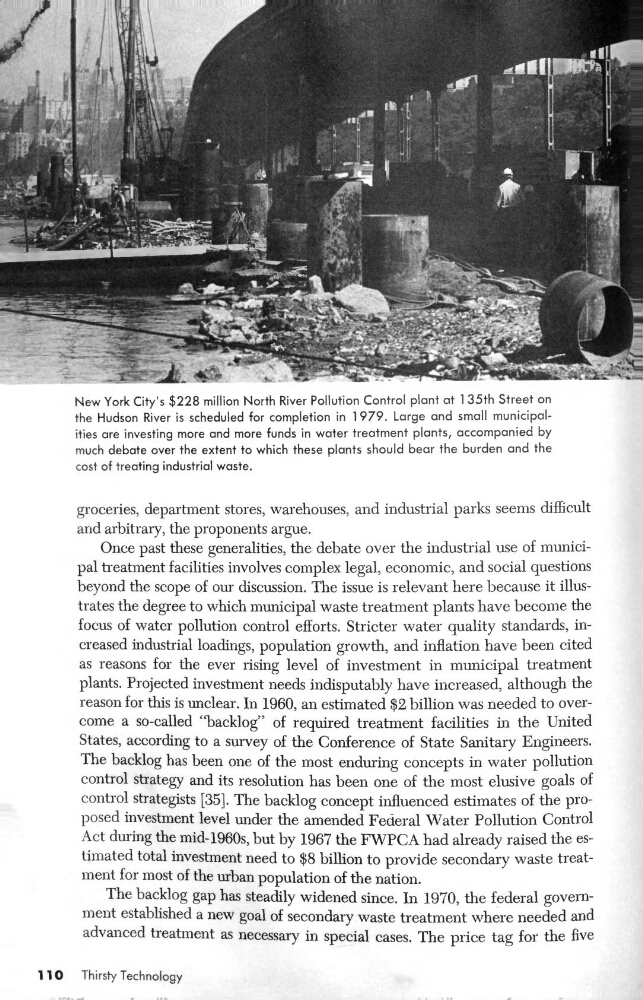
New York City’s $228 million North River Pollution Control plant at l35th Street on
the Hudson River is scheduled for completion in 1979. Large and small municipalities are investîng more and more funds in water treatment plants, accompanied by
much debate over the extent to which these plants should bear the burden and the
cost of treating industrial waste.
g1‘oceries, department stores, warehouses, and industrial parks seems difcult
and arbitrary, the proponents argue.
Once past these generalities, the debate over the industrial use of municipal treatment facilities involves complex'legal, economic, and social questions
beyond the scope of our discussion. The issue is relevant here because it illustrates the degree to which municipal waste treatment plants have become the
focus of water pollution control efforts. Stricter water quality standards, in—
creased industrial loadings, population growth, and ination have been cited
as reasons for the ever rising level of investment in municipal treatment
plants. Projected investment needs indisputably have increased, although the
reason for this is nuclear. In 1960, an estimated $2 billion was needed to over‘
come a so—called “backlog” of required treatment facilities in the United
States, according to a survey of the Conference of State Sanitary Engineers.
The backlog has been one of the most enduring concepts in water pollution
control strategy and its resolution has been one of the most elusive goals of
COM—l‘O] Strategists [85]. The backlog concept inuenced estimates of the pro—
posed investment level under the amended Federal Water Pollution Control
Act during the mid—19605, but by 1967 the FWPCA had already raised the es—
timated total investment need to $8 billion to provide secondary waste treatment for most of the urban population of the nation.
The backlog gap has steadily widened since. In 1970, the federal gove1‘n—
.
ment established a new goal of secondary waste treatment where needed and
advanced treatment as necessary in special cases. The price tag for the five
'
110
Thirsty Technology
|
\
il
…
ii
_
il
\
H
_
_
;
.
-»
««
—
.
,.-—.."
,
j?‘&…
_
…
P—°“â*««îî}ët
.°
.
;};Wf»
"‘…
.._
.
.
î
‘
%
..
»
‘
'
New York City’s $228 million North River Pollution Control plant at l35th Street on
the Hudson River is scheduled for completion in 1979. Large and small municipalities are investîng more and more funds in water treatment plants, accompanied by
much debate over the extent to which these plants should bear the burden and the
cost of treating industrial waste.
g1‘oceries, department stores, warehouses, and industrial parks seems difcult
and arbitrary, the proponents argue.
Once past these generalities, the debate over the industrial use of municipal treatment facilities involves complex'legal, economic, and social questions
beyond the scope of our discussion. The issue is relevant here because it illustrates the degree to which municipal waste treatment plants have become the
focus of water pollution control efforts. Stricter water quality standards, in—
creased industrial loadings, population growth, and ination have been cited
as reasons for the ever rising level of investment in municipal treatment
plants. Projected investment needs indisputably have increased, although the
reason for this is nuclear. In 1960, an estimated $2 billion was needed to over‘
come a so—called “backlog” of required treatment facilities in the United
States, according to a survey of the Conference of State Sanitary Engineers.
The backlog has been one of the most enduring concepts in water pollution
control strategy and its resolution has been one of the most elusive goals of
COM—l‘O] Strategists [85]. The backlog concept inuenced estimates of the pro—
posed investment level under the amended Federal Water Pollution Control
Act during the mid—19605, but by 1967 the FWPCA had already raised the es—
timated total investment need to $8 billion to provide secondary waste treatment for most of the urban population of the nation.
The backlog gap has steadily widened since. In 1970, the federal gove1‘n—
.
ment established a new goal of secondary waste treatment where needed and
advanced treatment as necessary in special cases. The price tag for the five
'
110
Thirsty Technology