

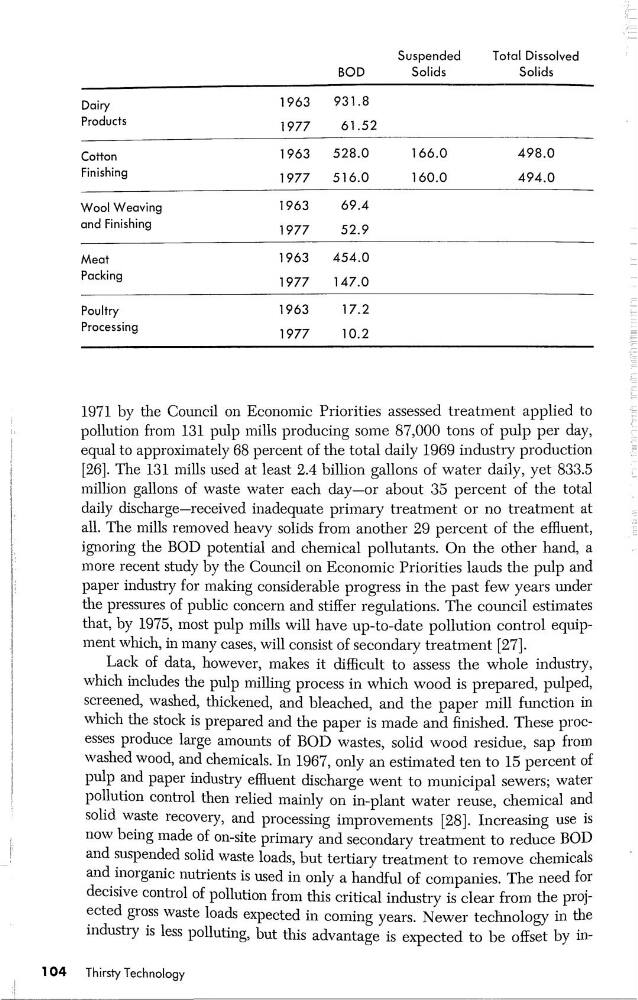
Suspended
Total Dissolved
BOD
Solids
Solids
___—___…
Dairy
1963
931.8
Pf°d”°*s
1977
61.52
Cotton
1963
528.0
166.0
498.0
F‘"‘Sh‘“9
1977
516.0
160.0
494.0
Wool Weaving
1963
69.4
and Finishing
1977
529
Meat
1963
454.0
.
P°°ki“9
1977
147.0
Poultry
1963
17.2
 ,
Processing
1977
1971 by the Council on Economic Priorities assessed treatment applied to
1
pollution from 131 pulp mills producing some 87,000 tons of pulp per day,
1
equal to approximately 68 percent of the total daily 1969 industry production
[26]. The 131 mills used at least 2.4 billion gallons of water daily, yet 883.5
_
1
million gallons of waste water each day—or about 35 percent of the total
daily discharge—received inadequate primary treatment or no treatment at
1
all. The mills removed heavy solids from another 29 percent of the efHuent,
1
ignoring the BOD potential and chemical pollutants. On the other hand, a
more recent study by the Council on Economic Priorities lands the pulp and
11
paper industry for making considerable progress
in the past few years
under
1
the pressures of public concern and stiffer regulations. The council estimates
1
that, by 1975, most pulp mills Will have up-to—date pollution control equip—
1
ment which, in many cases, will consist of secondary treatment [27].
1
Lack of data, however, makes it difcult to assess the Whole industry,
1
which includes the pulp milling process in which wood is prepared, pulped,
screened, washed, thickened, and bleached, and the paper
mill function in
1
which the stock is prepared and the paper is made and nished. These proc—
1
esses produce large amounts of BOD wastes, solid wood residue, sap
from
1
washed wood, and chemicals. In 1967, only an estimated ten to 15 percent
of
1
pulp and paper industry eluent discharge went to municipal sewers; water
1
pollution control then relied mainly on in—plant water reuse, chemical and
,
solid waste recovery, and processing improvements [28]. Increasing use is
now being made of on—site primary and secondary treatment to reduce BOD
1
and suspended solid waste loads, but tertiary treatment to remove chemicals
”
and inorganic nutrients is used in only a handful of companies. The need for
decisive control of pollution from this critical industry is clear from the proj—
ected gross waste loads expected in coming years. Newer technology in the
industry is less polluting, but this advantage is expected to be offset by in—
1
104
Thirsty Technology
Total Dissolved
BOD
Solids
Solids
___—___…
Dairy
1963
931.8
Pf°d”°*s
1977
61.52
Cotton
1963
528.0
166.0
498.0
F‘"‘Sh‘“9
1977
516.0
160.0
494.0
Wool Weaving
1963
69.4
and Finishing
1977
529
Meat
1963
454.0
.
P°°ki“9
1977
147.0
Poultry
1963
17.2
 ,
Processing
1977
1971 by the Council on Economic Priorities assessed treatment applied to
1
pollution from 131 pulp mills producing some 87,000 tons of pulp per day,
1
equal to approximately 68 percent of the total daily 1969 industry production
[26]. The 131 mills used at least 2.4 billion gallons of water daily, yet 883.5
_
1
million gallons of waste water each day—or about 35 percent of the total
daily discharge—received inadequate primary treatment or no treatment at
1
all. The mills removed heavy solids from another 29 percent of the efHuent,
1
ignoring the BOD potential and chemical pollutants. On the other hand, a
more recent study by the Council on Economic Priorities lands the pulp and
11
paper industry for making considerable progress
in the past few years
under
1
the pressures of public concern and stiffer regulations. The council estimates
1
that, by 1975, most pulp mills Will have up-to—date pollution control equip—
1
ment which, in many cases, will consist of secondary treatment [27].
1
Lack of data, however, makes it difcult to assess the Whole industry,
1
which includes the pulp milling process in which wood is prepared, pulped,
screened, washed, thickened, and bleached, and the paper
mill function in
1
which the stock is prepared and the paper is made and nished. These proc—
1
esses produce large amounts of BOD wastes, solid wood residue, sap
from
1
washed wood, and chemicals. In 1967, only an estimated ten to 15 percent
of
1
pulp and paper industry eluent discharge went to municipal sewers; water
1
pollution control then relied mainly on in—plant water reuse, chemical and
,
solid waste recovery, and processing improvements [28]. Increasing use is
now being made of on—site primary and secondary treatment to reduce BOD
1
and suspended solid waste loads, but tertiary treatment to remove chemicals
”
and inorganic nutrients is used in only a handful of companies. The need for
decisive control of pollution from this critical industry is clear from the proj—
ected gross waste loads expected in coming years. Newer technology in the
industry is less polluting, but this advantage is expected to be offset by in—
1
104
Thirsty Technology