

78
The Last Resource
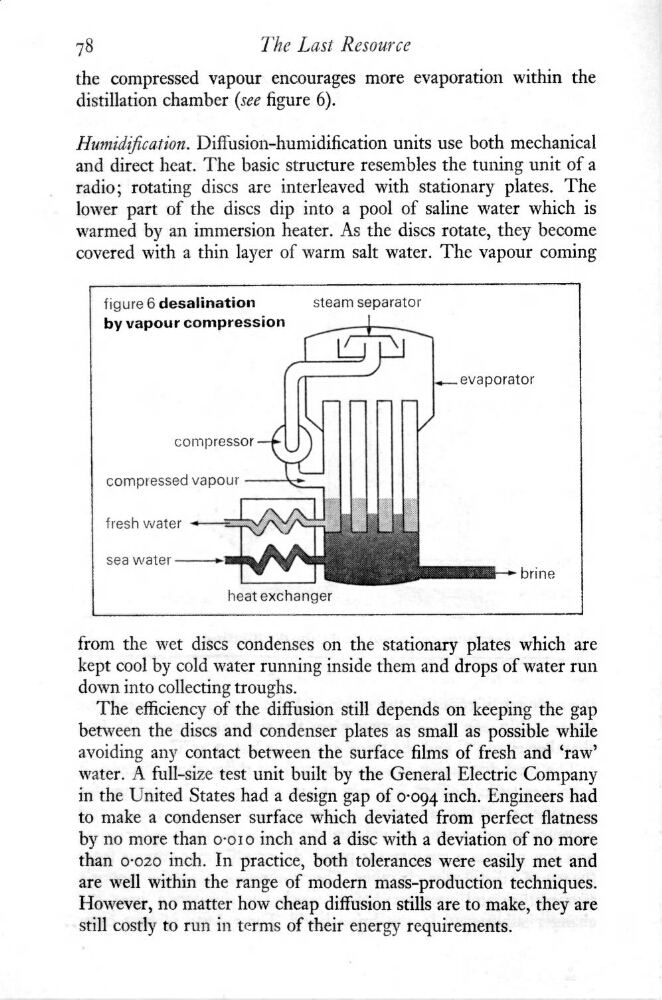
the compressed vapour encourages more evaporation within the
distillation chamber (see gure 6).
Humidmtian. Diffusion—humidication units use both mechanical
and direct heat. The basic structure resembles the tuning unit of a
radio; rotating discs are interleaved with stationary plates. The
lower part of the discs clip into a pool of saline water which is
warmed by an immersion heater. As the discs rotate, they become
covered with a thin layer of warm salt water. The vapour coming
gure 6 desalination
steam separator
by vapour compression
evaporator
COÛÎDÏGSSOÏ'
compressed vapour
fresh water
sea water
_
_
brune
.
heat exchanger
from the wet discs condenses on the stationary plates which are
kept cool by cold water running inside them and dr0ps of water run
down into collecting troughs.
The efciency of the diffusion still depends on keeping the gap
between the discs and condenser plates as small as possible while
avoiding any contact between the surface lms of fresh and ‘raw’
water. A full—size test unit built by the General Electric Company
in the United States had a design gap of 0094 inch. Engineers had
to make a condenser surface which deviated from perfect atness
by no more than o—oro inch and a disc with a deviation of no more
than o—ozo inch. In practice, both tolerances were easily met and
are well within the range of modern mass—production techniques.
However, no matter how cheap diffusion stills are to make, they are
still costly to run in terms of their energy requirements.
The Last Resource
the compressed vapour encourages more evaporation within the
distillation chamber (see gure 6).
Humidmtian. Diffusion—humidication units use both mechanical
and direct heat. The basic structure resembles the tuning unit of a
radio; rotating discs are interleaved with stationary plates. The
lower part of the discs clip into a pool of saline water which is
warmed by an immersion heater. As the discs rotate, they become
covered with a thin layer of warm salt water. The vapour coming
gure 6 desalination
steam separator
by vapour compression
evaporator
COÛÎDÏGSSOÏ'
compressed vapour
fresh water
sea water
_
_
brune
.
heat exchanger
from the wet discs condenses on the stationary plates which are
kept cool by cold water running inside them and dr0ps of water run
down into collecting troughs.
The efciency of the diffusion still depends on keeping the gap
between the discs and condenser plates as small as possible while
avoiding any contact between the surface lms of fresh and ‘raw’
water. A full—size test unit built by the General Electric Company
in the United States had a design gap of 0094 inch. Engineers had
to make a condenser surface which deviated from perfect atness
by no more than o—oro inch and a disc with a deviation of no more
than o—ozo inch. In practice, both tolerances were easily met and
are well within the range of modern mass—production techniques.
However, no matter how cheap diffusion stills are to make, they are
still costly to run in terms of their energy requirements.