

W ater, Water Everywhere . . .
77
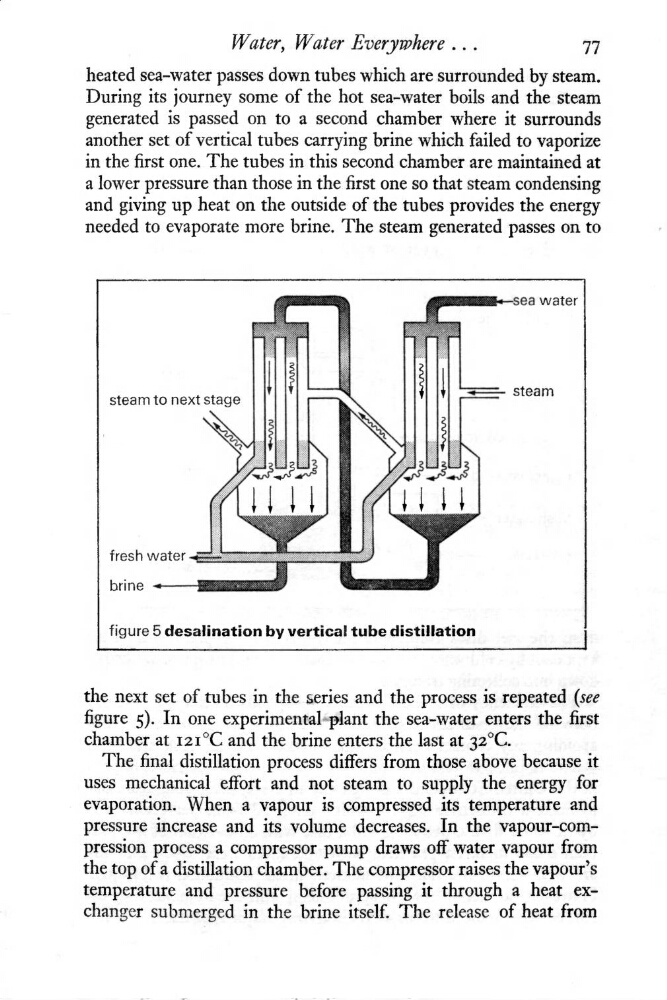
heated sea—water passes down tubes Which are surrounded by steam.
During its journey some of the hot sea—water boils and the steam
generated is passed on to a second chamber where it surrounds
another set of vertical tubes carrying brine which failed to vaporize
in the rst one. The tubes in this second chamber are maintained at
a lower pressure than those in the rst one so that steam condensing
and giving up heat on the outside of the tubes provides the energy
needed to evaporate more brine. The steam generated passes on to
""
.
water
steam to nextstage
l i
Steam
fresh water
brine
_
figure 5 desalination by vertical tube distillation
the next set of tubes in the.series and the process is repeated (see
gure 5). In one experimental»plant the sea—water enters the rst
chamber at 121°C and the brine enters the last at 32°C.
The nal distillation process di"ers from those above because it
uses
mechanical effort and not steam to supply the energy for
.
evaporation. When a vapour is compressed its temperature and
pressure increase and its volume decreases. In the vapour—com—
pression process a compressor pump draws off water vapour from
the top of a distillation chamber. The compressor raises the vapour’s
temperature and pressure before passing it through a heat ex—
changer submerged in the brine itself. The release of heat from
77
heated sea—water passes down tubes Which are surrounded by steam.
During its journey some of the hot sea—water boils and the steam
generated is passed on to a second chamber where it surrounds
another set of vertical tubes carrying brine which failed to vaporize
in the rst one. The tubes in this second chamber are maintained at
a lower pressure than those in the rst one so that steam condensing
and giving up heat on the outside of the tubes provides the energy
needed to evaporate more brine. The steam generated passes on to
""
.
water
steam to nextstage
l i
Steam
fresh water
brine
_
figure 5 desalination by vertical tube distillation
the next set of tubes in the.series and the process is repeated (see
gure 5). In one experimental»plant the sea—water enters the rst
chamber at 121°C and the brine enters the last at 32°C.
The nal distillation process di"ers from those above because it
uses
mechanical effort and not steam to supply the energy for
.
evaporation. When a vapour is compressed its temperature and
pressure increase and its volume decreases. In the vapour—com—
pression process a compressor pump draws off water vapour from
the top of a distillation chamber. The compressor raises the vapour’s
temperature and pressure before passing it through a heat ex—
changer submerged in the brine itself. The release of heat from