

28
_
.
_
…
'
_
FREEZÊ-DRYING
cut into thin sections about0.02 cm thick, and examined in polarised light ,9'
This shows
_
that0.l cm
at temperatures above about—— 6°Care single crystals
drops'nücleated at “lower temperatures give rise to new orientations (gure 8)
"
20 cfystals—at—À
and” several hundreds When the drop freezes by homogeneous nucleation at— 33°C. " We shall see later that a similar process occurs in solution.
case of homogeneous nùcleatiowe may interpret the observations in terms of “non
…
.
classical ‘nucleations” where—the size of the initial nucleus is comparable with the unit cell.
"
There Will not be'a
array of molecules to dene a specic crystal direction
“
and-_ many orientations may'.grow._
.
_
‘
'
'
THEORY
'
The velocity of crystàllisation is controlled by two distinct physical processes; the rate
‘
at which molecules are built into the CryStal lattice and the di"usion of heat and water
molecules in the neighbourhood of the growing interfaCe. Which of these two processes
dominates is determined by the molecular topography of different crystal interfaces. If
this should be smooth on a moleCular scale the crystal may only grow by nucleation of a
.
two dimensional layer on the surfaŒ_which can .subsequeny grow over the surface.
The process is exactly the same asthe formation of a three dimensional nucleus discussed
earlier, and will require a critical supercooling or supersaturation. In evaporation the
reverse is true, and it__ is necessary to nucleate a two dimensional hole which can grow
'
outwards.
In practice this is only necessary in the case of evaporation if we are far from
the crystal boundaries, as evaporation can easily begin at crystal edges. If the crystal
-
temperature is suîciently high, quite close
the melting point, a surface molecule may
possess suîcient kinetic energy to prevent a smooth surface forming; In this case
surface will be molecularly rough, and will not require a critical driving force for growth
or evaporation. If this last condition holds or if thedriving force for growth is wellin
excess of the critical values for nucleation on a smooth surface, the growth rate. will be
controlled entirely by the heat conductiori—di‘usion process, The equations for growth
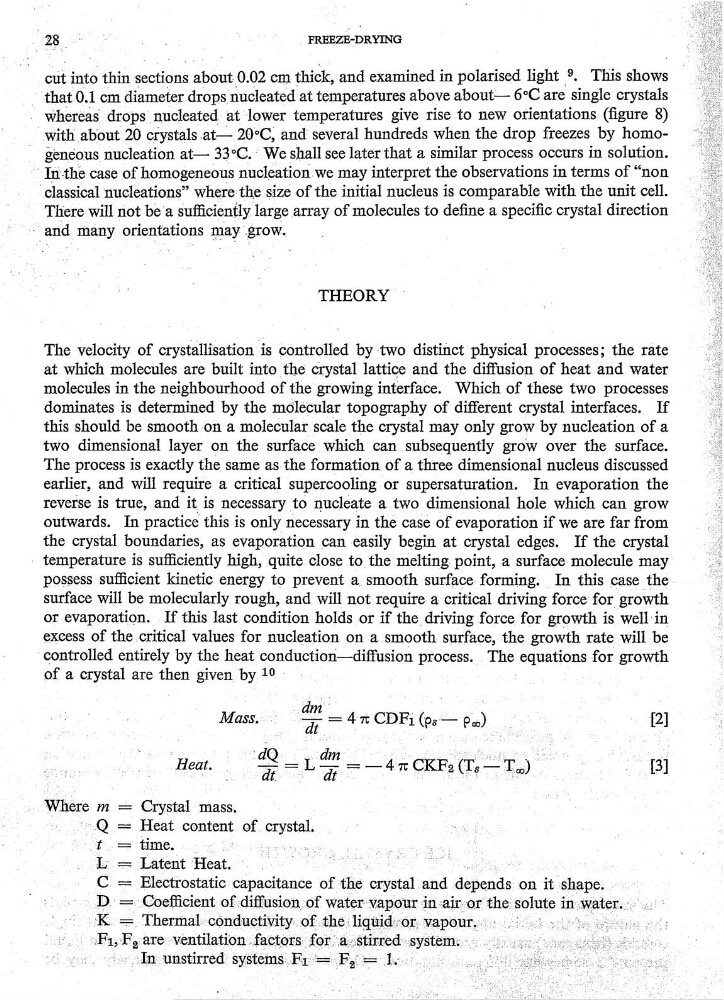
of a crystal are then given by
10
.
_
Ê
,
_
.
'
‘
Mass. _…
=
4nCDF1(ps'—— %)
.
'
'
[2]
…
.
_
Hear- _, ‘Î7‘î=,L % ,= —4=v= CKFz
,
dB]
Where m : Crystal mass.
'
_
-
'Ï
_
'
'
Ï'1Q = Heat content of crystal.
'
.
…
_
,
.
LJ= LatentHeat. %
.
_
-
,
»
,
C = Electrostaticcapacitance of the crystal and
'
-
rf
;
'
K .=. Thermaleonducüwty ofthe hqu1dor vapeur
î.
»L_s;
…
'
_
In unstirred systemsF1=F2=l
,
_
.
_
…
'
_
FREEZÊ-DRYING
cut into thin sections about0.02 cm thick, and examined in polarised light ,9'
This shows
_
that0.l cm
at temperatures above about—— 6°Care single crystals
drops'nücleated at “lower temperatures give rise to new orientations (gure 8)
"
20 cfystals—at—À
and” several hundreds When the drop freezes by homogeneous nucleation at— 33°C. " We shall see later that a similar process occurs in solution.
case of homogeneous nùcleatiowe may interpret the observations in terms of “non
…
.
classical ‘nucleations” where—the size of the initial nucleus is comparable with the unit cell.
"
There Will not be'a
array of molecules to dene a specic crystal direction
“
and-_ many orientations may'.grow._
.
_
‘
'
'
THEORY
'
The velocity of crystàllisation is controlled by two distinct physical processes; the rate
‘
at which molecules are built into the CryStal lattice and the di"usion of heat and water
molecules in the neighbourhood of the growing interfaCe. Which of these two processes
dominates is determined by the molecular topography of different crystal interfaces. If
this should be smooth on a moleCular scale the crystal may only grow by nucleation of a
.
two dimensional layer on the surfaŒ_which can .subsequeny grow over the surface.
The process is exactly the same asthe formation of a three dimensional nucleus discussed
earlier, and will require a critical supercooling or supersaturation. In evaporation the
reverse is true, and it__ is necessary to nucleate a two dimensional hole which can grow
'
outwards.
In practice this is only necessary in the case of evaporation if we are far from
the crystal boundaries, as evaporation can easily begin at crystal edges. If the crystal
-
temperature is suîciently high, quite close
the melting point, a surface molecule may
possess suîcient kinetic energy to prevent a smooth surface forming; In this case
surface will be molecularly rough, and will not require a critical driving force for growth
or evaporation. If this last condition holds or if thedriving force for growth is wellin
excess of the critical values for nucleation on a smooth surface, the growth rate. will be
controlled entirely by the heat conductiori—di‘usion process, The equations for growth
of a crystal are then given by
10
.
_
Ê
,
_
.
'
‘
Mass. _…
=
4nCDF1(ps'—— %)
.
'
'
[2]
…
.
_
Hear- _, ‘Î7‘î=,L % ,= —4=v= CKFz
,
dB]
Where m : Crystal mass.
'
_
-
'Ï
_
'
'
Ï'1Q = Heat content of crystal.
'
.
…
_
,
.
LJ= LatentHeat. %
.
_
-
,
»
,
C = Electrostaticcapacitance of the crystal and
'
-
rf
;
'
K .=. Thermaleonducüwty ofthe hqu1dor vapeur
î.
»L_s;
…
'
_
In unstirred systemsF1=F2=l
,