

ICE CRYSTALS
27
4.0
_
Z'
,
A
‘
supersaturated
‘l'b _
salt solution
,
20
equu num
curves
\
°”
0
X
_
__
—
'
E
=
g_
supercooled
.
.
Ë“20
water
B
Y'
eu echc
.
point
__"'\
equilibrium
40
equ1hbnum
;
__:
\\
salt \
,":
_
\\\
: _—
—60
Y
1002
50%
lOOZ
_
water
'
.
salt
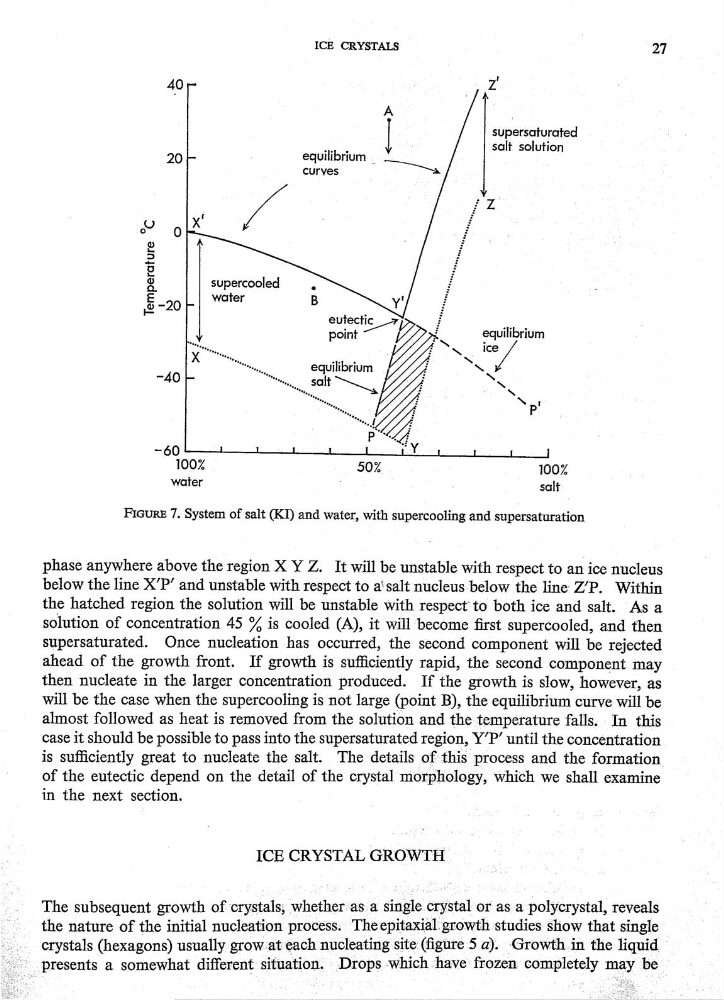
FIGURE 7. System of salt (KI) and water, With supercooling and supersaü1ra‘cion
phase anywhere above the region X Y Z. It will be unstable with respect to an ice nucleus
below the line X'P' and unstable with respectto a‘ï salt nucleus below the line Z’P. Within
the hatched region the solution will be unstable with respect” to both ice and salt. “As a
solution of concentration 45 % is cooled (A), it will becOme rst supercooled, and then
supersaturated.
Once nucleation has occurred, the second component will be rejected
ahead of the growth front. If growth is suîcieny rapid, the second component may
then nucleate in the larger concentration produced. If the growth is slow, however, as
Will be the case when the supercooling is not large (point B), the equilibrium curve Will be
almost followed as heat is removed from the solution and the-temperature falls. — In this
case it should be possible to pass into the supersaturated region,_Yf
P’ until the concentration
is suicieny great to nucleate the salt. The details of this process and the formation
of the eutectic depend on the detail of the crystal“10rrähology, Which we shall examine
in the next section.
,
ICE CRYSTAL GROWTH
,
‘
“_ ,
The subsequent growth of “crystals, whetheras a
or‘ as apoly‘crystal, reveals
the nature of the initial nucleation process.
studies show
that single
crystals (hexagons) usually grow ateaoh nucleating'site
a); ;Gr0‘vhin the liquid
presents a somewhat different situation: «Drops which have frozen completely may
be
_
-
27
4.0
_
Z'
,
A
‘
supersaturated
‘l'b _
salt solution
,
20
equu num
curves
\
°”
0
X
_
__
—
'
E
=
g_
supercooled
.
.
Ë“20
water
B
Y'
eu echc
.
point
__"'\
equilibrium
40
equ1hbnum
;
__:
\\
salt \
,":
_
\\\
: _—
—60
Y
1002
50%
lOOZ
_
water
'
.
salt
FIGURE 7. System of salt (KI) and water, With supercooling and supersaü1ra‘cion
phase anywhere above the region X Y Z. It will be unstable with respect to an ice nucleus
below the line X'P' and unstable with respectto a‘ï salt nucleus below the line Z’P. Within
the hatched region the solution will be unstable with respect” to both ice and salt. “As a
solution of concentration 45 % is cooled (A), it will becOme rst supercooled, and then
supersaturated.
Once nucleation has occurred, the second component will be rejected
ahead of the growth front. If growth is suîcieny rapid, the second component may
then nucleate in the larger concentration produced. If the growth is slow, however, as
Will be the case when the supercooling is not large (point B), the equilibrium curve Will be
almost followed as heat is removed from the solution and the-temperature falls. — In this
case it should be possible to pass into the supersaturated region,_Yf
P’ until the concentration
is suicieny great to nucleate the salt. The details of this process and the formation
of the eutectic depend on the detail of the crystal“10rrähology, Which we shall examine
in the next section.
,
ICE CRYSTAL GROWTH
,
‘
“_ ,
The subsequent growth of “crystals, whetheras a
or‘ as apoly‘crystal, reveals
the nature of the initial nucleation process.
studies show
that single
crystals (hexagons) usually grow ateaoh nucleating'site
a); ;Gr0‘vhin the liquid
presents a somewhat different situation: «Drops which have frozen completely may
be
_
-