

THERMAL ANALYSIS
17
1056
«\
% 300K
\
=
: =
°
107. .
om7’.
|
…
lOOK
A7
%
j
‘ »z
E
‘
tZ
‘
”%
Ë
20 4
.
‘
È
\ \
10
.
-90
>80
-700
-60
-50
-40
-30
-20
-10
°
rewmaruns
°c
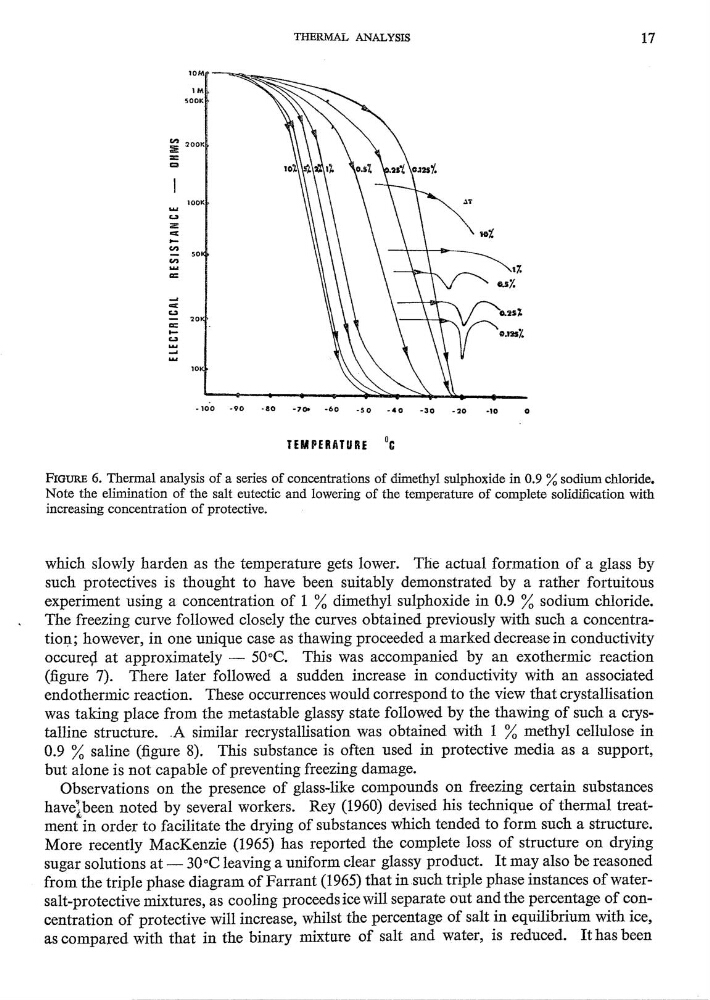
FIGURE 6. Thermal analysis of a series of concentrations of dimethyl sulphoxide in 0.9 % sodium chloride.
Note the elimination of the salt eutectic and lowering of the temperature of complete sodication with
increasing concentration of protective.
-
which slowly harden as the temperature gets lower. The actual formation of a glass by
such protectives is thought to have been suitably demonstrated by a rather fortuitous
experiment using a concentration of 1 % dimethyl sulphoxide in 0.9 % sodium chloride.
.
The freezing curve followed closely the curves obtained previously with such a concentra—
tion; however, in one unique case as thawing proceeded a marked decrease in conductivity
occured at approximately —— 50°C. This was accompanied by an exothermic reaction
(gure 7).
There later followed a sudden increase in conductivity with an associated
endothermic reaction.
These occurrences would correspond to the view that crystallisation
was taking place from the metastable glassy state followed by the thawing of such a crys—
talline structure.
.A similar recrystallisation was obtained with 1 % methyl cellulose in
0.9 % saline (gure 8). This substance is often used in protective media as a support,
but alone is not capable of preventing freezing damage.
Observations on the presence of glass—like compounds on freezing certain substances
haveïbeen noted by several workers. Rey (1960) devised his technique of thermal treatment in order to facilitate the drying of substances which tended to form such a structure.
More recently MacKenzie (1965) has reported the complete loss of structure on drying
sugar solutions at —— 30°C leaving a uniform clear glassy product. It may also be reasoned
from the triple phase diagram of Farrant (1965) that insuch triple phase instances of watersalt—protective mixtures, as cooling proceeds ice Will separate out and the percentage of con—
centration of protective will increase, Whilst the percentage of salt in equilibrium with ice,
as compared With that in the binary mixture of salt and water, is reduced. It has been
17
1056
«\
% 300K
\
=
: =
°
107. .
om7’.
|
…
lOOK
A7
%
j
‘ »z
E
‘
tZ
‘
”%
Ë
20 4
.
‘
È
\ \
10
.
-90
>80
-700
-60
-50
-40
-30
-20
-10
°
rewmaruns
°c
FIGURE 6. Thermal analysis of a series of concentrations of dimethyl sulphoxide in 0.9 % sodium chloride.
Note the elimination of the salt eutectic and lowering of the temperature of complete sodication with
increasing concentration of protective.
-
which slowly harden as the temperature gets lower. The actual formation of a glass by
such protectives is thought to have been suitably demonstrated by a rather fortuitous
experiment using a concentration of 1 % dimethyl sulphoxide in 0.9 % sodium chloride.
.
The freezing curve followed closely the curves obtained previously with such a concentra—
tion; however, in one unique case as thawing proceeded a marked decrease in conductivity
occured at approximately —— 50°C. This was accompanied by an exothermic reaction
(gure 7).
There later followed a sudden increase in conductivity with an associated
endothermic reaction.
These occurrences would correspond to the view that crystallisation
was taking place from the metastable glassy state followed by the thawing of such a crys—
talline structure.
.A similar recrystallisation was obtained with 1 % methyl cellulose in
0.9 % saline (gure 8). This substance is often used in protective media as a support,
but alone is not capable of preventing freezing damage.
Observations on the presence of glass—like compounds on freezing certain substances
haveïbeen noted by several workers. Rey (1960) devised his technique of thermal treatment in order to facilitate the drying of substances which tended to form such a structure.
More recently MacKenzie (1965) has reported the complete loss of structure on drying
sugar solutions at —— 30°C leaving a uniform clear glassy product. It may also be reasoned
from the triple phase diagram of Farrant (1965) that insuch triple phase instances of watersalt—protective mixtures, as cooling proceeds ice Will separate out and the percentage of con—
centration of protective will increase, Whilst the percentage of salt in equilibrium with ice,
as compared With that in the binary mixture of salt and water, is reduced. It has been