

16
FREEZE—DRYING
'
'10M;
IM
soon
,.,
; -2oo
;
=
E
.
!
'
\
Y00
Ë.
a
a
.«
:
1
£
5
{
.
.,
AT
È
__
&”
:
"
‘
2
…,
_
=
4
‘n
.
…
104
5
—100
-90
—50
-70
-60
—-40
—30
.
-2
-l0
.
nmranunr
°c
FIGURE 5
.
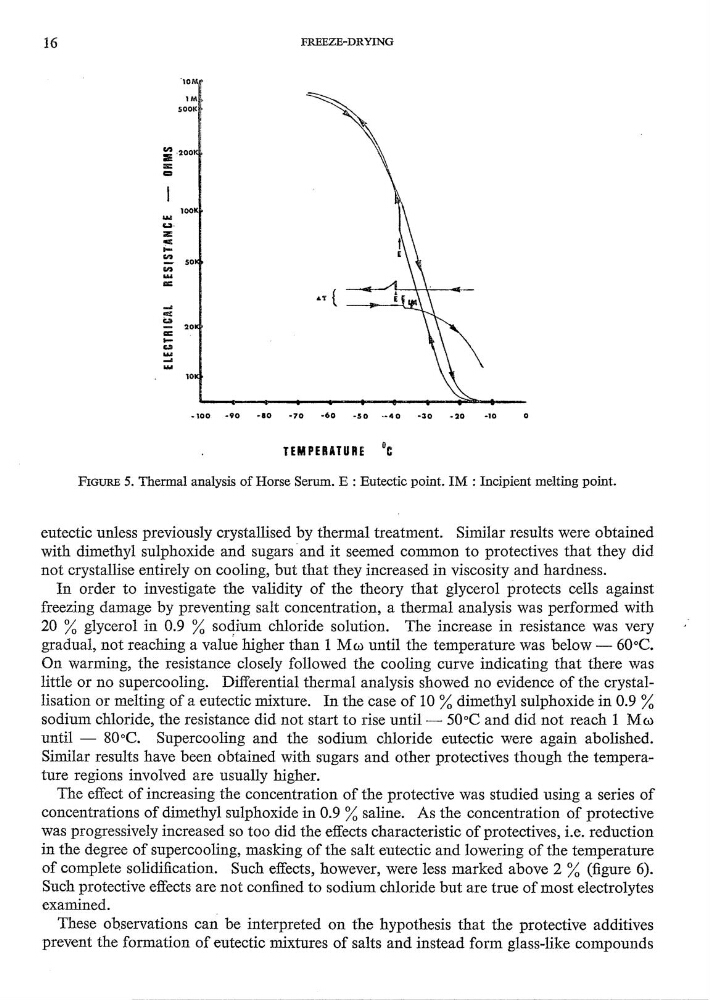
Thermal analysis of Horse Serum. E : Eutectic point. IM : Incipient melting point.
eutectic unless previously crystallised by
thermal treatment.
Similar results were obtained
with dimethyl sulphoxide and sugars and it seemed common to protectives that they did
not crystallise entirely on cooling, but that they increased in viscosity and
hardness.
In order to investigate the validity of the theory that glycerol protects cells against
freeZing damage by preventing salt concentration, a thermal analysis was performed With
20 % glycerol in 0.9 % sodium chloride solution. The increase in resistance was very
gradual, not reaching a value higher than 1 M0) until the temperature was below — 60°C.
On warming, the resistance closely followed the cooling curve indicating that there was
little or no supercooling. Differential thermal analysis showed no evidence of the crystal—
lisation or melting of a eutectic mixture. In the case of 10 % dimethyl sulphoxide in 0.9 %
sodium chloride, the resistance did not start to rise until —— 50°C and did not reach l Mœ
until — 80°C.
Supercooling and the sodium chloride eutectic were again abolished.
Similar results have been obtained with sugars and other protectives though the tempera—
ture regions involved are usually higher.
The effect of increasing the concentration of the protective was studied using a series of
concentrations of dimethyl sulphoxide in 0.9 % saline. As the concentration of protective
was progressively increased so too did the effects characteristic of protectives, i.e. reduction
in the degree of supercooling, masking of the salt eutectic and lowering of the temperature
of complete solidication. Such effects, however, were less marked above 2 % (gure 6).
Such protective effects are not conned to sodium chloride but are true of most electrolytes
examined.
_
These observations can be interpreted on the hypothesis that the protective additives
prevent the formation of eutectic mixtures of salts and instead form glass-like compounds
FREEZE—DRYING
'
'10M;
IM
soon
,.,
; -2oo
;
=
E
.
!
'
\
Y00
Ë.
a
a
.«
:
1
£
5
{
.
.,
AT
È
__
&”
:
"
‘
2
…,
_
=
4
‘n
.
…
104
5
—100
-90
—50
-70
-60
—-40
—30
.
-2
-l0
.
nmranunr
°c
FIGURE 5
.
Thermal analysis of Horse Serum. E : Eutectic point. IM : Incipient melting point.
eutectic unless previously crystallised by
thermal treatment.
Similar results were obtained
with dimethyl sulphoxide and sugars and it seemed common to protectives that they did
not crystallise entirely on cooling, but that they increased in viscosity and
hardness.
In order to investigate the validity of the theory that glycerol protects cells against
freeZing damage by preventing salt concentration, a thermal analysis was performed With
20 % glycerol in 0.9 % sodium chloride solution. The increase in resistance was very
gradual, not reaching a value higher than 1 M0) until the temperature was below — 60°C.
On warming, the resistance closely followed the cooling curve indicating that there was
little or no supercooling. Differential thermal analysis showed no evidence of the crystal—
lisation or melting of a eutectic mixture. In the case of 10 % dimethyl sulphoxide in 0.9 %
sodium chloride, the resistance did not start to rise until —— 50°C and did not reach l Mœ
until — 80°C.
Supercooling and the sodium chloride eutectic were again abolished.
Similar results have been obtained with sugars and other protectives though the tempera—
ture regions involved are usually higher.
The effect of increasing the concentration of the protective was studied using a series of
concentrations of dimethyl sulphoxide in 0.9 % saline. As the concentration of protective
was progressively increased so too did the effects characteristic of protectives, i.e. reduction
in the degree of supercooling, masking of the salt eutectic and lowering of the temperature
of complete solidication. Such effects, however, were less marked above 2 % (gure 6).
Such protective effects are not conned to sodium chloride but are true of most electrolytes
examined.
_
These observations can be interpreted on the hypothesis that the protective additives
prevent the formation of eutectic mixtures of salts and instead form glass-like compounds