

455
What Are Some Other Cool Developments in Geospatial Technology?
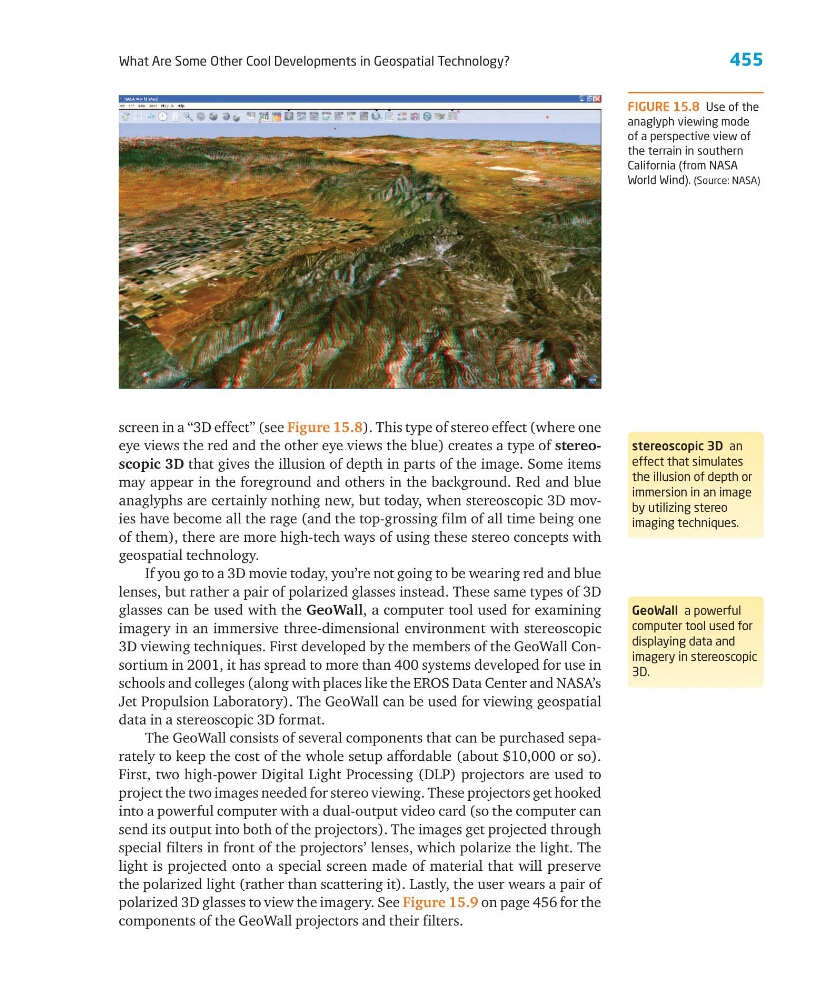
screen in a “3D effect” (see Figure 15.8). This type of stereo effect (where one
eye views the red and the other eye views the blue) creates a type of stereoscopic 3D that gives the illusion of depth in parts of the image. Some items
may appear in the foreground and others in the background. Red and blue
anaglyphs are certainly nothing new, but today, when stereoscopic 3D movies have become all the rage (and the top-grossing film of all time being one
of them), there are more high-tech ways of using these stereo concepts with
geospatial technology.
If you go to a 3D movie today, you’re not going to be wearing red and blue
lenses, but rather a pair of polarized glasses instead. These same types of 3D
glasses can be used with the GeoWall, a computer tool used for examining
imagery in an immersive three-dimensional environment with stereoscopic
3D viewing techniques. First developed by the members of the GeoWall Consortium in 2001, it has spread to more than 400 systems developed for use in
schools and colleges (along with places like the EROS Data Center and NASA’s
Jet Propulsion Laboratory). The GeoWall can be used for viewing geospatial
data in a stereoscopic 3D format.
The GeoWall consists of several components that can be purchased separately to keep the cost of the whole setup affordable (about $10,000 or so).
First, two high-power Digital Light Processing (DLP) projectors are used to
project the two images needed for stereo viewing. These projectors get hooked
into a powerful computer with a dual-output video card (so the computer can
send its output into both of the projectors). The images get projected through
special filters in front of the projectors’ lenses, which polarize the light. The
light is projected onto a special screen made of material that will preserve
the polarized light (rather than scattering it). Lastly, the user wears a pair of
polarized 3D glasses to view the imagery. See Figure 15.9 on page 456 for the
components of the GeoWall projectors and their filters.
FIGURE 15.8 Use of the
anaglyph viewing mode
of a perspective view of
the terrain in southern
California (from NASA
World Wind). (Source: NASA)
stereoscopic 3D an
effect that simulates
the illusion of depth or
immersion in an image
by utilizing stereo
imaging techniques.
GeoWall a powerful
computer tool used for
displaying data and
imagery in stereoscopic
3D.
What Are Some Other Cool Developments in Geospatial Technology?
screen in a “3D effect” (see Figure 15.8). This type of stereo effect (where one
eye views the red and the other eye views the blue) creates a type of stereoscopic 3D that gives the illusion of depth in parts of the image. Some items
may appear in the foreground and others in the background. Red and blue
anaglyphs are certainly nothing new, but today, when stereoscopic 3D movies have become all the rage (and the top-grossing film of all time being one
of them), there are more high-tech ways of using these stereo concepts with
geospatial technology.
If you go to a 3D movie today, you’re not going to be wearing red and blue
lenses, but rather a pair of polarized glasses instead. These same types of 3D
glasses can be used with the GeoWall, a computer tool used for examining
imagery in an immersive three-dimensional environment with stereoscopic
3D viewing techniques. First developed by the members of the GeoWall Consortium in 2001, it has spread to more than 400 systems developed for use in
schools and colleges (along with places like the EROS Data Center and NASA’s
Jet Propulsion Laboratory). The GeoWall can be used for viewing geospatial
data in a stereoscopic 3D format.
The GeoWall consists of several components that can be purchased separately to keep the cost of the whole setup affordable (about $10,000 or so).
First, two high-power Digital Light Processing (DLP) projectors are used to
project the two images needed for stereo viewing. These projectors get hooked
into a powerful computer with a dual-output video card (so the computer can
send its output into both of the projectors). The images get projected through
special filters in front of the projectors’ lenses, which polarize the light. The
light is projected onto a special screen made of material that will preserve
the polarized light (rather than scattering it). Lastly, the user wears a pair of
polarized 3D glasses to view the imagery. See Figure 15.9 on page 456 for the
components of the GeoWall projectors and their filters.
FIGURE 15.8 Use of the
anaglyph viewing mode
of a perspective view of
the terrain in southern
California (from NASA
World Wind). (Source: NASA)
stereoscopic 3D an
effect that simulates
the illusion of depth or
immersion in an image
by utilizing stereo
imaging techniques.
GeoWall a powerful
computer tool used for
displaying data and
imagery in stereoscopic
3D.