

362
Chapter 12 Studying the Environment from Space
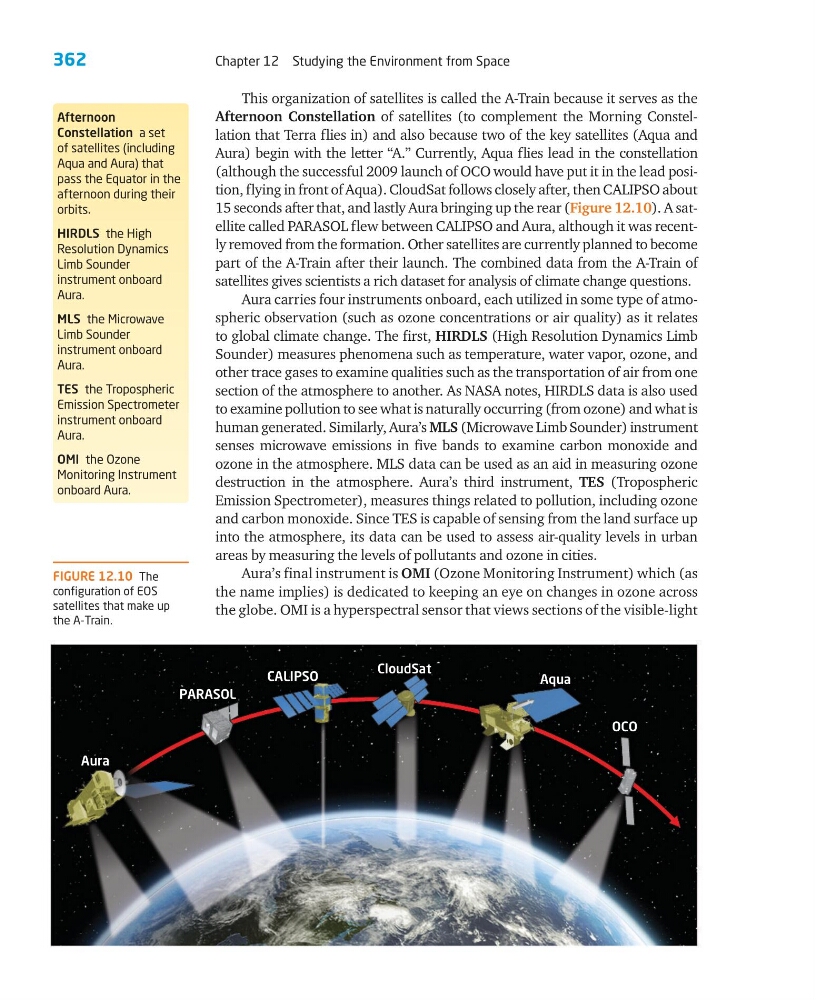
FIGURE 12.10 The
configuration of EOS
satellites that make up
the A-Train.
This organization of satellites is called the A-Train because it serves as the
Afternoon Constellation of satellites (to complement the Morning Constellation that Terra flies in) and also because two of the key satellites (Aqua and
Aura) begin with the letter “A.” Currently, Aqua flies lead in the constellation
(although the successful 2009 launch of OCO would have put it in the lead position, flying in front of Aqua). CloudSat follows closely after, then CALIPSO about
15 seconds after that, and lastly Aura bringing up the rear (Figure 12.10). A satellite called PARASOL flew between CALIPSO and Aura, although it was recently removed from the formation. Other satellites are currently planned to become
part of the A-Train after their launch. The combined data from the A-Train of
satellites gives scientists a rich dataset for analysis of climate change questions.
Aura carries four instruments onboard, each utilized in some type of atmospheric observation (such as ozone concentrations or air quality) as it relates
to global climate change. The first, HIRDLS (High Resolution Dynamics Limb
Sounder) measures phenomena such as temperature, water vapor, ozone, and
other trace gases to examine qualities such as the transportation of air from one
section of the atmosphere to another. As NASA notes, HIRDLS data is also used
to examine pollution to see what is naturally occurring (from ozone) and what is
human generated. Similarly, Aura’s MLS (Microwave Limb Sounder) instrument
senses microwave emissions in five bands to examine carbon monoxide and
ozone in the atmosphere. MLS data can be used as an aid in measuring ozone
destruction in the atmosphere. Aura’s third instrument, TES (Tropospheric
Emission Spectrometer), measures things related to pollution, including ozone
and carbon monoxide. Since TES is capable of sensing from the land surface up
into the atmosphere, its data can be used to assess air-quality levels in urban
areas by measuring the levels of pollutants and ozone in cities.
Aura’s final instrument is OMI (Ozone Monitoring Instrument) which (as
the name implies) is dedicated to keeping an eye on changes in ozone across
the globe. OMI is a hyperspectral sensor that views sections of the visible-light
Afternoon
Constellation a set
of satellites (including
Aqua and Aura) that
pass the Equator in the
afternoon during their
orbits.
HIRDLS the High
Resolution Dynamics
Limb Sounder
instrument onboard
Aura.
MLS the Microwave
Limb Sounder
instrument onboard
Aura.
TES the Tropospheric
Emission Spectrometer
instrument onboard
Aura.
OMI the Ozone
Monitoring Instrument
onboard Aura.
Aura
PARASOL
CALIPSO
CloudSat
Aqua
OCO
Chapter 12 Studying the Environment from Space
FIGURE 12.10 The
configuration of EOS
satellites that make up
the A-Train.
This organization of satellites is called the A-Train because it serves as the
Afternoon Constellation of satellites (to complement the Morning Constellation that Terra flies in) and also because two of the key satellites (Aqua and
Aura) begin with the letter “A.” Currently, Aqua flies lead in the constellation
(although the successful 2009 launch of OCO would have put it in the lead position, flying in front of Aqua). CloudSat follows closely after, then CALIPSO about
15 seconds after that, and lastly Aura bringing up the rear (Figure 12.10). A satellite called PARASOL flew between CALIPSO and Aura, although it was recently removed from the formation. Other satellites are currently planned to become
part of the A-Train after their launch. The combined data from the A-Train of
satellites gives scientists a rich dataset for analysis of climate change questions.
Aura carries four instruments onboard, each utilized in some type of atmospheric observation (such as ozone concentrations or air quality) as it relates
to global climate change. The first, HIRDLS (High Resolution Dynamics Limb
Sounder) measures phenomena such as temperature, water vapor, ozone, and
other trace gases to examine qualities such as the transportation of air from one
section of the atmosphere to another. As NASA notes, HIRDLS data is also used
to examine pollution to see what is naturally occurring (from ozone) and what is
human generated. Similarly, Aura’s MLS (Microwave Limb Sounder) instrument
senses microwave emissions in five bands to examine carbon monoxide and
ozone in the atmosphere. MLS data can be used as an aid in measuring ozone
destruction in the atmosphere. Aura’s third instrument, TES (Tropospheric
Emission Spectrometer), measures things related to pollution, including ozone
and carbon monoxide. Since TES is capable of sensing from the land surface up
into the atmosphere, its data can be used to assess air-quality levels in urban
areas by measuring the levels of pollutants and ozone in cities.
Aura’s final instrument is OMI (Ozone Monitoring Instrument) which (as
the name implies) is dedicated to keeping an eye on changes in ozone across
the globe. OMI is a hyperspectral sensor that views sections of the visible-light
Afternoon
Constellation a set
of satellites (including
Aqua and Aura) that
pass the Equator in the
afternoon during their
orbits.
HIRDLS the High
Resolution Dynamics
Limb Sounder
instrument onboard
Aura.
MLS the Microwave
Limb Sounder
instrument onboard
Aura.
TES the Tropospheric
Emission Spectrometer
instrument onboard
Aura.
OMI the Ozone
Monitoring Instrument
onboard Aura.
Aura
PARASOL
CALIPSO
CloudSat
Aqua
OCO