

327
How Do Remote Sensing Satellites Collect Data?
The sensors onboard the satellites have different ways of actually scanning the ground and collecting information in the swath being imaged. In
along-track scanning, a linear array is used to scan the ground along the
path the satellite is moving in. As the satellite moves, the detectors collect
the information from the entire swath width underneath them. This type of
detector is referred to as a “pushbroom” sensor. Think of pushing a broom in
a straight line across a floor—the broom itself is the sensor and each bristle
of the broom represents a part of the array sensing what is on the ground
underneath it. A second method is an across-track scanner, where a rotating
mirror moves back and forth over the swath width of the ground collecting
information. This type of detector is referred to as a “whiskbroom” sensor.
Think of sweeping a floor with a broom, swinging the broom back and forth
across a path on the floor—the broom is the sensor and the bristles represent
the detectors collecting the data on the ground below them. Satellite systems
usually use one of these types of sensors to obtain the energy reflectance measurements from the ground (see Figure 11.4 on page 328 for examples of the
operation of both sensor types).
along-track a
scanning method
using a linear array to
collect data directly on
the path the satellite
moves on.
across-track a
scanning method using
a rotating mirror to
collect data by moving
the device the width of
the satellite’s swath.
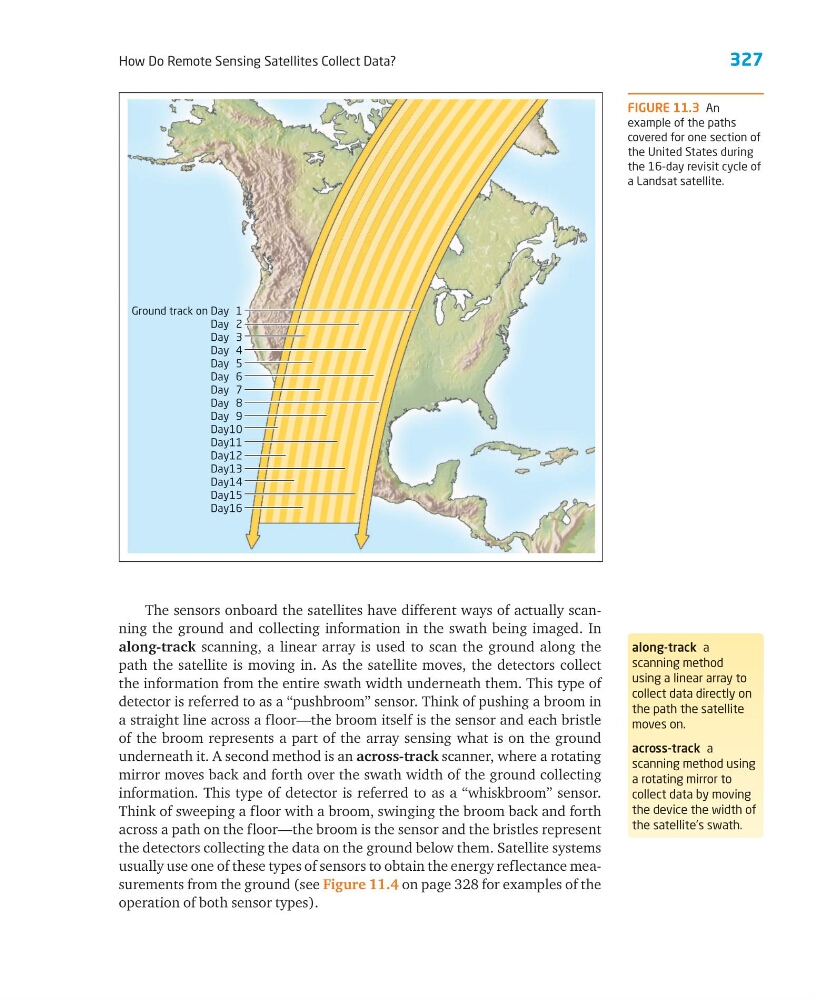
FIGURE 11.3 An
example of the paths
covered for one section of
the United States during
the 16-day revisit cycle of
a Landsat satellite.
Ground track on Day 1
Day 2
Day 3
Day 4
Day 5
Day 6
Day 7
Day 8
Day 9
Day10
Day11
Day12
Day13
Day14
Day15
Day16
How Do Remote Sensing Satellites Collect Data?
The sensors onboard the satellites have different ways of actually scanning the ground and collecting information in the swath being imaged. In
along-track scanning, a linear array is used to scan the ground along the
path the satellite is moving in. As the satellite moves, the detectors collect
the information from the entire swath width underneath them. This type of
detector is referred to as a “pushbroom” sensor. Think of pushing a broom in
a straight line across a floor—the broom itself is the sensor and each bristle
of the broom represents a part of the array sensing what is on the ground
underneath it. A second method is an across-track scanner, where a rotating
mirror moves back and forth over the swath width of the ground collecting
information. This type of detector is referred to as a “whiskbroom” sensor.
Think of sweeping a floor with a broom, swinging the broom back and forth
across a path on the floor—the broom is the sensor and the bristles represent
the detectors collecting the data on the ground below them. Satellite systems
usually use one of these types of sensors to obtain the energy reflectance measurements from the ground (see Figure 11.4 on page 328 for examples of the
operation of both sensor types).
along-track a
scanning method
using a linear array to
collect data directly on
the path the satellite
moves on.
across-track a
scanning method using
a rotating mirror to
collect data by moving
the device the width of
the satellite’s swath.
FIGURE 11.3 An
example of the paths
covered for one section of
the United States during
the 16-day revisit cycle of
a Landsat satellite.
Ground track on Day 1
Day 2
Day 3
Day 4
Day 5
Day 6
Day 7
Day 8
Day 9
Day10
Day11
Day12
Day13
Day14
Day15
Day16