

321
Remotely Sensed Imagery and Color Composites
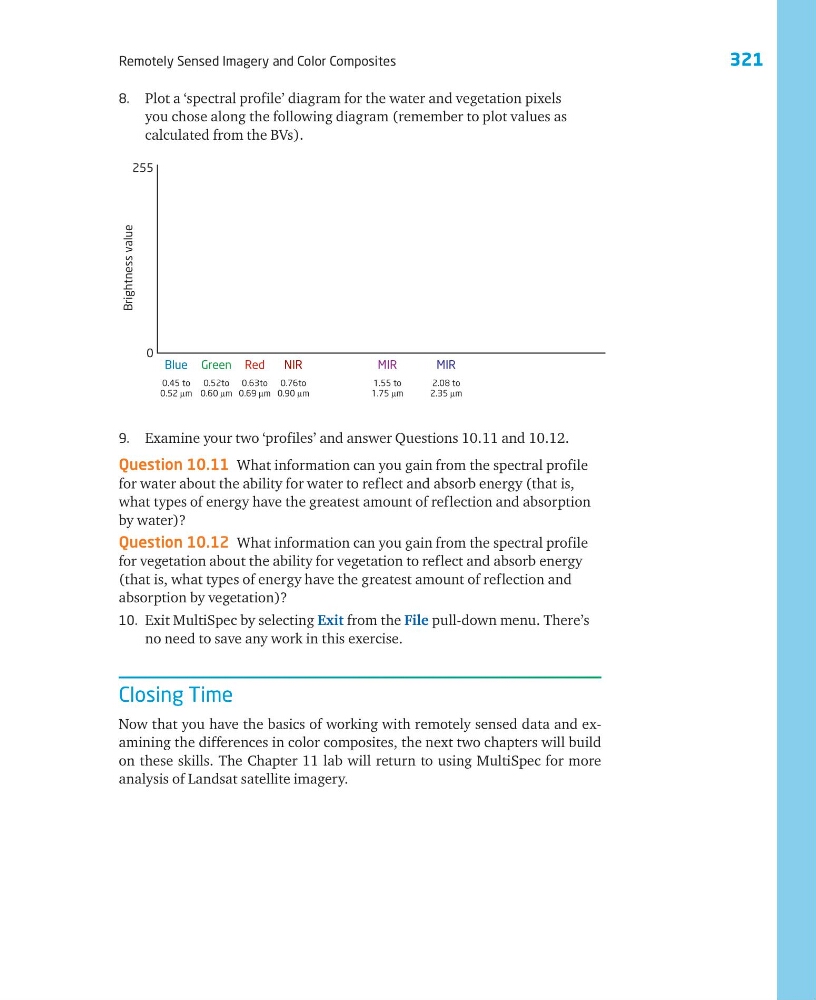
8. Plot a ‘spectral profile’ diagram for the water and vegetation pixels
you chose along the following diagram (remember to plot values as
calculated from the BVs).
0
Blue
0.45 to
0.52 µm
0.52to
0.60 µm
0.63to
0.69 µm
0.76to
0.90 µm
1.55 to
1.75 µm
2.08 to
2.35 µm
Green Red
NIR
MIR
MIR
255
Brightness value
9. Examine your two ‘profiles’ and answer Questions 10.11 and 10.12.
Question 10.11 What information can you gain from the spectral profile
for water about the ability for water to reflect and absorb energy (that is,
what types of energy have the greatest amount of reflection and absorption
by water)?
Question 10.12 What information can you gain from the spectral profile
for vegetation about the ability for vegetation to reflect and absorb energy
(that is, what types of energy have the greatest amount of reflection and
absorption by vegetation)?
10. Exit MultiSpec by selecting Exit from the File pull-down menu. There’s
no need to save any work in this exercise.
Closing Time
Now that you have the basics of working with remotely sensed data and examining the differences in color composites, the next two chapters will build
on these skills. The Chapter 11 lab will return to using MultiSpec for more
analysis of Landsat satellite imagery.
Remotely Sensed Imagery and Color Composites
8. Plot a ‘spectral profile’ diagram for the water and vegetation pixels
you chose along the following diagram (remember to plot values as
calculated from the BVs).
0
Blue
0.45 to
0.52 µm
0.52to
0.60 µm
0.63to
0.69 µm
0.76to
0.90 µm
1.55 to
1.75 µm
2.08 to
2.35 µm
Green Red
NIR
MIR
MIR
255
Brightness value
9. Examine your two ‘profiles’ and answer Questions 10.11 and 10.12.
Question 10.11 What information can you gain from the spectral profile
for water about the ability for water to reflect and absorb energy (that is,
what types of energy have the greatest amount of reflection and absorption
by water)?
Question 10.12 What information can you gain from the spectral profile
for vegetation about the ability for vegetation to reflect and absorb energy
(that is, what types of energy have the greatest amount of reflection and
absorption by vegetation)?
10. Exit MultiSpec by selecting Exit from the File pull-down menu. There’s
no need to save any work in this exercise.
Closing Time
Now that you have the basics of working with remotely sensed data and examining the differences in color composites, the next two chapters will build
on these skills. The Chapter 11 lab will return to using MultiSpec for more
analysis of Landsat satellite imagery.