

276
Chapter 9 Remotely Sensed Images from Above
were looking down from the plane. Many aerial photos are vertical (although
there may be some minor tilting from the camera). The spot directly under the
camera is referred to as nadir.
Aerial photos can also be panchromatic or color. Panchromatic imagery
is only capturing the visible portion of light in its entirety. As a result, panchromatic aerial photos will be grayscale (that is, black and white—like the
Cuban aerial photo). Color imagery is capturing the three main bands of visible light—red, green, and blue—and the colors are composited together in
the digital imagery (or film) as a true color composite (we’ll discuss much
more about light and composites in Chapter 10).
A distinctive type of color aerial photo is a color infrared (CIR) photo. A
CIR image is captured with a special type of film sensitive to infrared light.
Infrared energy is invisible to the naked eye, but special film processes can
capture it. In order for us to see infrared energy reflection, a special filter is
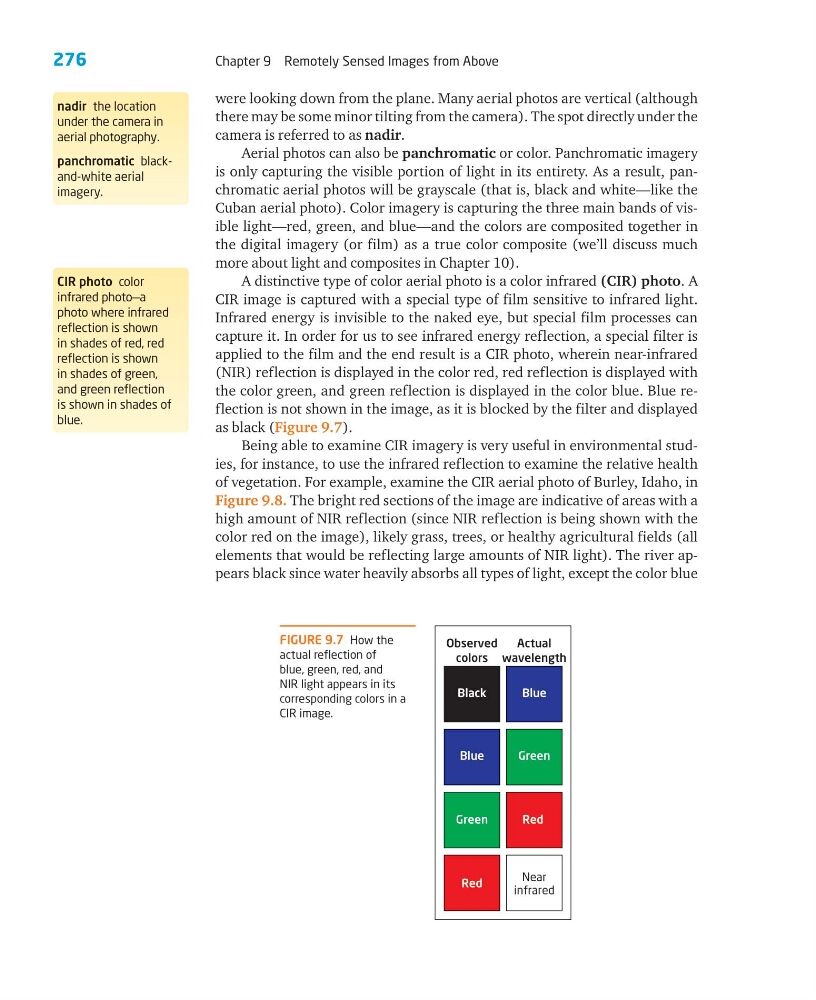
applied to the film and the end result is a CIR photo, wherein near-infrared
(NIR) reflection is displayed in the color red, red reflection is displayed with
the color green, and green reflection is displayed in the color blue. Blue reflection is not shown in the image, as it is blocked by the filter and displayed
as black (Figure 9.7).
Being able to examine CIR imagery is very useful in environmental studies, for instance, to use the infrared reflection to examine the relative health
of vegetation. For example, examine the CIR aerial photo of Burley, Idaho, in
Figure 9.8. The bright red sections of the image are indicative of areas with a
high amount of NIR reflection (since NIR reflection is being shown with the
color red on the image), likely grass, trees, or healthy agricultural fields (all
elements that would be reflecting large amounts of NIR light). The river appears black since water heavily absorbs all types of light, except the color blue
CIR photo color
infrared photo—a
photo where infrared
reflection is shown
in shades of red, red
reflection is shown
in shades of green,
and green reflection
is shown in shades of
blue.
nadir the location
under the camera in
aerial photography.
panchromatic blackand-white aerial
imagery.
FIGURE 9.7 How the
actual reflection of
blue, green, red, and
NIR light appears in its
corresponding colors in a
CIR image.
Observed
colors
Actual
wavelength
Black
Blue
Blue
Green
Green
Red
Red
Near
infrared
Chapter 9 Remotely Sensed Images from Above
were looking down from the plane. Many aerial photos are vertical (although
there may be some minor tilting from the camera). The spot directly under the
camera is referred to as nadir.
Aerial photos can also be panchromatic or color. Panchromatic imagery
is only capturing the visible portion of light in its entirety. As a result, panchromatic aerial photos will be grayscale (that is, black and white—like the
Cuban aerial photo). Color imagery is capturing the three main bands of visible light—red, green, and blue—and the colors are composited together in
the digital imagery (or film) as a true color composite (we’ll discuss much
more about light and composites in Chapter 10).
A distinctive type of color aerial photo is a color infrared (CIR) photo. A
CIR image is captured with a special type of film sensitive to infrared light.
Infrared energy is invisible to the naked eye, but special film processes can
capture it. In order for us to see infrared energy reflection, a special filter is
applied to the film and the end result is a CIR photo, wherein near-infrared
(NIR) reflection is displayed in the color red, red reflection is displayed with
the color green, and green reflection is displayed in the color blue. Blue reflection is not shown in the image, as it is blocked by the filter and displayed
as black (Figure 9.7).
Being able to examine CIR imagery is very useful in environmental studies, for instance, to use the infrared reflection to examine the relative health
of vegetation. For example, examine the CIR aerial photo of Burley, Idaho, in
Figure 9.8. The bright red sections of the image are indicative of areas with a
high amount of NIR reflection (since NIR reflection is being shown with the
color red on the image), likely grass, trees, or healthy agricultural fields (all
elements that would be reflecting large amounts of NIR light). The river appears black since water heavily absorbs all types of light, except the color blue
CIR photo color
infrared photo—a
photo where infrared
reflection is shown
in shades of red, red
reflection is shown
in shades of green,
and green reflection
is shown in shades of
blue.
nadir the location
under the camera in
aerial photography.
panchromatic blackand-white aerial
imagery.
FIGURE 9.7 How the
actual reflection of
blue, green, red, and
NIR light appears in its
corresponding colors in a
CIR image.
Observed
colors
Actual
wavelength
Black
Blue
Blue
Green
Green
Red
Red
Near
infrared