

194
Chapter 7 Using GIS to Make a Map
method takes all of the values being mapped and looks at how they’re grouped
together. The spaces in between the data values are used to make different
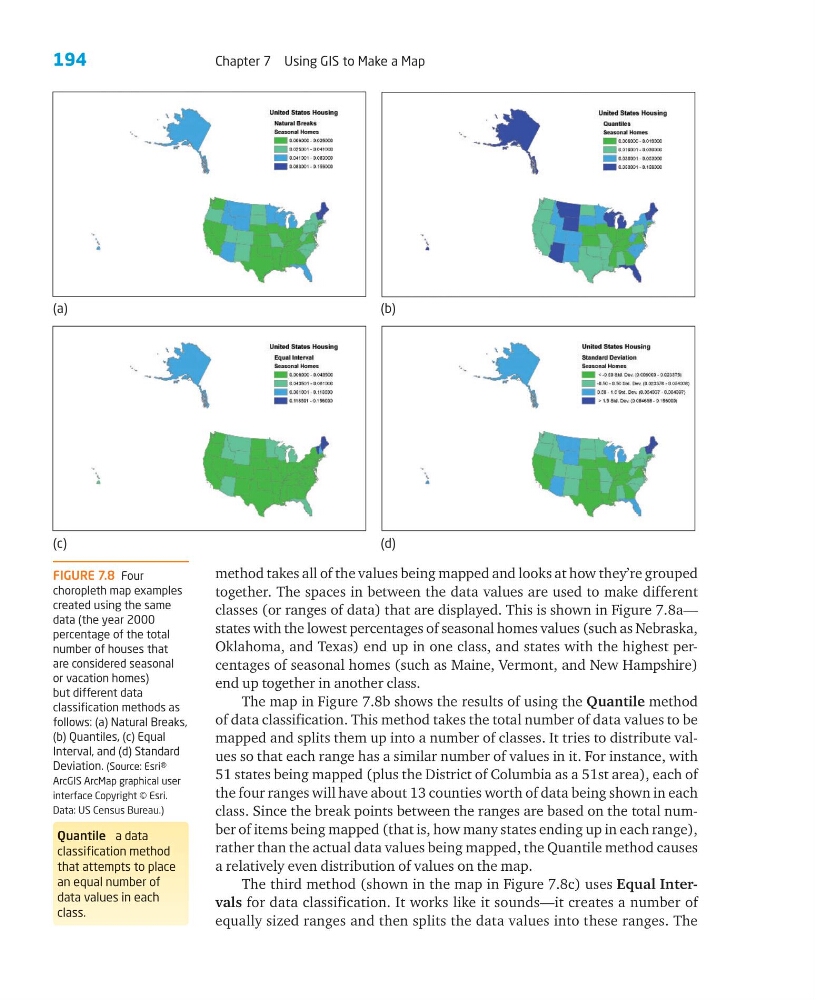
classes (or ranges of data) that are displayed. This is shown in Figure 7.8a—
states with the lowest percentages of seasonal homes values (such as Nebraska,
Oklahoma, and Texas) end up in one class, and states with the highest percentages of seasonal homes (such as Maine, Vermont, and New Hampshire)
end up together in another class.
The map in Figure 7.8b shows the results of using the Quantile method
of data classification. This method takes the total number of data values to be
mapped and splits them up into a number of classes. It tries to distribute values so that each range has a similar number of values in it. For instance, with
51 states being mapped (plus the District of Columbia as a 51st area), each of
the four ranges will have about 13 counties worth of data being shown in each
class. Since the break points between the ranges are based on the total number of items being mapped (that is, how many states ending up in each range),
rather than the actual data values being mapped, the Quantile method causes
a relatively even distribution of values on the map.
The third method (shown in the map in Figure 7.8c) uses Equal Intervals for data classification. It works like it sounds—it creates a number of
equally sized ranges and then splits the data values into these ranges. The
Quantile a data
classification method
that attempts to place
an equal number of
data values in each
class.
FIGURE 7.8 Four
choropleth map examples
created using the same
data (the year 2000
percentage of the total
number of houses that
are considered seasonal
or vacation homes)
but different data
classification methods as
follows: (a) Natural Breaks,
(b) Quantiles, (c) Equal
Interval, and (d) Standard
Deviation. (Source: Esri®
ArcGIS ArcMap graphical user
interface Copyright © Esri.
Data: US Census Bureau.)
(a)
(b)
(c)
(d)
Chapter 7 Using GIS to Make a Map
method takes all of the values being mapped and looks at how they’re grouped
together. The spaces in between the data values are used to make different
classes (or ranges of data) that are displayed. This is shown in Figure 7.8a—
states with the lowest percentages of seasonal homes values (such as Nebraska,
Oklahoma, and Texas) end up in one class, and states with the highest percentages of seasonal homes (such as Maine, Vermont, and New Hampshire)
end up together in another class.
The map in Figure 7.8b shows the results of using the Quantile method
of data classification. This method takes the total number of data values to be
mapped and splits them up into a number of classes. It tries to distribute values so that each range has a similar number of values in it. For instance, with
51 states being mapped (plus the District of Columbia as a 51st area), each of
the four ranges will have about 13 counties worth of data being shown in each
class. Since the break points between the ranges are based on the total number of items being mapped (that is, how many states ending up in each range),
rather than the actual data values being mapped, the Quantile method causes
a relatively even distribution of values on the map.
The third method (shown in the map in Figure 7.8c) uses Equal Intervals for data classification. It works like it sounds—it creates a number of
equally sized ranges and then splits the data values into these ranges. The
Quantile a data
classification method
that attempts to place
an equal number of
data values in each
class.
FIGURE 7.8 Four
choropleth map examples
created using the same
data (the year 2000
percentage of the total
number of houses that
are considered seasonal
or vacation homes)
but different data
classification methods as
follows: (a) Natural Breaks,
(b) Quantiles, (c) Equal
Interval, and (d) Standard
Deviation. (Source: Esri®
ArcGIS ArcMap graphical user
interface Copyright © Esri.
Data: US Census Bureau.)
(a)
(b)
(c)
(d)