

Télédétection et ressources en eau/Remote sensing and water resources
117
In order to plan the development of these water resources carefully, especially for agriculture which
is by far the biggest user of water, a re-assessment of the irrigation potential for the African continent
has been judged necessary. The definition of irrigation potential is not straightforward and implies a
series of assumptions about irrigation techniques, investment capacity, national and regional policies,
social, health and environmental aspects, and international relationships, notably regarding the sharing
of waters (IFPRI, 1995).
The most logical research unit for the computation of irrigation potential is the river basin, as only
at this level can the water availability be evaluated. However, as most of the information is available at
country level, and as information at country level may also be important for planning purposes, both
these research units have been used to define the base on which irrigation potential is assessed (FAO, in
preparation).
When combining the available land resources suitable for irrigation, expressed in hectares, and the
available water resources, expressed in m
3 per year, for assessing the irrigation potential, knowledge of
the irrigation water requirements, expressed in m
3
/ha per year or in mm per year, is necessary.
Figure 1 shows the computation process for the assessment of physical irrigation potential in a first
step, and the identification of possibilities for irrigation development in a second step, after taking into
consideration the non-physical factors. This article deals with the computation of the irrigation water
requirements, as a part of the first step of the process, and the use of a Geographical Information
System (GIS) in that context
1 .
IRRIGATION WATER REQUIREMENTS CALCULATION
Crop water requirements (CWR) are calculated on the basis of monthly effective rainfall (P eff ) and
reference evapotranspiration (ET o ), the first being calculated from average rainfall following the USDA
Soil Conservation Service method and the latter being calculated following the Penman-Monteith
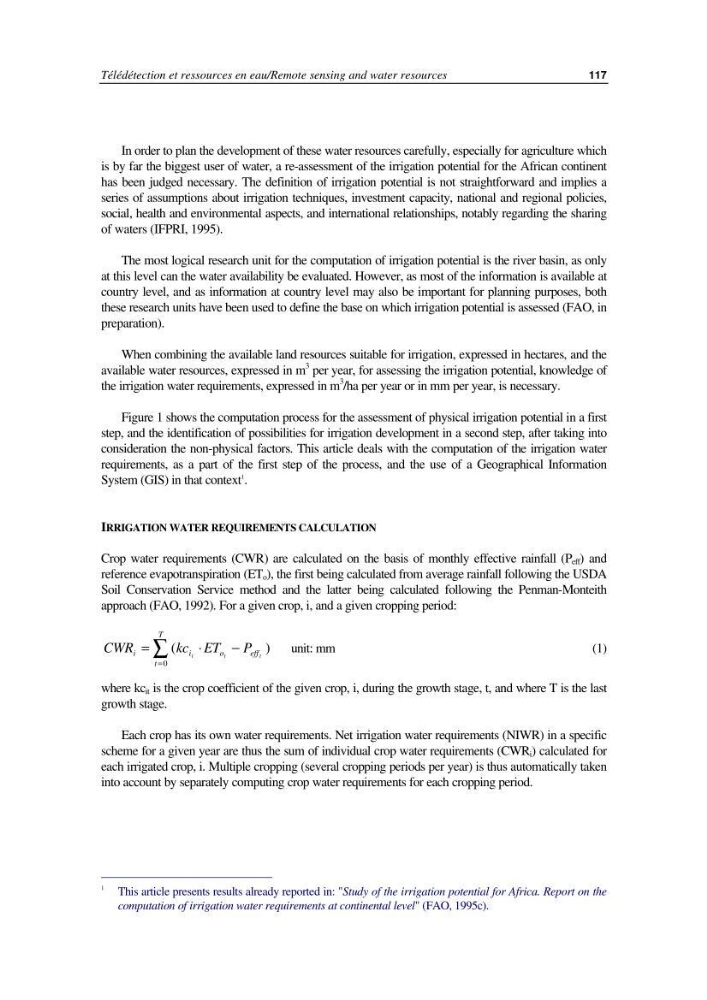
approach (FAO, 1992). For a given crop, i, and a given cropping period:
CWR
kc ET
P
i
i
o
t
T
eff
t
t
t
=
⋅
−
=
∑ (
)
0
unit: mm
(1)
where kc it is the crop coefficient of the given crop, i, during the growth stage, t, and where T is the last
growth stage.
Each crop has its own water requirements. Net irrigation water requirements (NIWR) in a specific
scheme for a given year are thus the sum of individual crop water requirements (CWR i ) calculated for
each irrigated crop, i. Multiple cropping (several cropping periods per year) is thus automatically taken
into account by separately computing crop water requirements for each cropping period.
1
This article presents results already reported in: "Study of the irrigation potential for Africa. Report on the
computation of irrigation water requirements at continental level" (FAO, 1995c).
117
In order to plan the development of these water resources carefully, especially for agriculture which
is by far the biggest user of water, a re-assessment of the irrigation potential for the African continent
has been judged necessary. The definition of irrigation potential is not straightforward and implies a
series of assumptions about irrigation techniques, investment capacity, national and regional policies,
social, health and environmental aspects, and international relationships, notably regarding the sharing
of waters (IFPRI, 1995).
The most logical research unit for the computation of irrigation potential is the river basin, as only
at this level can the water availability be evaluated. However, as most of the information is available at
country level, and as information at country level may also be important for planning purposes, both
these research units have been used to define the base on which irrigation potential is assessed (FAO, in
preparation).
When combining the available land resources suitable for irrigation, expressed in hectares, and the
available water resources, expressed in m
3 per year, for assessing the irrigation potential, knowledge of
the irrigation water requirements, expressed in m
3
/ha per year or in mm per year, is necessary.
Figure 1 shows the computation process for the assessment of physical irrigation potential in a first
step, and the identification of possibilities for irrigation development in a second step, after taking into
consideration the non-physical factors. This article deals with the computation of the irrigation water
requirements, as a part of the first step of the process, and the use of a Geographical Information
System (GIS) in that context
1 .
IRRIGATION WATER REQUIREMENTS CALCULATION
Crop water requirements (CWR) are calculated on the basis of monthly effective rainfall (P eff ) and
reference evapotranspiration (ET o ), the first being calculated from average rainfall following the USDA
Soil Conservation Service method and the latter being calculated following the Penman-Monteith
approach (FAO, 1992). For a given crop, i, and a given cropping period:
CWR
kc ET
P
i
i
o
t
T
eff
t
t
t
=
⋅
−
=
∑ (
)
0
unit: mm
(1)
where kc it is the crop coefficient of the given crop, i, during the growth stage, t, and where T is the last
growth stage.
Each crop has its own water requirements. Net irrigation water requirements (NIWR) in a specific
scheme for a given year are thus the sum of individual crop water requirements (CWR i ) calculated for
each irrigated crop, i. Multiple cropping (several cropping periods per year) is thus automatically taken
into account by separately computing crop water requirements for each cropping period.
1
This article presents results already reported in: "Study of the irrigation potential for Africa. Report on the
computation of irrigation water requirements at continental level" (FAO, 1995c).