

Using exergy, the second law of thermodynamics can be applied to nonequilibrium
regions and processes. This system can be described in terms of the exergy fluxes
setting up gradients (e.g., temperature and pressure differences in classical thermodynamic systems). With the establishment of these gradients, the system is no longer
in equilibrium. The system responds to these imposed gradients by self-organizing in
a way which resists the ability of the exergy fluxes to establish gradients and hence
move the system further away from equilibrium. More formally, a restatement of the
second law says that as systems are moved away from equilibrium, they will utilize all
avenues available to counter the applied gradients. As the applied gradients increase,
so does the system’s ability to oppose further movement from equilibrium (Schneider
and Kay, 1994a). The more a system self-organizes, the more effective it will become
at exergy utilization. Kay and Schneider (1994) have focused on the application of
this thermodynamic principle to the science of ecology. Ecosystems are viewed as
open thermodynamic systems with a large gradient impressed on them by the exergy
flux from the sun. Ecosystems, according to the restated second law, develop in ways
that systematically increase their ability to degrade the incoming solar exergy, hence
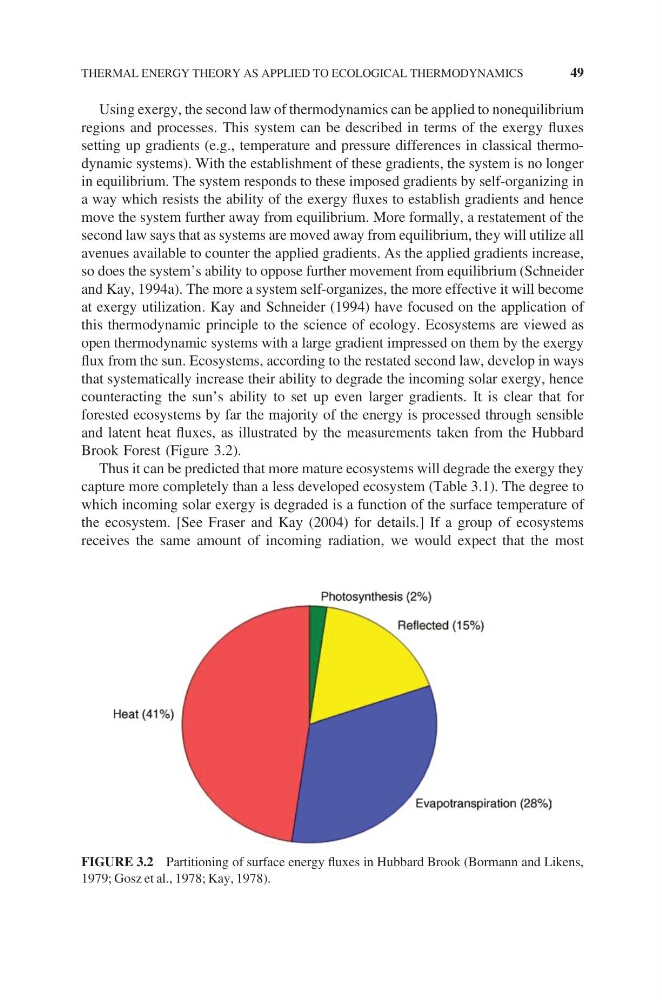
counteracting the sun’s ability to set up even larger gradients. It is clear that for
forested ecosystems by far the majority of the energy is processed through sensible
and latent heat fluxes, as illustrated by the measurements taken from the Hubbard
Brook Forest (Figure 3.2).
Thus it can be predicted that more mature ecosystems will degrade the exergy they
capture more completely than a less developed ecosystem (Table 3.1). The degree to
which incoming solar exergy is degraded is a function of the surface temperature of
the ecosystem. [See Fraser and Kay (2004) for details.] If a group of ecosystems
receives the same amount of incoming radiation, we would expect that the most
FIGURE 3.2 Partitioning of surface energy fluxes in Hubbard Brook (Bormann and Likens,
1979; Gosz et al., 1978; Kay, 1978).
THERMAL ENERGY THEORY AS APPLIED TO ECOLOGICAL THERMODYNAMICS
49
regions and processes. This system can be described in terms of the exergy fluxes
setting up gradients (e.g., temperature and pressure differences in classical thermodynamic systems). With the establishment of these gradients, the system is no longer
in equilibrium. The system responds to these imposed gradients by self-organizing in
a way which resists the ability of the exergy fluxes to establish gradients and hence
move the system further away from equilibrium. More formally, a restatement of the
second law says that as systems are moved away from equilibrium, they will utilize all
avenues available to counter the applied gradients. As the applied gradients increase,
so does the system’s ability to oppose further movement from equilibrium (Schneider
and Kay, 1994a). The more a system self-organizes, the more effective it will become
at exergy utilization. Kay and Schneider (1994) have focused on the application of
this thermodynamic principle to the science of ecology. Ecosystems are viewed as
open thermodynamic systems with a large gradient impressed on them by the exergy
flux from the sun. Ecosystems, according to the restated second law, develop in ways
that systematically increase their ability to degrade the incoming solar exergy, hence
counteracting the sun’s ability to set up even larger gradients. It is clear that for
forested ecosystems by far the majority of the energy is processed through sensible
and latent heat fluxes, as illustrated by the measurements taken from the Hubbard
Brook Forest (Figure 3.2).
Thus it can be predicted that more mature ecosystems will degrade the exergy they
capture more completely than a less developed ecosystem (Table 3.1). The degree to
which incoming solar exergy is degraded is a function of the surface temperature of
the ecosystem. [See Fraser and Kay (2004) for details.] If a group of ecosystems
receives the same amount of incoming radiation, we would expect that the most
FIGURE 3.2 Partitioning of surface energy fluxes in Hubbard Brook (Bormann and Likens,
1979; Gosz et al., 1978; Kay, 1978).
THERMAL ENERGY THEORY AS APPLIED TO ECOLOGICAL THERMODYNAMICS
49