

Based on the results with real multisensor and artificially created multiscale IKONOS
images it can be concluded that scale ratios of up to 1 : 10 can safely be used for image
fusion provided that the spectral fidelity of the fusion process can be guaranteed. Fusion
with a ratio below 1 : 10 is only meaningful for a limited number of applications such as
agricultural analyses. For scale ratios of 1 : 20, positive experiences with the Ehlers fusion
technique are reported by project partners in the European Union agricultural monitoring
program “Control with Remote Sensing.” In one of the reports they wrote: “Ehlers image
fusion method can get fusion images from different sensors and from different date of
image acquisition. The profits of this method are located in the radiometric aspect, since
this method keeps the radiometric properties of the multispectral image giving certain
texture that improves the photointerpretation task. The improvement in the spatial
resolution affects two factors during the computer aided photo interpretation (CAPI),
namely permanent land uses which present not much soil cover are more precisely
recognized and a better delineation of the field boundaries can be made, without a decrease
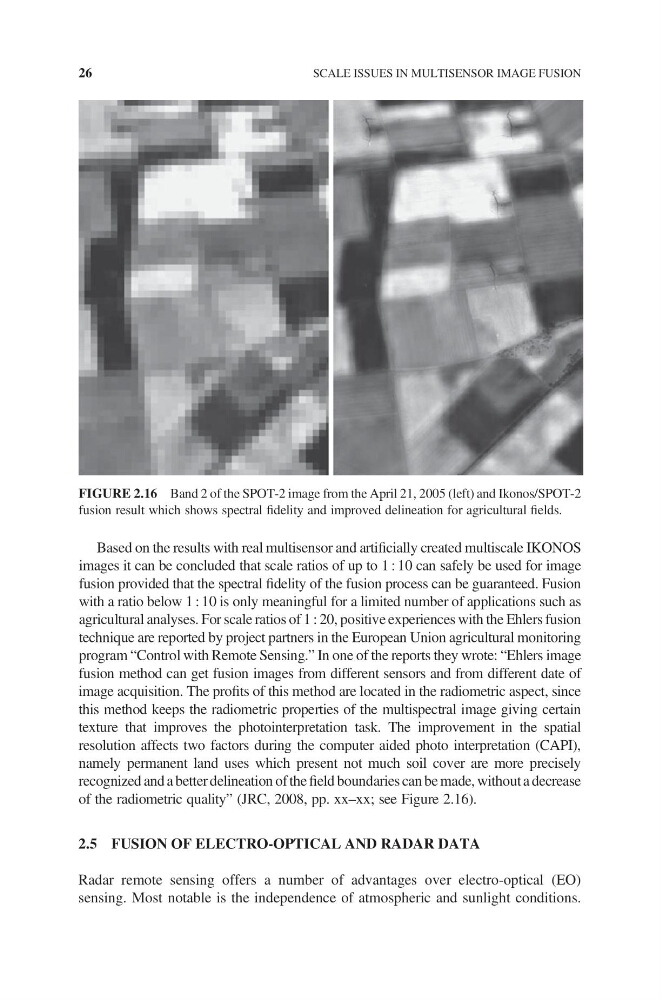
of the radiometric quality” (JRC, 2008, pp. xx–xx; see Figure 2.16).
2.5 FUSION OF ELECTRO-OPTICAL AND RADAR DATA
Radar remote sensing offers a number of advantages over electro-optical (EO)
sensing. Most notable is the independence of atmospheric and sunlight conditions.
FIGURE 2.16 Band 2 of the SPOT-2 image from the April 21, 2005 (left) and Ikonos/SPOT-2
fusion result which shows spectral fidelity and improved delineation for agricultural fields.
26
SCALE ISSUES IN MULTISENSOR IMAGE FUSION
images it can be concluded that scale ratios of up to 1 : 10 can safely be used for image
fusion provided that the spectral fidelity of the fusion process can be guaranteed. Fusion
with a ratio below 1 : 10 is only meaningful for a limited number of applications such as
agricultural analyses. For scale ratios of 1 : 20, positive experiences with the Ehlers fusion
technique are reported by project partners in the European Union agricultural monitoring
program “Control with Remote Sensing.” In one of the reports they wrote: “Ehlers image
fusion method can get fusion images from different sensors and from different date of
image acquisition. The profits of this method are located in the radiometric aspect, since
this method keeps the radiometric properties of the multispectral image giving certain
texture that improves the photointerpretation task. The improvement in the spatial
resolution affects two factors during the computer aided photo interpretation (CAPI),
namely permanent land uses which present not much soil cover are more precisely
recognized and a better delineation of the field boundaries can be made, without a decrease
of the radiometric quality” (JRC, 2008, pp. xx–xx; see Figure 2.16).
2.5 FUSION OF ELECTRO-OPTICAL AND RADAR DATA
Radar remote sensing offers a number of advantages over electro-optical (EO)
sensing. Most notable is the independence of atmospheric and sunlight conditions.
FIGURE 2.16 Band 2 of the SPOT-2 image from the April 21, 2005 (left) and Ikonos/SPOT-2
fusion result which shows spectral fidelity and improved delineation for agricultural fields.
26
SCALE ISSUES IN MULTISENSOR IMAGE FUSION