

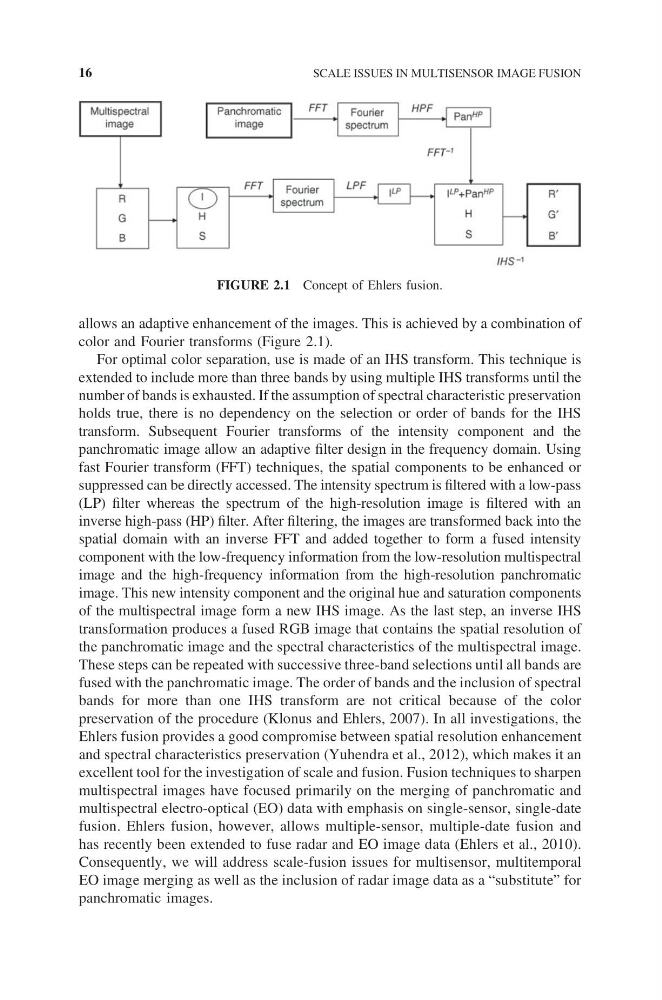
allows an adaptive enhancement of the images. This is achieved by a combination of
color and Fourier transforms (Figure 2.1).
For optimal color separation, use is made of an IHS transform. This technique is
extended to include more than three bands by using multiple IHS transforms until the
number of bands is exhausted. If the assumption of spectral characteristic preservation
holds true, there is no dependency on the selection or order of bands for the IHS
transform. Subsequent Fourier transforms of the intensity component and the
panchromatic image allow an adaptive filter design in the frequency domain. Using
fast Fourier transform (FFT) techniques, the spatial components to be enhanced or
suppressed can be directly accessed. The intensity spectrum is filtered with a low-pass
(LP) filter whereas the spectrum of the high-resolution image is filtered with an
inverse high-pass (HP) filter. After filtering, the images are transformed back into the
spatial domain with an inverse FFT and added together to form a fused intensity
component with the low-frequency information from the low-resolution multispectral
image and the high-frequency information from the high-resolution panchromatic
image. This new intensity component and the original hue and saturation components
of the multispectral image form a new IHS image. As the last step, an inverse IHS
transformation produces a fused RGB image that contains the spatial resolution of
the panchromatic image and the spectral characteristics of the multispectral image.
These steps can be repeated with successive three-band selections until all bands are
fused with the panchromatic image. The order of bands and the inclusion of spectral
bands for more than one IHS transform are not critical because of the color
preservation of the procedure (Klonus and Ehlers, 2007). In all investigations, the
Ehlers fusion provides a good compromise between spatial resolution enhancement
and spectral characteristics preservation (Yuhendra et al., 2012), which makes it an
excellent tool for the investigation of scale and fusion. Fusion techniques to sharpen
multispectral images have focused primarily on the merging of panchromatic and
multispectral electro-optical (EO) data with emphasis on single-sensor, single-date
fusion. Ehlers fusion, however, allows multiple-sensor, multiple-date fusion and
has recently been extended to fuse radar and EO image data (Ehlers et al., 2010).
Consequently, we will address scale-fusion issues for multisensor, multitemporal
EO image merging as well as the inclusion of radar image data as a “substitute” for
panchromatic images.
FIGURE 2.1 Concept of Ehlers fusion.
16
SCALE ISSUES IN MULTISENSOR IMAGE FUSION
color and Fourier transforms (Figure 2.1).
For optimal color separation, use is made of an IHS transform. This technique is
extended to include more than three bands by using multiple IHS transforms until the
number of bands is exhausted. If the assumption of spectral characteristic preservation
holds true, there is no dependency on the selection or order of bands for the IHS
transform. Subsequent Fourier transforms of the intensity component and the
panchromatic image allow an adaptive filter design in the frequency domain. Using
fast Fourier transform (FFT) techniques, the spatial components to be enhanced or
suppressed can be directly accessed. The intensity spectrum is filtered with a low-pass
(LP) filter whereas the spectrum of the high-resolution image is filtered with an
inverse high-pass (HP) filter. After filtering, the images are transformed back into the
spatial domain with an inverse FFT and added together to form a fused intensity
component with the low-frequency information from the low-resolution multispectral
image and the high-frequency information from the high-resolution panchromatic
image. This new intensity component and the original hue and saturation components
of the multispectral image form a new IHS image. As the last step, an inverse IHS
transformation produces a fused RGB image that contains the spatial resolution of
the panchromatic image and the spectral characteristics of the multispectral image.
These steps can be repeated with successive three-band selections until all bands are
fused with the panchromatic image. The order of bands and the inclusion of spectral
bands for more than one IHS transform are not critical because of the color
preservation of the procedure (Klonus and Ehlers, 2007). In all investigations, the
Ehlers fusion provides a good compromise between spatial resolution enhancement
and spectral characteristics preservation (Yuhendra et al., 2012), which makes it an
excellent tool for the investigation of scale and fusion. Fusion techniques to sharpen
multispectral images have focused primarily on the merging of panchromatic and
multispectral electro-optical (EO) data with emphasis on single-sensor, single-date
fusion. Ehlers fusion, however, allows multiple-sensor, multiple-date fusion and
has recently been extended to fuse radar and EO image data (Ehlers et al., 2010).
Consequently, we will address scale-fusion issues for multisensor, multitemporal
EO image merging as well as the inclusion of radar image data as a “substitute” for
panchromatic images.
FIGURE 2.1 Concept of Ehlers fusion.
16
SCALE ISSUES IN MULTISENSOR IMAGE FUSION