

15.2.2.1 Unaltered Reflectance Spectral Library In case no quantitative manipulations of the estimates of the field-sensed data have been performed, the spectral
reflectance is unaltered, that is, “instrument-produced” reflectance. Unaltered reflectance of vegetation land cover has been widely studied because it is commonly viewed
as an indicator of the properties of the landscape and the interaction between the local
climate, rocks and soil, landforms, fauna, water and humans, and landscape factors
integrated within digital imagery (Schmidt and Skidmore, 2003). This implies that the
value of the unaltered spectral libraries is taken into account in the above-mentioned
variation sources inherent in the pixel data sensed by the air- and spaceborne scale
remote sensing systems (Manevski et al., 2012). Therefore, unaltered spectral libraries
are most often used as sets of reference spectra to delineate different land covers and
mixed communities within a certain spatial extent. Apart from the effect of canopy
structure and soil background from the canopy spectra, other factors that can cause
vegetation to show variability in unaltered spectral reflectance from one target to
another include the leaf shape and size, the canopy architecture and density, its
internal water content, as well as the soil type beneath the vegetation cover
(Price, 1994).
15.2.2.2 Continuum-Removed Spectral Library Continuum removal is a mathematical manipulation of the unaltered spectral reflectance with the use of a continuum
line fitted over the top of the spectral signature local maxima that are connected using
straight-line segments according to the equation
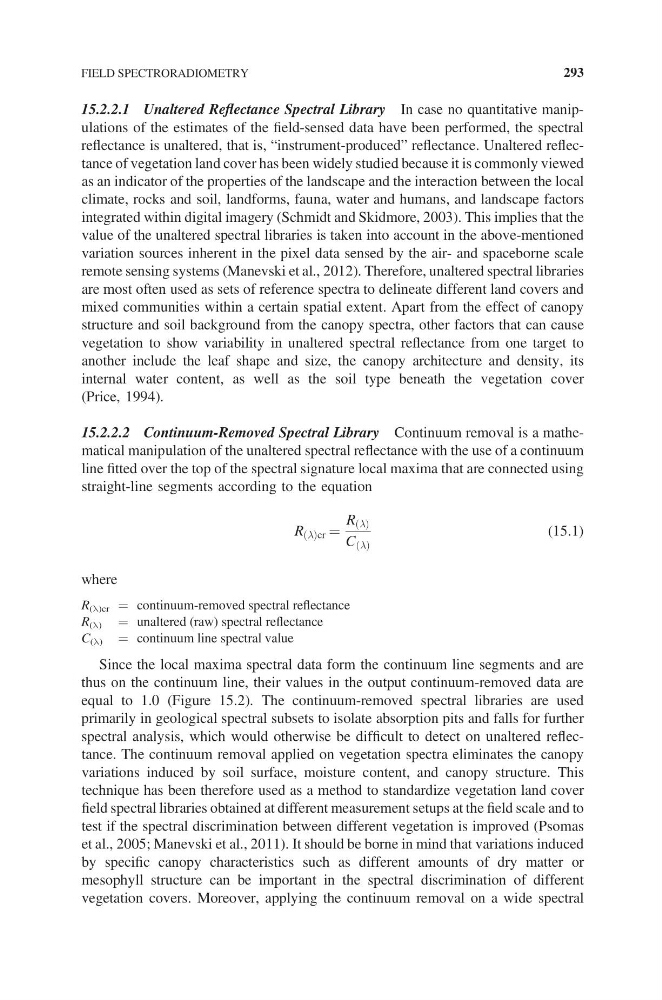
R lcr =
R l
C l
(15.1)
where
R (l)cr = continuum-removed spectral reflectance
R (l) = unaltered (raw) spectral reflectance
C (l) = continuum line spectral value
Since the local maxima spectral data form the continuum line segments and are
thus on the continuum line, their values in the output continuum-removed data are
equal to 1.0 (Figure 15.2). The continuum-removed spectral libraries are used
primarily in geological spectral subsets to isolate absorption pits and falls for further
spectral analysis, which would otherwise be difficult to detect on unaltered reflectance. The continuum removal applied on vegetation spectra eliminates the canopy
variations induced by soil surface, moisture content, and canopy structure. This
technique has been therefore used as a method to standardize vegetation land cover
field spectral libraries obtained at different measurement setups at the field scale and to
test if the spectral discrimination between different vegetation is improved (Psomas
et al., 2005; Manevski et al., 2011). It should be borne in mind that variations induced
by specific canopy characteristics such as different amounts of dry matter or
mesophyll structure can be important in the spectral discrimination of different
vegetation covers. Moreover, applying the continuum removal on a wide spectral
FIELD SPECTRORADIOMETRY
293
reflectance is unaltered, that is, “instrument-produced” reflectance. Unaltered reflectance of vegetation land cover has been widely studied because it is commonly viewed
as an indicator of the properties of the landscape and the interaction between the local
climate, rocks and soil, landforms, fauna, water and humans, and landscape factors
integrated within digital imagery (Schmidt and Skidmore, 2003). This implies that the
value of the unaltered spectral libraries is taken into account in the above-mentioned
variation sources inherent in the pixel data sensed by the air- and spaceborne scale
remote sensing systems (Manevski et al., 2012). Therefore, unaltered spectral libraries
are most often used as sets of reference spectra to delineate different land covers and
mixed communities within a certain spatial extent. Apart from the effect of canopy
structure and soil background from the canopy spectra, other factors that can cause
vegetation to show variability in unaltered spectral reflectance from one target to
another include the leaf shape and size, the canopy architecture and density, its
internal water content, as well as the soil type beneath the vegetation cover
(Price, 1994).
15.2.2.2 Continuum-Removed Spectral Library Continuum removal is a mathematical manipulation of the unaltered spectral reflectance with the use of a continuum
line fitted over the top of the spectral signature local maxima that are connected using
straight-line segments according to the equation
R lcr =
R l
C l
(15.1)
where
R (l)cr = continuum-removed spectral reflectance
R (l) = unaltered (raw) spectral reflectance
C (l) = continuum line spectral value
Since the local maxima spectral data form the continuum line segments and are
thus on the continuum line, their values in the output continuum-removed data are
equal to 1.0 (Figure 15.2). The continuum-removed spectral libraries are used
primarily in geological spectral subsets to isolate absorption pits and falls for further
spectral analysis, which would otherwise be difficult to detect on unaltered reflectance. The continuum removal applied on vegetation spectra eliminates the canopy
variations induced by soil surface, moisture content, and canopy structure. This
technique has been therefore used as a method to standardize vegetation land cover
field spectral libraries obtained at different measurement setups at the field scale and to
test if the spectral discrimination between different vegetation is improved (Psomas
et al., 2005; Manevski et al., 2011). It should be borne in mind that variations induced
by specific canopy characteristics such as different amounts of dry matter or
mesophyll structure can be important in the spectral discrimination of different
vegetation covers. Moreover, applying the continuum removal on a wide spectral
FIELD SPECTRORADIOMETRY
293