

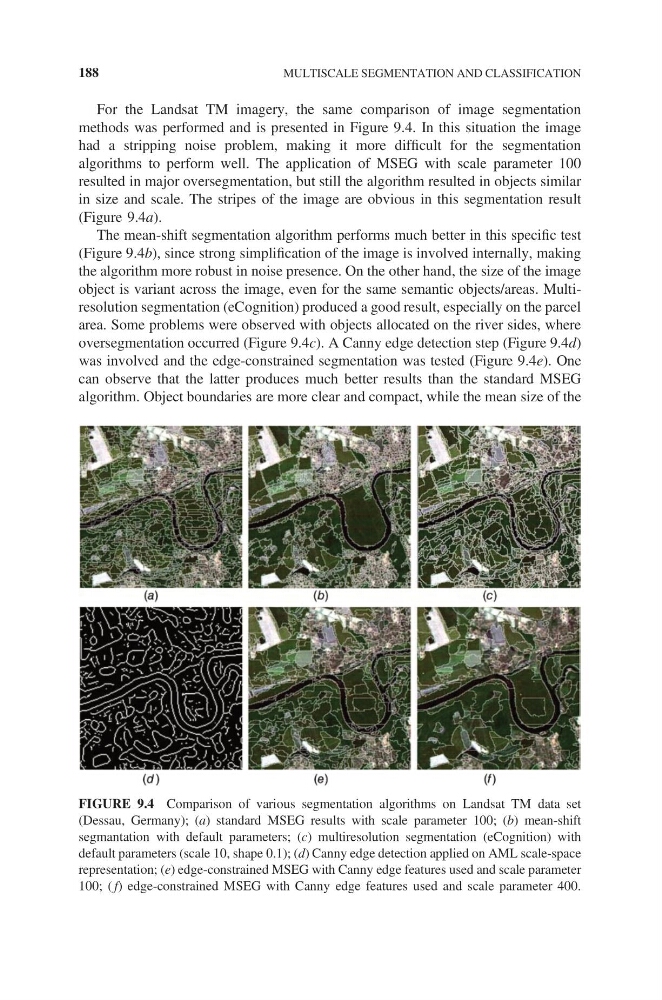
For the Landsat TM imagery, the same comparison of image segmentation
methods was performed and is presented in Figure 9.4. In this situation the image
had a stripping noise problem, making it more difficult for the segmentation
algorithms to perform well. The application of MSEG with scale parameter 100
resulted in major oversegmentation, but still the algorithm resulted in objects similar
in size and scale. The stripes of the image are obvious in this segmentation result
(Figure 9.4a).
The mean-shift segmentation algorithm performs much better in this specific test
(Figure 9.4b), since strong simplification of the image is involved internally, making
the algorithm more robust in noise presence. On the other hand, the size of the image
object is variant across the image, even for the same semantic objects/areas. Multiresolution segmentation (eCognition) produced a good result, especially on the parcel
area. Some problems were observed with objects allocated on the river sides, where
oversegmentation occurred (Figure 9.4c). A Canny edge detection step (Figure 9.4d)
was involved and the edge-constrained segmentation was tested (Figure 9.4e). One
can observe that the latter produces much better results than the standard MSEG
algorithm. Object boundaries are more clear and compact, while the mean size of the
FIGURE 9.4 Comparison of various segmentation algorithms on Landsat TM data set
(Dessau, Germany); (a) standard MSEG results with scale parameter 100; (b) mean-shift
segmantation with default parameters; (c) multiresolution segmentation (eCognition) with
default parameters (scale 10, shape 0.1); (d) Canny edge detection applied on AML scale-space
representation; (e) edge-constrained MSEG with Canny edge features used and scale parameter
100; ( f) edge-constrained MSEG with Canny edge features used and scale parameter 400.
188
MULTISCALE SEGMENTATION AND CLASSIFICATION
methods was performed and is presented in Figure 9.4. In this situation the image
had a stripping noise problem, making it more difficult for the segmentation
algorithms to perform well. The application of MSEG with scale parameter 100
resulted in major oversegmentation, but still the algorithm resulted in objects similar
in size and scale. The stripes of the image are obvious in this segmentation result
(Figure 9.4a).
The mean-shift segmentation algorithm performs much better in this specific test
(Figure 9.4b), since strong simplification of the image is involved internally, making
the algorithm more robust in noise presence. On the other hand, the size of the image
object is variant across the image, even for the same semantic objects/areas. Multiresolution segmentation (eCognition) produced a good result, especially on the parcel
area. Some problems were observed with objects allocated on the river sides, where
oversegmentation occurred (Figure 9.4c). A Canny edge detection step (Figure 9.4d)
was involved and the edge-constrained segmentation was tested (Figure 9.4e). One
can observe that the latter produces much better results than the standard MSEG
algorithm. Object boundaries are more clear and compact, while the mean size of the
FIGURE 9.4 Comparison of various segmentation algorithms on Landsat TM data set
(Dessau, Germany); (a) standard MSEG results with scale parameter 100; (b) mean-shift
segmantation with default parameters; (c) multiresolution segmentation (eCognition) with
default parameters (scale 10, shape 0.1); (d) Canny edge detection applied on AML scale-space
representation; (e) edge-constrained MSEG with Canny edge features used and scale parameter
100; ( f) edge-constrained MSEG with Canny edge features used and scale parameter 400.
188
MULTISCALE SEGMENTATION AND CLASSIFICATION