

images, which models the evolution of the original image through scale. Each
hierarchical layer in a stack represents convolution at a fixed scale, with the smallest
scale (i.e., finest object details) at the bottom and the largest scale (i.e., coarsest object
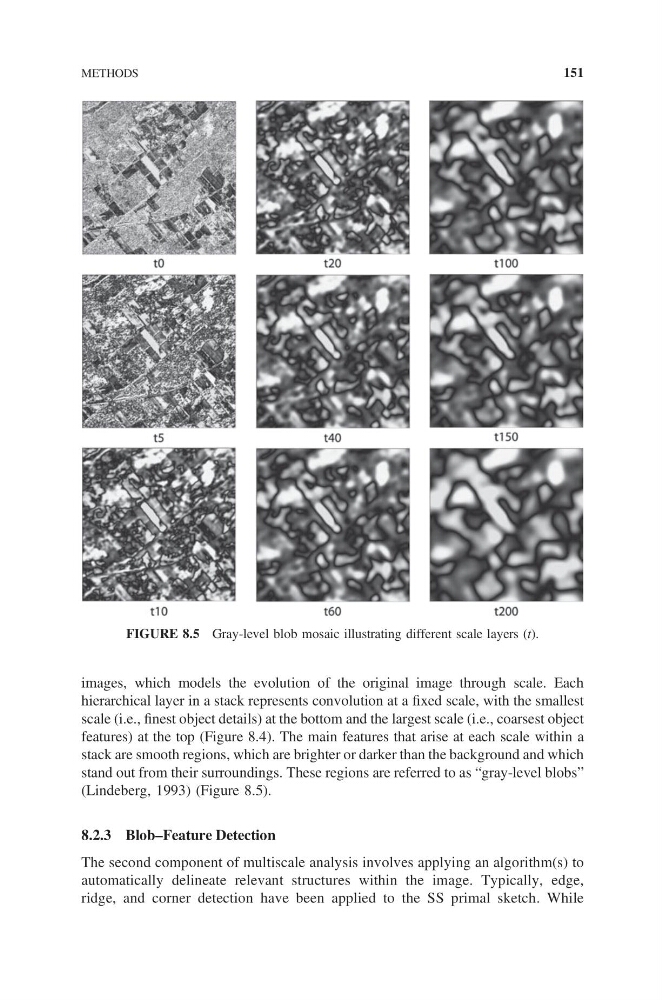
features) at the top (Figure 8.4). The main features that arise at each scale within a
stack are smooth regions, which are brighter or darker than the background and which
stand out from their surroundings. These regions are referred to as “gray-level blobs”
(Lindeberg, 1993) (Figure 8.5).
8.2.3 Blob–Feature Detection
The second component of multiscale analysis involves applying an algorithm(s) to
automatically delineate relevant structures within the image. Typically, edge,
ridge, and corner detection have been applied to the SS primal sketch. While
FIGURE 8.5 Gray-level blob mosaic illustrating different scale layers (t).
METHODS
151
hierarchical layer in a stack represents convolution at a fixed scale, with the smallest
scale (i.e., finest object details) at the bottom and the largest scale (i.e., coarsest object
features) at the top (Figure 8.4). The main features that arise at each scale within a
stack are smooth regions, which are brighter or darker than the background and which
stand out from their surroundings. These regions are referred to as “gray-level blobs”
(Lindeberg, 1993) (Figure 8.5).
8.2.3 Blob–Feature Detection
The second component of multiscale analysis involves applying an algorithm(s) to
automatically delineate relevant structures within the image. Typically, edge,
ridge, and corner detection have been applied to the SS primal sketch. While
FIGURE 8.5 Gray-level blob mosaic illustrating different scale layers (t).
METHODS
151