

input data at all (i.e., multiple) scales. Thus, the basic premise underlying SS is that
a multiscale representation of a signal (such as a remotely sensed image) is an
ordered set of derived signals showing structures at coarser scales that constitute
“simplifications” of corresponding structures at finer scales. Simplification results
from applying Gaussian filters to an initial image (i.e., the signal) at a range of
increasing kernel sizes resulting in a “scale-space primal sketch” or “stack” of
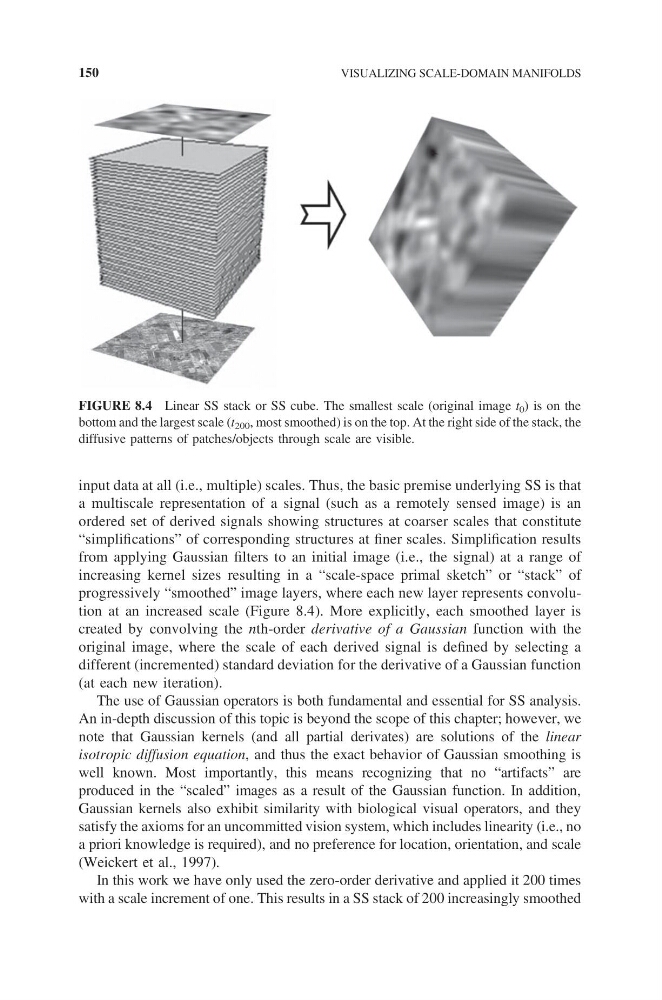
progressively “smoothed” image layers, where each new layer represents convolution at an increased scale (Figure 8.4). More explicitly, each smoothed layer is
created by convolving the nth-order derivative of a Gaussian function with the
original image, where the scale of each derived signal is defined by selecting a
different (incremented) standard deviation for the derivative of a Gaussian function
(at each new iteration).
The use of Gaussian operators is both fundamental and essential for SS analysis.
An in-depth discussion of this topic is beyond the scope of this chapter; however, we
note that Gaussian kernels (and all partial derivates) are solutions of the linear
isotropic diffusion equation, and thus the exact behavior of Gaussian smoothing is
well known. Most importantly, this means recognizing that no “artifacts” are
produced in the “scaled” images as a result of the Gaussian function. In addition,
Gaussian kernels also exhibit similarity with biological visual operators, and they
satisfy the axioms for an uncommitted vision system, which includes linearity (i.e., no
a priori knowledge is required), and no preference for location, orientation, and scale
(Weickert et al., 1997).
In this work we have only used the zero-order derivative and applied it 200 times
with a scale increment of one. This results in a SS stack of 200 increasingly smoothed
FIGURE 8.4 Linear SS stack or SS cube. The smallest scale (original image t 0 ) is on the
bottom and the largest scale (t 200 , most smoothed) is on the top. At the right side of the stack, the
diffusive patterns of patches/objects through scale are visible.
150
VISUALIZING SCALE-DOMAIN MANIFOLDS
a multiscale representation of a signal (such as a remotely sensed image) is an
ordered set of derived signals showing structures at coarser scales that constitute
“simplifications” of corresponding structures at finer scales. Simplification results
from applying Gaussian filters to an initial image (i.e., the signal) at a range of
increasing kernel sizes resulting in a “scale-space primal sketch” or “stack” of
progressively “smoothed” image layers, where each new layer represents convolution at an increased scale (Figure 8.4). More explicitly, each smoothed layer is
created by convolving the nth-order derivative of a Gaussian function with the
original image, where the scale of each derived signal is defined by selecting a
different (incremented) standard deviation for the derivative of a Gaussian function
(at each new iteration).
The use of Gaussian operators is both fundamental and essential for SS analysis.
An in-depth discussion of this topic is beyond the scope of this chapter; however, we
note that Gaussian kernels (and all partial derivates) are solutions of the linear
isotropic diffusion equation, and thus the exact behavior of Gaussian smoothing is
well known. Most importantly, this means recognizing that no “artifacts” are
produced in the “scaled” images as a result of the Gaussian function. In addition,
Gaussian kernels also exhibit similarity with biological visual operators, and they
satisfy the axioms for an uncommitted vision system, which includes linearity (i.e., no
a priori knowledge is required), and no preference for location, orientation, and scale
(Weickert et al., 1997).
In this work we have only used the zero-order derivative and applied it 200 times
with a scale increment of one. This results in a SS stack of 200 increasingly smoothed
FIGURE 8.4 Linear SS stack or SS cube. The smallest scale (original image t 0 ) is on the
bottom and the largest scale (t 200 , most smoothed) is on the top. At the right side of the stack, the
diffusive patterns of patches/objects through scale are visible.
150
VISUALIZING SCALE-DOMAIN MANIFOLDS