

decreasing in proportion to the square root of the sample size. Accuracy is the
deviation of the measured results from the true value, but in the case of some
biophysical variables, the true value is unknown. Therefore, increasing the precision
of a set of measurements by increasing sample size will not improve accuracy.
As an example, LAI is usually measured by optical devices such as the LICOR 2000
LAI meter, but this instrument has a built-in assumption that the canopy is uniform and
continuous over the measuring device. This assumption is violated in many natural
stands of plants, particularly when plants are widely spaced as in arid zones. Errors of
50% or greater are common in riparian zones and upland desert habitats (Nagler et al.,
2005c). Sap flux measurements of ET are subject to errors of up to 50% if not
individually calibrated for the plant and ecosystem of interest (Allen et al., 2011).
Moisture flux towers are subject to errors of up to 30% due to advection of energy from
adjacent ecosystems and the so-called closure error in the energy balance equations by
which ET is calculated from tower data (Allen et al., 2011). These are all examples of
“accuracy” errors since true LAI or ET values are not available. They cannot be reduced
by increasing sample size, but their magnitude can be assessed by using two or more
independent methods for estimating the same parameter.
5.3.3 Example of Multiple Sources of Measurements to Constrain
Accuracy of ET Estimates
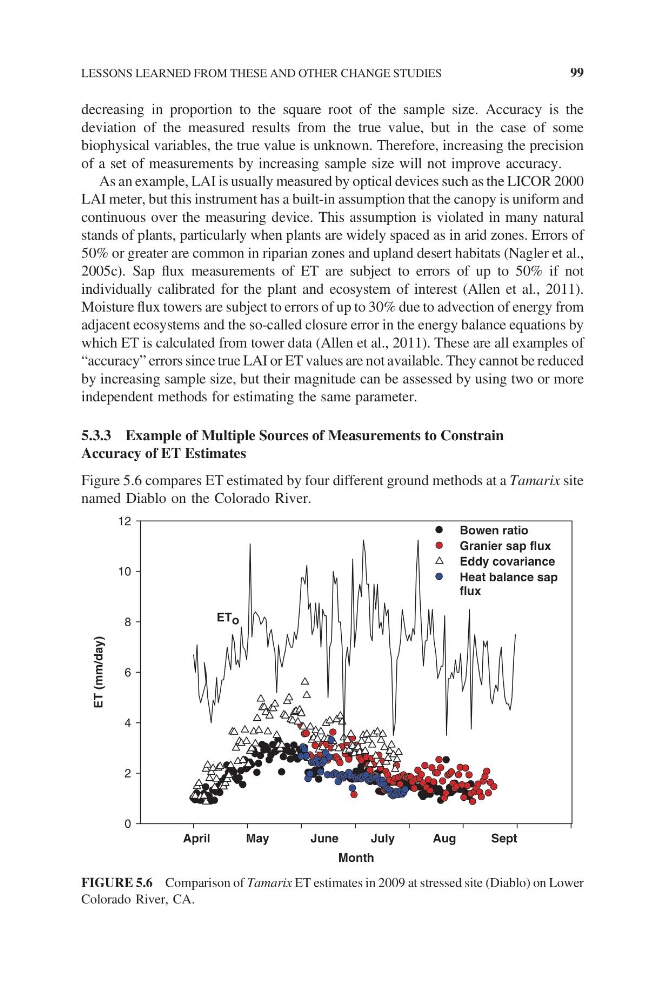
Figure 5.6 compares ET estimated by four different ground methods at a Tamarix site
named Diablo on the Colorado River.
Month
ET (mm/day)
0
2
4
6
8
10
12
Bowen ratio
Granier sap flux
Eddy covariance
Heat balance sap
flux
Sept
Aug
July
June
May
April
ET o
FIGURE 5.6 Comparison of Tamarix ET estimates in 2009 at stressed site (Diablo) on Lower
Colorado River, CA.
LESSONS LEARNED FROM THESE AND OTHER CHANGE STUDIES
99
deviation of the measured results from the true value, but in the case of some
biophysical variables, the true value is unknown. Therefore, increasing the precision
of a set of measurements by increasing sample size will not improve accuracy.
As an example, LAI is usually measured by optical devices such as the LICOR 2000
LAI meter, but this instrument has a built-in assumption that the canopy is uniform and
continuous over the measuring device. This assumption is violated in many natural
stands of plants, particularly when plants are widely spaced as in arid zones. Errors of
50% or greater are common in riparian zones and upland desert habitats (Nagler et al.,
2005c). Sap flux measurements of ET are subject to errors of up to 50% if not
individually calibrated for the plant and ecosystem of interest (Allen et al., 2011).
Moisture flux towers are subject to errors of up to 30% due to advection of energy from
adjacent ecosystems and the so-called closure error in the energy balance equations by
which ET is calculated from tower data (Allen et al., 2011). These are all examples of
“accuracy” errors since true LAI or ET values are not available. They cannot be reduced
by increasing sample size, but their magnitude can be assessed by using two or more
independent methods for estimating the same parameter.
5.3.3 Example of Multiple Sources of Measurements to Constrain
Accuracy of ET Estimates
Figure 5.6 compares ET estimated by four different ground methods at a Tamarix site
named Diablo on the Colorado River.
Month
ET (mm/day)
0
2
4
6
8
10
12
Bowen ratio
Granier sap flux
Eddy covariance
Heat balance sap
flux
Sept
Aug
July
June
May
April
ET o
FIGURE 5.6 Comparison of Tamarix ET estimates in 2009 at stressed site (Diablo) on Lower
Colorado River, CA.
LESSONS LEARNED FROM THESE AND OTHER CHANGE STUDIES
99