

The distribution of diversity: challenges and applications
81
if, for example, you are keen to develop a standard
international approach to designating important sites
for conservation (e.g. within the European Union).
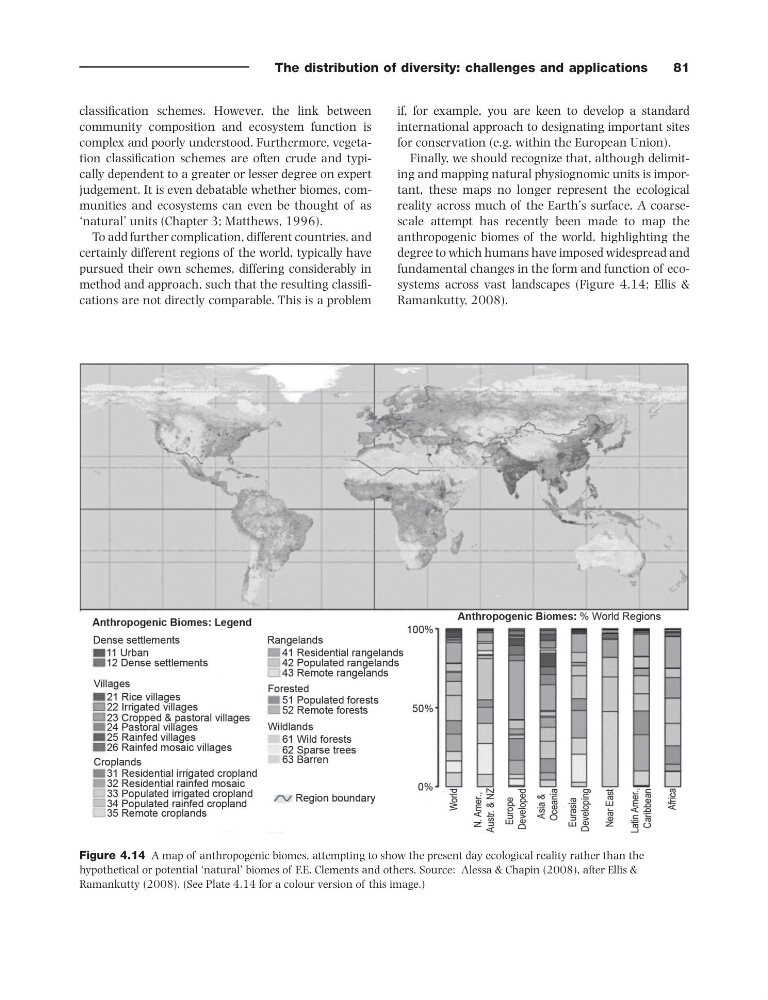
Finally, we should recognize that, although delimiting and mapping natural physiognomic units is important, these maps no longer represent the ecological
reality across much of the Earth ’ s surface. A coarse -
scale attempt has recently been made to map the
anthropogenic biomes of the world, highlighting the
degree to which humans have imposed widespread and
fundamental changes in the form and function of ecosystems across vast landscapes (Figure 4.14 ; Ellis &
Ramankutty, 2008 ).
classifi cation schemes. However, the link between
community composition and ecosystem function is
complex and poorly understood. Furthermore, vegetation classifi cation schemes are often crude and typically dependent to a greater or lesser degree on expert
judgement. It is even debatable whether biomes, communities and ecosystems can even be thought of as
‘ natural ’ units (Chapter 3 ; Matthews, 1996 ).
To add further complication, different countries, and
certainly different regions of the world, typically have
pursued their own schemes, differing considerably in
method and approach, such that the resulting classifi -
cations are not directly comparable. This is a problem
Figure 4.14 A map of anthropogenic biomes, attempting to show the present day ecological reality rather than the
hypothetical or potential ‘ natural ’ biomes of F.E. Clements and others. Source: Alessa & Chapin (2008) , after Ellis &
Ramankutty (2008) . (See Plate 4.14 for a colour version of this image.)
81
if, for example, you are keen to develop a standard
international approach to designating important sites
for conservation (e.g. within the European Union).
Finally, we should recognize that, although delimiting and mapping natural physiognomic units is important, these maps no longer represent the ecological
reality across much of the Earth ’ s surface. A coarse -
scale attempt has recently been made to map the
anthropogenic biomes of the world, highlighting the
degree to which humans have imposed widespread and
fundamental changes in the form and function of ecosystems across vast landscapes (Figure 4.14 ; Ellis &
Ramankutty, 2008 ).
classifi cation schemes. However, the link between
community composition and ecosystem function is
complex and poorly understood. Furthermore, vegetation classifi cation schemes are often crude and typically dependent to a greater or lesser degree on expert
judgement. It is even debatable whether biomes, communities and ecosystems can even be thought of as
‘ natural ’ units (Chapter 3 ; Matthews, 1996 ).
To add further complication, different countries, and
certainly different regions of the world, typically have
pursued their own schemes, differing considerably in
method and approach, such that the resulting classifi -
cations are not directly comparable. This is a problem
Figure 4.14 A map of anthropogenic biomes, attempting to show the present day ecological reality rather than the
hypothetical or potential ‘ natural ’ biomes of F.E. Clements and others. Source: Alessa & Chapin (2008) , after Ellis &
Ramankutty (2008) . (See Plate 4.14 for a colour version of this image.)