

74
Basic biogeography: estimating biodiversity and mapping nature
regions (below) is, in essence, an application of the
same concept.
Within conservation biogeography, scientists are
commonly interested in identifying areas that possess
exceptional concentrations of species richness and
endemism (also known as centres of richness and
endemism – CORE areas) for conservation prioritization, with most emphasis being given to endemics. In
this sense, endemism has agency. In short, the possession of one or more endemic species, signifying something unique, can make a big political difference to
resource allocation and prioritization efforts. This can
work at a coarse scale with many endemics, or at a very
local scale with one or two.
For example, the Conservation International (CI)
hotspots scheme (Myers et al ., 2000 ) is based on two
criteria: identifying areas of the world possessing more
than 0.5 per cent of the world ’ s plant species as endemics (assuming a global total of 300,000 species);
and areas that have lost more than 70 per cent of
their natural vegetation. Their approach of focusing
resources within hotspots (a so - called ‘ silver bullet ’
strategy) sold well in the biodiversity funding marketplace and attracted huge levels of donations to their
organization (Chapter 5 ; Myers, 2003 ).
At a fi ner scale, Mace (2004) suggests that some
decisions regarding whether a taxonomic group warrants full species or merely sub - species/variety status
can be infl uenced by the perceived need to maintain
or enhance the level of protection it receives. For
example, Karl & Bowen (1999) describe how the black
Generally, phylogeographical analyses are producing novel and important insights into the distribution
of biodiversity hotspots across the Earth and the role
of biogeographical histories in producing them, in terrestrial systems such as Australian rain forests (Moritz
et al ., 2005 ), Brazilian Atlantic forest (Carnaval et al .,
2009 ), Amazonian rain forest (Moritz et al ., 2000 ), the
South African Cape region (Tolley et al ., 2009 ) and
marine realms (Rocha et al ., 2007 ). This supports
Avise ’ s contention that the elucidation of intraspecifi c
patterns of biodiversity will continue to become
increasingly important in supplying units for conservation decision - makers.
4.4.3 Endemism
The term ‘ endemic ’ implies that for a given area, a
species (or other taxonomic entity) is naturally confi ned only to that area. Although some argue for its
application to a particular scale of analysis, most
accept that the term can be applied on any scale to any
size of region. Hence, a species could be endemic to
northern parts of America and Eurasia (thus straddling two continents), or could be restricted to an
island region such as Macaronesia, or to the Canaries
(a constituent archipelago), a single island such as
Tenerife, or to a particular massif within Tenerife. It
follows that endemism can be summed for regions of
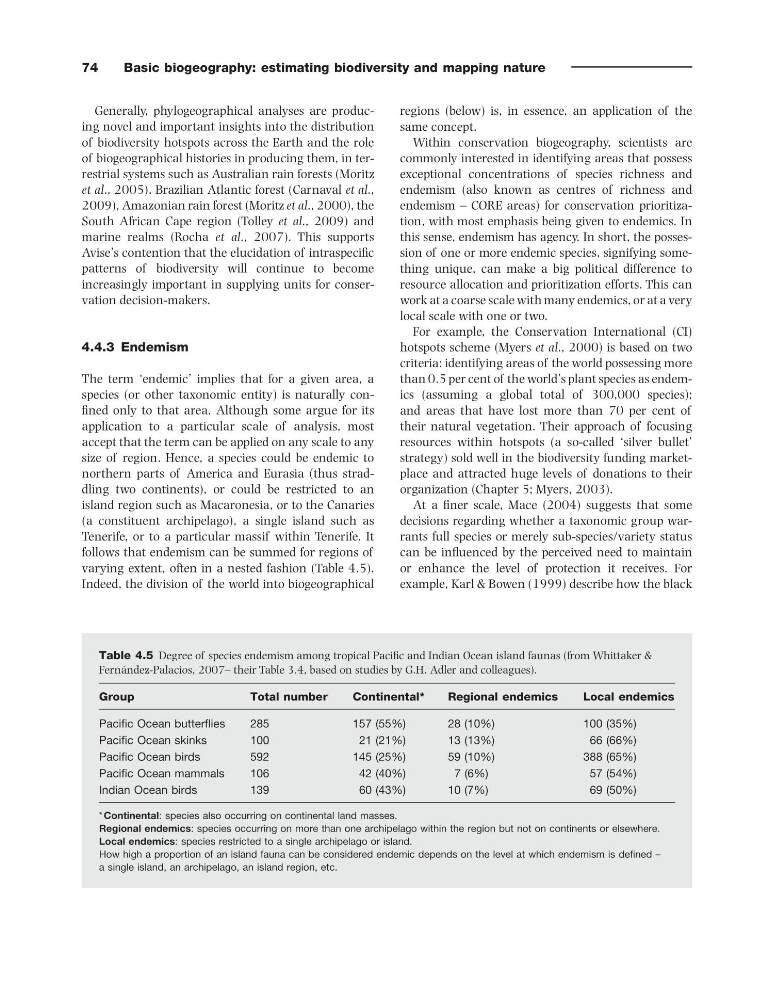
varying extent, often in a nested fashion (Table 4.5 ).
Indeed, the division of the world into biogeographical
Table 4.5 Degree of species endemism among tropical Pacifi c and Indian Ocean island faunas (from Whittaker &
Fern á ndez - Palacios, 2007 – their Table 3.4, based on studies by G.H. Adler and colleagues) .
Group
Total number
Continental *
Regional endemics
Local endemics
Pacifi c Ocean butterfl ies
285
157 (55%)
28 (10%)
100 (35%)
Pacifi c Ocean skinks
100
21 (21%)
13 (13%)
66 (66%)
Pacifi c Ocean birds
592
145 (25%)
59 (10%)
388 (65%)
Pacifi c Ocean mammals
106
42 (40%)
7 (6%)
57 (54%)
Indian Ocean birds
139
60 (43%)
10 (7%)
69 (50%)
* Continental : species also occurring on continental land masses.
Regional endemics : species occurring on more than one archipelago within the region but not on continents or elsewhere.
Local endemics : species restricted to a single archipelago or island.
How high a proportion of an island fauna can be considered endemic depends on the level at which endemism is defi ned –
a single island, an archipelago, an island region, etc.
Basic biogeography: estimating biodiversity and mapping nature
regions (below) is, in essence, an application of the
same concept.
Within conservation biogeography, scientists are
commonly interested in identifying areas that possess
exceptional concentrations of species richness and
endemism (also known as centres of richness and
endemism – CORE areas) for conservation prioritization, with most emphasis being given to endemics. In
this sense, endemism has agency. In short, the possession of one or more endemic species, signifying something unique, can make a big political difference to
resource allocation and prioritization efforts. This can
work at a coarse scale with many endemics, or at a very
local scale with one or two.
For example, the Conservation International (CI)
hotspots scheme (Myers et al ., 2000 ) is based on two
criteria: identifying areas of the world possessing more
than 0.5 per cent of the world ’ s plant species as endemics (assuming a global total of 300,000 species);
and areas that have lost more than 70 per cent of
their natural vegetation. Their approach of focusing
resources within hotspots (a so - called ‘ silver bullet ’
strategy) sold well in the biodiversity funding marketplace and attracted huge levels of donations to their
organization (Chapter 5 ; Myers, 2003 ).
At a fi ner scale, Mace (2004) suggests that some
decisions regarding whether a taxonomic group warrants full species or merely sub - species/variety status
can be infl uenced by the perceived need to maintain
or enhance the level of protection it receives. For
example, Karl & Bowen (1999) describe how the black
Generally, phylogeographical analyses are producing novel and important insights into the distribution
of biodiversity hotspots across the Earth and the role
of biogeographical histories in producing them, in terrestrial systems such as Australian rain forests (Moritz
et al ., 2005 ), Brazilian Atlantic forest (Carnaval et al .,
2009 ), Amazonian rain forest (Moritz et al ., 2000 ), the
South African Cape region (Tolley et al ., 2009 ) and
marine realms (Rocha et al ., 2007 ). This supports
Avise ’ s contention that the elucidation of intraspecifi c
patterns of biodiversity will continue to become
increasingly important in supplying units for conservation decision - makers.
4.4.3 Endemism
The term ‘ endemic ’ implies that for a given area, a
species (or other taxonomic entity) is naturally confi ned only to that area. Although some argue for its
application to a particular scale of analysis, most
accept that the term can be applied on any scale to any
size of region. Hence, a species could be endemic to
northern parts of America and Eurasia (thus straddling two continents), or could be restricted to an
island region such as Macaronesia, or to the Canaries
(a constituent archipelago), a single island such as
Tenerife, or to a particular massif within Tenerife. It
follows that endemism can be summed for regions of
varying extent, often in a nested fashion (Table 4.5 ).
Indeed, the division of the world into biogeographical
Table 4.5 Degree of species endemism among tropical Pacifi c and Indian Ocean island faunas (from Whittaker &
Fern á ndez - Palacios, 2007 – their Table 3.4, based on studies by G.H. Adler and colleagues) .
Group
Total number
Continental *
Regional endemics
Local endemics
Pacifi c Ocean butterfl ies
285
157 (55%)
28 (10%)
100 (35%)
Pacifi c Ocean skinks
100
21 (21%)
13 (13%)
66 (66%)
Pacifi c Ocean birds
592
145 (25%)
59 (10%)
388 (65%)
Pacifi c Ocean mammals
106
42 (40%)
7 (6%)
57 (54%)
Indian Ocean birds
139
60 (43%)
10 (7%)
69 (50%)
* Continental : species also occurring on continental land masses.
Regional endemics : species occurring on more than one archipelago within the region but not on continents or elsewhere.
Local endemics : species restricted to a single archipelago or island.
How high a proportion of an island fauna can be considered endemic depends on the level at which endemism is defi ned –
a single island, an archipelago, an island region, etc.