

The distribution of diversity: challenges and applications
73
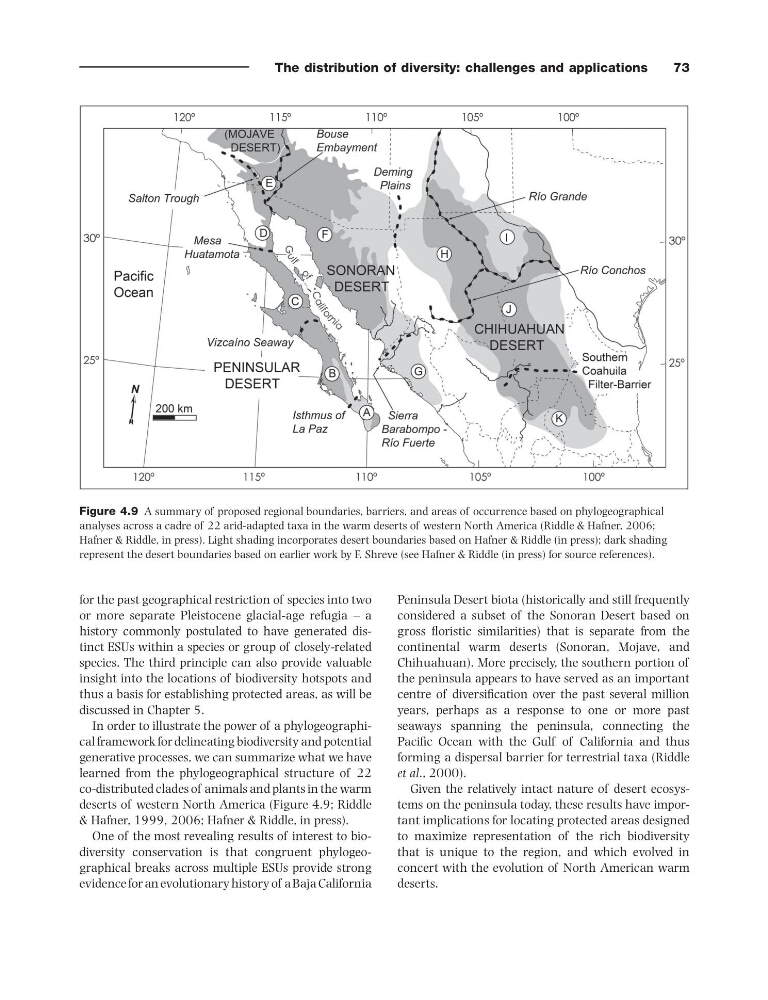
Figure 4.9 A summary of proposed regional boundaries, barriers, and areas of occurrence based on phylogeographical
analyses across a cadre of 22 arid - adapted taxa in the warm deserts of western North America (Riddle & Hafner, 2006 ;
Hafner & Riddle, in press ). Light shading incorporates desert boundaries based on Hafner & Riddle (in press) ; dark shading
represent the desert boundaries based on earlier work by F. Shreve (see Hafner & Riddle (in press) for source references).
for the past geographical restriction of species into two
or more separate Pleistocene glacial - age refugia – a
history commonly postulated to have generated distinct ESUs within a species or group of closely - related
species. The third principle can also provide valuable
insight into the locations of biodiversity hotspots and
thus a basis for establishing protected areas, as will be
discussed in Chapter 5 .
In order to illustrate the power of a phylogeographical framework for delineating biodiversity and potential
generative processes, we can summarize what we have
learned from the phylogeographical structure of 22
co - distributed clades of animals and plants in the warm
deserts of western North America (Figure 4.9 ; Riddle
& Hafner, 1999, 2006 ; Hafner & Riddle, in press ).
One of the most revealing results of interest to biodiversity conservation is that congruent phylogeographical breaks across multiple ESUs provide strong
evidence for an evolutionary history of a Baja California
Peninsula Desert biota (historically and still frequently
considered a subset of the Sonoran Desert based on
gross fl oristic similarities) that is separate from the
continental warm deserts (Sonoran, Mojave, and
Chihuahuan). More precisely, the southern portion of
the peninsula appears to have served as an important
centre of diversifi cation over the past several million
years, perhaps as a response to one or more past
seaways spanning the peninsula, connecting the
Pacifi c Ocean with the Gulf of California and thus
forming a dispersal barrier for terrestrial taxa (Riddle
et al ., 2000 ).
Given the relatively intact nature of desert ecosystems on the peninsula today, these results have important implications for locating protected areas designed
to maximize representation of the rich biodiversity
that is unique to the region, and which evolved in
concert with the evolution of North American warm
deserts.
73
Figure 4.9 A summary of proposed regional boundaries, barriers, and areas of occurrence based on phylogeographical
analyses across a cadre of 22 arid - adapted taxa in the warm deserts of western North America (Riddle & Hafner, 2006 ;
Hafner & Riddle, in press ). Light shading incorporates desert boundaries based on Hafner & Riddle (in press) ; dark shading
represent the desert boundaries based on earlier work by F. Shreve (see Hafner & Riddle (in press) for source references).
for the past geographical restriction of species into two
or more separate Pleistocene glacial - age refugia – a
history commonly postulated to have generated distinct ESUs within a species or group of closely - related
species. The third principle can also provide valuable
insight into the locations of biodiversity hotspots and
thus a basis for establishing protected areas, as will be
discussed in Chapter 5 .
In order to illustrate the power of a phylogeographical framework for delineating biodiversity and potential
generative processes, we can summarize what we have
learned from the phylogeographical structure of 22
co - distributed clades of animals and plants in the warm
deserts of western North America (Figure 4.9 ; Riddle
& Hafner, 1999, 2006 ; Hafner & Riddle, in press ).
One of the most revealing results of interest to biodiversity conservation is that congruent phylogeographical breaks across multiple ESUs provide strong
evidence for an evolutionary history of a Baja California
Peninsula Desert biota (historically and still frequently
considered a subset of the Sonoran Desert based on
gross fl oristic similarities) that is separate from the
continental warm deserts (Sonoran, Mojave, and
Chihuahuan). More precisely, the southern portion of
the peninsula appears to have served as an important
centre of diversifi cation over the past several million
years, perhaps as a response to one or more past
seaways spanning the peninsula, connecting the
Pacifi c Ocean with the Gulf of California and thus
forming a dispersal barrier for terrestrial taxa (Riddle
et al ., 2000 ).
Given the relatively intact nature of desert ecosystems on the peninsula today, these results have important implications for locating protected areas designed
to maximize representation of the rich biodiversity
that is unique to the region, and which evolved in
concert with the evolution of North American warm
deserts.