

The distribution of diversity: challenges and applications
71
Figure 4.8 Predicted distributions of the cryptozoogeographical entity known as bigfoot (sasquatch) constructed from all
available encounter data using the modelling method MAXENT (a) for the present climate and (b) under a possible climate -
change scenario involving a doubling of atmospheric CO 2 levels. Results are presented for logistic probabilities of occurrence
ranging continuously from low (white) to high (black). Differences between (a) and (b) are shown in (c) , with whiter values
refl ecting a decline in probability of occurrence under climate change, darker values refl ecting a gain, and grey refl ecting no
change. A predicted distribution of the bear Ursus americanus in western North America under a present - day climate is also
shown (d) . White points indicate sampling localities in California, Oregon and Washington (n = 113 for training, 28 for
testing; compare with Figure 4.7 ) used for the MAXENT model with shading as in (a) and (b) ; black points indicate additional
known records not included in the model.
From Lozier et al. ( 2009 , their Figure 2).
71
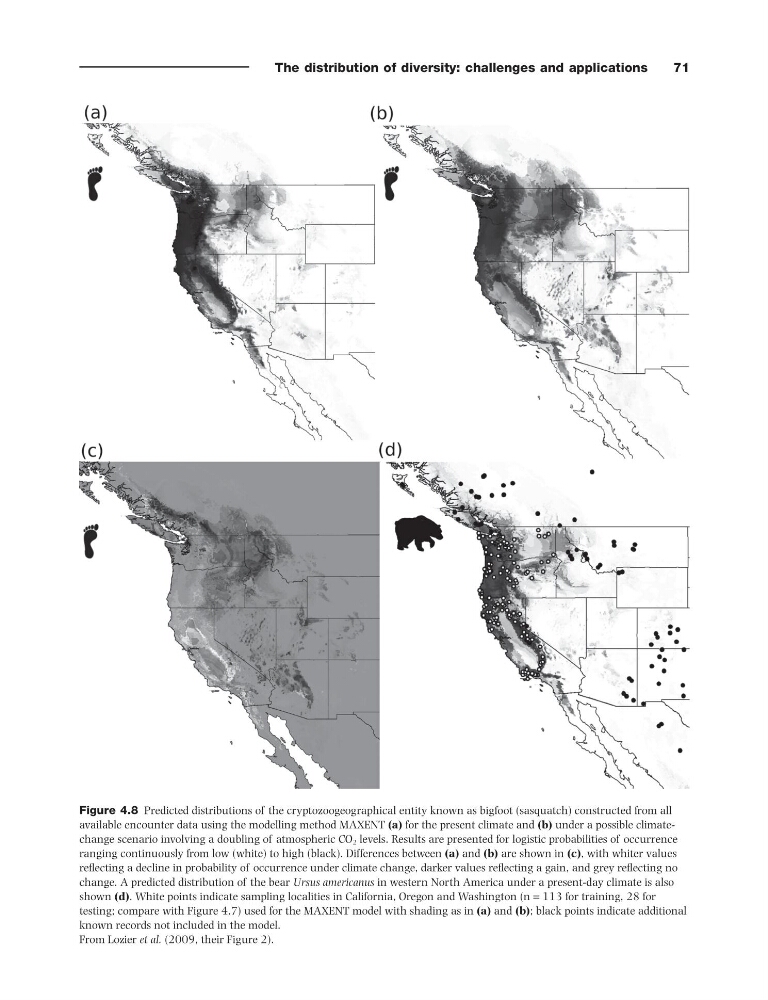
Figure 4.8 Predicted distributions of the cryptozoogeographical entity known as bigfoot (sasquatch) constructed from all
available encounter data using the modelling method MAXENT (a) for the present climate and (b) under a possible climate -
change scenario involving a doubling of atmospheric CO 2 levels. Results are presented for logistic probabilities of occurrence
ranging continuously from low (white) to high (black). Differences between (a) and (b) are shown in (c) , with whiter values
refl ecting a decline in probability of occurrence under climate change, darker values refl ecting a gain, and grey refl ecting no
change. A predicted distribution of the bear Ursus americanus in western North America under a present - day climate is also
shown (d) . White points indicate sampling localities in California, Oregon and Washington (n = 113 for training, 28 for
testing; compare with Figure 4.7 ) used for the MAXENT model with shading as in (a) and (b) ; black points indicate additional
known records not included in the model.
From Lozier et al. ( 2009 , their Figure 2).