

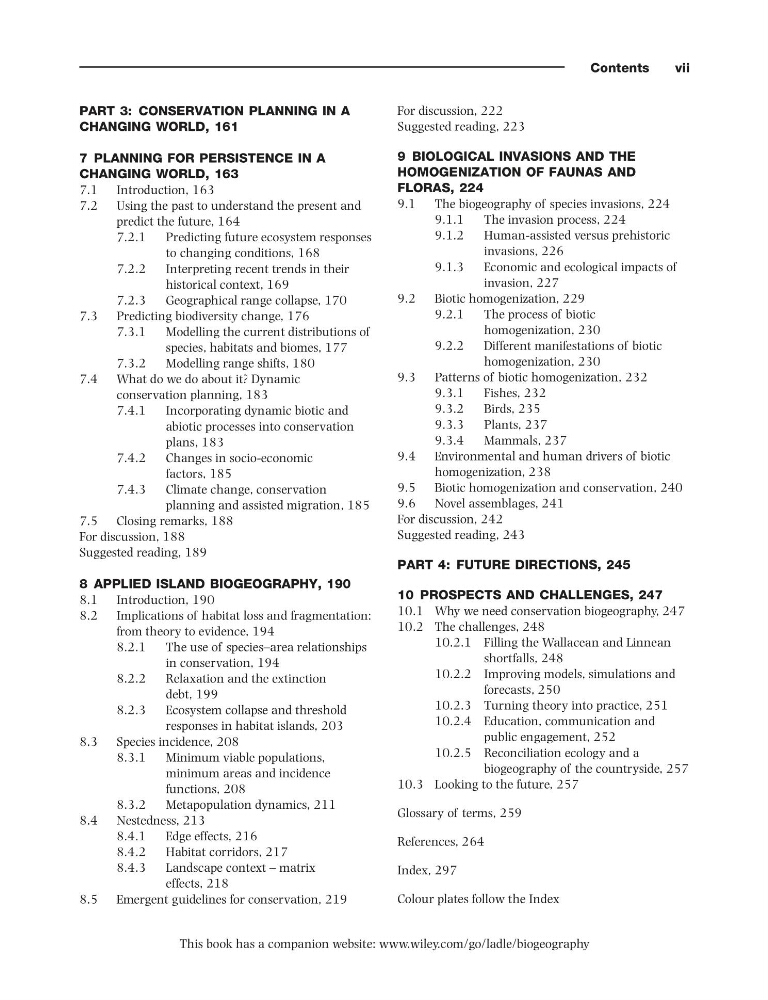
Contents
vii
PART 3: CONSERVATION PLANNING IN A
CHANGING WORLD, 161
7 PLANNING FOR PERSISTENCE IN A
CHANGING WORLD, 163
7.1 Introduction, 163
7.2 Using the past to understand the present and
predict the future, 164
7.2.1
Predicting future ecosystem responses
to changing conditions, 168
7.2.2
Interpreting recent trends in their
historical context, 169
7.2.3
Geographical range collapse, 170
7.3 Predicting biodiversity change, 176
7.3.1
Modelling the current distributions of
species, habitats and biomes, 177
7.3.2
Modelling range shifts, 180
7.4 What do we do about it? Dynamic
conservation planning, 183
7.4.1
Incorporating dynamic biotic and
abiotic processes into conservation
plans, 183
7.4.2
Changes in socio-economic
factors, 185
7.4.3
Climate change, conservation
planning and assisted migration, 185
7.5 Closing remarks, 188
For discussion, 188
Suggested reading, 189
8 APPLIED ISLAND BIOGEOGRAPHY, 190
8.1 Introduction, 190
8.2 Implications of habitat loss and fragmentation:
from theory to evidence, 194
8.2.1
The use of species–area relationships
in conservation, 194
8.2.2
Relaxation and the extinction
debt, 199
8.2.3
Ecosystem collapse and threshold
responses in habitat islands, 203
8.3 Species incidence, 208
8.3.1
Minimum viable populations,
minimum areas and incidence
functions, 208
8.3.2
Metapopulation dynamics, 211
8.4 Nestedness, 213
8.4.1
Edge effects, 216
8.4.2
Habitat corridors, 217
8.4.3
Landscape context – matrix
effects, 218
8.5 Emergent guidelines for conservation, 219
For discussion, 222
Suggested reading, 223
9 BIOLOGICAL INVASIONS AND THE
HOMOGENIZATION OF FAUNAS AND
FLORAS, 224
9.1 The biogeography of species invasions, 224
9.1.1
The invasion process, 224
9.1.2
Human-assisted versus prehistoric
invasions, 226
9.1.3
Economic and ecological impacts of
invasion, 227
9.2 Biotic homogenization, 229
9.2.1
The process of biotic
homogenization, 230
9.2.2
Different manifestations of biotic
homogenization, 230
9.3 Patterns of biotic homogenization, 232
9.3.1
Fishes, 232
9.3.2
Birds, 235
9.3.3
Plants, 237
9.3.4
Mammals, 237
9.4 Environmental and human drivers of biotic
homogenization, 238
9.5 Biotic homogenization and conservation, 240
9.6 Novel assemblages, 241
For discussion, 242
Suggested reading, 243
PART 4: FUTURE DIRECTIONS, 245
10 PROSPECTS AND CHALLENGES, 247
10.1 Why we need conservation biogeography, 247
10.2 The challenges, 248
10.2.1 Filling the Wallacean and Linnean
shortfalls, 248
10.2.2 Improving models, simulations and
forecasts, 250
10.2.3 Turning theory into practice, 251
10.2.4 Education, communication and
public engagement, 252
10.2.5 Reconciliation ecology and a
biogeography of the countryside, 257
10.3 Looking to the future, 257
Glossary of terms, 259
References, 264
Index, 297
Colour plates follow the Index
This book has a companion website: www.wiley.com/go/ladle/biogeography
vii
PART 3: CONSERVATION PLANNING IN A
CHANGING WORLD, 161
7 PLANNING FOR PERSISTENCE IN A
CHANGING WORLD, 163
7.1 Introduction, 163
7.2 Using the past to understand the present and
predict the future, 164
7.2.1
Predicting future ecosystem responses
to changing conditions, 168
7.2.2
Interpreting recent trends in their
historical context, 169
7.2.3
Geographical range collapse, 170
7.3 Predicting biodiversity change, 176
7.3.1
Modelling the current distributions of
species, habitats and biomes, 177
7.3.2
Modelling range shifts, 180
7.4 What do we do about it? Dynamic
conservation planning, 183
7.4.1
Incorporating dynamic biotic and
abiotic processes into conservation
plans, 183
7.4.2
Changes in socio-economic
factors, 185
7.4.3
Climate change, conservation
planning and assisted migration, 185
7.5 Closing remarks, 188
For discussion, 188
Suggested reading, 189
8 APPLIED ISLAND BIOGEOGRAPHY, 190
8.1 Introduction, 190
8.2 Implications of habitat loss and fragmentation:
from theory to evidence, 194
8.2.1
The use of species–area relationships
in conservation, 194
8.2.2
Relaxation and the extinction
debt, 199
8.2.3
Ecosystem collapse and threshold
responses in habitat islands, 203
8.3 Species incidence, 208
8.3.1
Minimum viable populations,
minimum areas and incidence
functions, 208
8.3.2
Metapopulation dynamics, 211
8.4 Nestedness, 213
8.4.1
Edge effects, 216
8.4.2
Habitat corridors, 217
8.4.3
Landscape context – matrix
effects, 218
8.5 Emergent guidelines for conservation, 219
For discussion, 222
Suggested reading, 223
9 BIOLOGICAL INVASIONS AND THE
HOMOGENIZATION OF FAUNAS AND
FLORAS, 224
9.1 The biogeography of species invasions, 224
9.1.1
The invasion process, 224
9.1.2
Human-assisted versus prehistoric
invasions, 226
9.1.3
Economic and ecological impacts of
invasion, 227
9.2 Biotic homogenization, 229
9.2.1
The process of biotic
homogenization, 230
9.2.2
Different manifestations of biotic
homogenization, 230
9.3 Patterns of biotic homogenization, 232
9.3.1
Fishes, 232
9.3.2
Birds, 235
9.3.3
Plants, 237
9.3.4
Mammals, 237
9.4 Environmental and human drivers of biotic
homogenization, 238
9.5 Biotic homogenization and conservation, 240
9.6 Novel assemblages, 241
For discussion, 242
Suggested reading, 243
PART 4: FUTURE DIRECTIONS, 245
10 PROSPECTS AND CHALLENGES, 247
10.1 Why we need conservation biogeography, 247
10.2 The challenges, 248
10.2.1 Filling the Wallacean and Linnean
shortfalls, 248
10.2.2 Improving models, simulations and
forecasts, 250
10.2.3 Turning theory into practice, 251
10.2.4 Education, communication and
public engagement, 252
10.2.5 Reconciliation ecology and a
biogeography of the countryside, 257
10.3 Looking to the future, 257
Glossary of terms, 259
References, 264
Index, 297
Colour plates follow the Index
This book has a companion website: www.wiley.com/go/ladle/biogeography