

The distribution of diversity: challenges and applications
63
disjunct (non - overlapping, i.e. allopatric) populations
rarely have the opportunity to interbreed. Second, as
would be predicted under gradualist models of evolution, reproductive isolation is frequently incomplete.
For example, the oak species Quercus robur and Quercus
petraea sometimes interbreed and produce viable
progeny, yet seem to have maintained their biological
integrity over millions of years. In contrast, red deer
( Cervus elephas ) and introduced sika deer ( Cervus
nippon ) in the UK are now so interbred that it is diffi cult
to distinguish them in many localities. Other taxa,
such as the bdelloid rotifers, do not even reproduce
sexually (Welch & Meselson, 2000 ), rendering the BSC
meaningless.
The diffi culties encountered with trying to apply the
BSC have led to a number of new species concepts
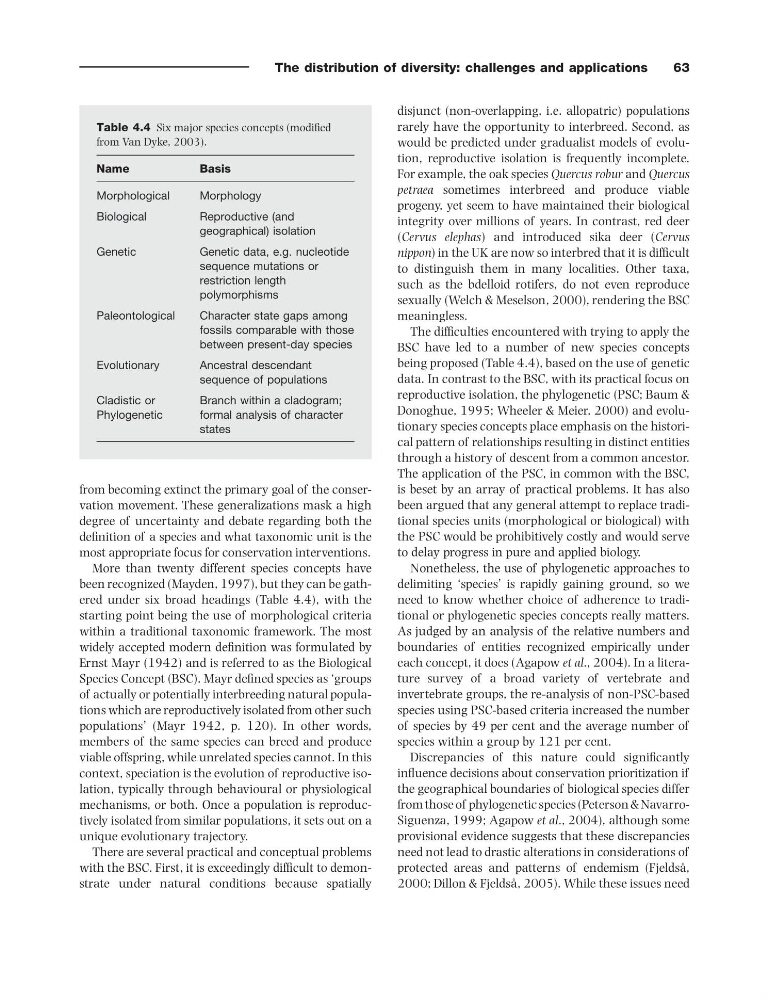
being proposed (Table 4.4 ), based on the use of genetic
data. In contrast to the BSC, with its practical focus on
reproductive isolation, the phylogenetic (PSC; Baum &
Donoghue, 1995 ; Wheeler & Meier, 2000 ) and evolutionary species concepts place emphasis on the historical pattern of relationships resulting in distinct entities
through a history of descent from a common ancestor.
The application of the PSC, in common with the BSC,
is beset by an array of practical problems. It has also
been argued that any general attempt to replace traditional species units (morphological or biological) with
the PSC would be prohibitively costly and would serve
to delay progress in pure and applied biology.
Nonetheless, the use of phylogenetic approaches to
delimiting ‘ species ’ is rapidly gaining ground, so we
need to know whether choice of adherence to traditional or phylogenetic species concepts really matters.
As judged by an analysis of the relative numbers and
boundaries of entities recognized empirically under
each concept, it does (Agapow et al ., 2004 ). In a literature survey of a broad variety of vertebrate and
invertebrate groups, the re - analysis of non - PSC - based
species using PSC - based criteria increased the number
of species by 49 per cent and the average number of
species within a group by 121 per cent.
Discrepancies of this nature could signifi cantly
infl uence decisions about conservation prioritization if
the geographical boundaries of biological species differ
from those of phylogenetic species (Peterson & Navarro -
Siguenza, 1999 ; Agapow et al ., 2004 ), although some
provisional evidence suggests that these discrepancies
need not lead to drastic alterations in considerations of
protected areas and patterns of endemism (Fjelds å ,
2000 ; Dillon & Fjelds å , 2005 ). While these issues need
from becoming extinct the primary goal of the conservation movement. These generalizations mask a high
degree of uncertainty and debate regarding both the
defi nition of a species and what taxonomic unit is the
most appropriate focus for conservation interventions.
More than twenty different species concepts have
been recognized (Mayden, 1997 ), but they can be gathered under six broad headings (Table 4.4 ), with the
starting point being the use of morphological criteria
within a traditional taxonomic framework. The most
widely accepted modern defi nition was formulated by
Ernst Mayr (1942) and is referred to as the Biological
Species Concept (BSC). Mayr defi ned species as ‘ groups
of actually or potentially interbreeding natural populations which are reproductively isolated from other such
populations ’ (Mayr 1942 , p. 120). In other words,
members of the same species can breed and produce
viable offspring, while unrelated species cannot. In this
context, speciation is the evolution of reproductive isolation, typically through behavioural or physiological
mechanisms, or both. Once a population is reproductively isolated from similar populations, it sets out on a
unique evolutionary trajectory.
There are several practical and conceptual problems
with the BSC. First, it is exceedingly diffi cult to demonstrate under natural conditions because spatially
Table 4.4 Six major species concepts (modifi ed
from Van Dyke, 2003 ) .
Name
Basis
Morphological
Morphology
Biological
Reproductive (and
geographical) isolation
Genetic
Genetic data, e.g. nucleotide
sequence mutations or
restriction length
polymorphisms
Paleontological
Character state gaps among
fossils comparable with those
between present - day species
Evolutionary
Ancestral descendant
sequence of populations
Cladistic or
Phylogenetic
Branch within a cladogram;
formal analysis of character
states
63
disjunct (non - overlapping, i.e. allopatric) populations
rarely have the opportunity to interbreed. Second, as
would be predicted under gradualist models of evolution, reproductive isolation is frequently incomplete.
For example, the oak species Quercus robur and Quercus
petraea sometimes interbreed and produce viable
progeny, yet seem to have maintained their biological
integrity over millions of years. In contrast, red deer
( Cervus elephas ) and introduced sika deer ( Cervus
nippon ) in the UK are now so interbred that it is diffi cult
to distinguish them in many localities. Other taxa,
such as the bdelloid rotifers, do not even reproduce
sexually (Welch & Meselson, 2000 ), rendering the BSC
meaningless.
The diffi culties encountered with trying to apply the
BSC have led to a number of new species concepts
being proposed (Table 4.4 ), based on the use of genetic
data. In contrast to the BSC, with its practical focus on
reproductive isolation, the phylogenetic (PSC; Baum &
Donoghue, 1995 ; Wheeler & Meier, 2000 ) and evolutionary species concepts place emphasis on the historical pattern of relationships resulting in distinct entities
through a history of descent from a common ancestor.
The application of the PSC, in common with the BSC,
is beset by an array of practical problems. It has also
been argued that any general attempt to replace traditional species units (morphological or biological) with
the PSC would be prohibitively costly and would serve
to delay progress in pure and applied biology.
Nonetheless, the use of phylogenetic approaches to
delimiting ‘ species ’ is rapidly gaining ground, so we
need to know whether choice of adherence to traditional or phylogenetic species concepts really matters.
As judged by an analysis of the relative numbers and
boundaries of entities recognized empirically under
each concept, it does (Agapow et al ., 2004 ). In a literature survey of a broad variety of vertebrate and
invertebrate groups, the re - analysis of non - PSC - based
species using PSC - based criteria increased the number
of species by 49 per cent and the average number of
species within a group by 121 per cent.
Discrepancies of this nature could signifi cantly
infl uence decisions about conservation prioritization if
the geographical boundaries of biological species differ
from those of phylogenetic species (Peterson & Navarro -
Siguenza, 1999 ; Agapow et al ., 2004 ), although some
provisional evidence suggests that these discrepancies
need not lead to drastic alterations in considerations of
protected areas and patterns of endemism (Fjelds å ,
2000 ; Dillon & Fjelds å , 2005 ). While these issues need
from becoming extinct the primary goal of the conservation movement. These generalizations mask a high
degree of uncertainty and debate regarding both the
defi nition of a species and what taxonomic unit is the
most appropriate focus for conservation interventions.
More than twenty different species concepts have
been recognized (Mayden, 1997 ), but they can be gathered under six broad headings (Table 4.4 ), with the
starting point being the use of morphological criteria
within a traditional taxonomic framework. The most
widely accepted modern defi nition was formulated by
Ernst Mayr (1942) and is referred to as the Biological
Species Concept (BSC). Mayr defi ned species as ‘ groups
of actually or potentially interbreeding natural populations which are reproductively isolated from other such
populations ’ (Mayr 1942 , p. 120). In other words,
members of the same species can breed and produce
viable offspring, while unrelated species cannot. In this
context, speciation is the evolution of reproductive isolation, typically through behavioural or physiological
mechanisms, or both. Once a population is reproductively isolated from similar populations, it sets out on a
unique evolutionary trajectory.
There are several practical and conceptual problems
with the BSC. First, it is exceedingly diffi cult to demonstrate under natural conditions because spatially
Table 4.4 Six major species concepts (modifi ed
from Van Dyke, 2003 ) .
Name
Basis
Morphological
Morphology
Biological
Reproductive (and
geographical) isolation
Genetic
Genetic data, e.g. nucleotide
sequence mutations or
restriction length
polymorphisms
Paleontological
Character state gaps among
fossils comparable with those
between present - day species
Evolutionary
Ancestral descendant
sequence of populations
Cladistic or
Phylogenetic
Branch within a cladogram;
formal analysis of character
states