

38
Baselines, patterns and process
rest of the world, perhaps because of the continued
existence of large wilderness areas, tend to use prehistoric baselines.
Behind these generalizations lies enormous variation in how baselines are chosen and used, as well as
an increasingly sophisticated understanding of their
power and limitations. Most importantly, conservationists have begun to appreciate the ramifi cations of
the shifting world view of the dynamism of natural
ecosystems.
3.5.1 Baselines d erived from r elict
p ristine s ystems
Clements ( 1934 , p. 42) defi ned an ecological relict as
a ‘ community or fragment of one that has survived
some important change, often to become in appearance an integral part of the existing vegetation ’ . Relict
communities can often be found in places that are very
isolated or diffi cult to access, such as cliffs, mountaintops and steep - sided valleys – typically places where
livestock grazing is diffi cult or impossible – and sometimes in refugia that were buffered from past climate
changes due to micro - climatic stability. These sites
have been extensively used both to assess the impacts
of direct or indirect human disturbance and, in some
3.5 DEFINING AND USING BASELINES
From a conservation perspective, ecological baselines
are static points in time and space from which ecological information, typically on species composition and
abundance (relative or absolute), can be compared
with contemporary sites for the purposes of assessing
anthropogenic impact/environmental change and
informing management decisions, or both. Baselines
are frequently derived from historical literature (e.g.
published studies or reports) or from palaeoecological
investigations, but may also be taken from ecologically
similar sites that are not subject to signifi cant levels of
human impact (Arcese & Sinclair, 1997 ).
The choice of baseline, and the way in which it is
used to inform management, can have a profound
infl uence on the ecology of a protected area. For
example, choice of a baseline from the 1970s, pre -
industrial or pre - human colonization could profoundly
change biodiversity targets, plans for reintroduction
and the level of resources required to achieve the conservation objectives. Generally speaking, European
conservation has tended to favour the use of pre -
industrial baselines that refl ect a deeply rooted
yearning for a lost pastoral idyll (see Chapter 2 ).
Conservationists in North America and most of the
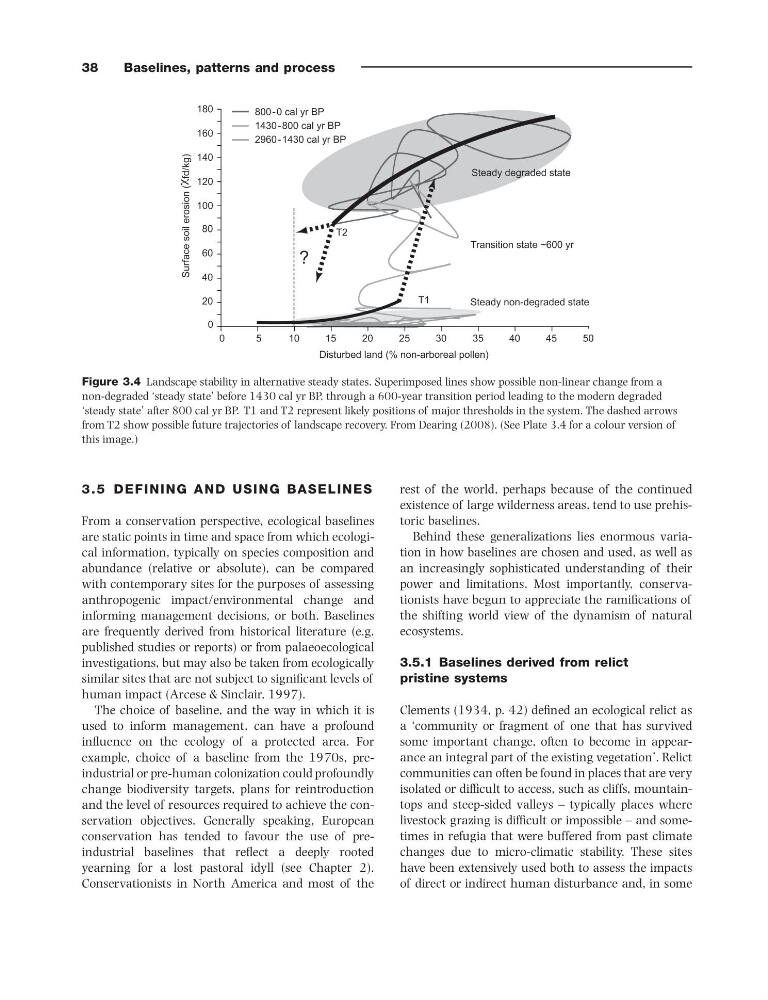
Figure 3.4 Landscape stability in alternative steady states. Superimposed lines show possible non - linear change from a
non - degraded ‘ steady state ’ before 1430 cal yr BP, through a 600 - year transition period leading to the modern degraded
‘ steady state ’ after 800 cal yr BP. T1 and T2 represent likely positions of major thresholds in the system. The dashed arrows
from T2 show possible future trajectories of landscape recovery. From Dearing (2008) . (See Plate 3.4 for a colour version of
this image.)
Baselines, patterns and process
rest of the world, perhaps because of the continued
existence of large wilderness areas, tend to use prehistoric baselines.
Behind these generalizations lies enormous variation in how baselines are chosen and used, as well as
an increasingly sophisticated understanding of their
power and limitations. Most importantly, conservationists have begun to appreciate the ramifi cations of
the shifting world view of the dynamism of natural
ecosystems.
3.5.1 Baselines d erived from r elict
p ristine s ystems
Clements ( 1934 , p. 42) defi ned an ecological relict as
a ‘ community or fragment of one that has survived
some important change, often to become in appearance an integral part of the existing vegetation ’ . Relict
communities can often be found in places that are very
isolated or diffi cult to access, such as cliffs, mountaintops and steep - sided valleys – typically places where
livestock grazing is diffi cult or impossible – and sometimes in refugia that were buffered from past climate
changes due to micro - climatic stability. These sites
have been extensively used both to assess the impacts
of direct or indirect human disturbance and, in some
3.5 DEFINING AND USING BASELINES
From a conservation perspective, ecological baselines
are static points in time and space from which ecological information, typically on species composition and
abundance (relative or absolute), can be compared
with contemporary sites for the purposes of assessing
anthropogenic impact/environmental change and
informing management decisions, or both. Baselines
are frequently derived from historical literature (e.g.
published studies or reports) or from palaeoecological
investigations, but may also be taken from ecologically
similar sites that are not subject to signifi cant levels of
human impact (Arcese & Sinclair, 1997 ).
The choice of baseline, and the way in which it is
used to inform management, can have a profound
infl uence on the ecology of a protected area. For
example, choice of a baseline from the 1970s, pre -
industrial or pre - human colonization could profoundly
change biodiversity targets, plans for reintroduction
and the level of resources required to achieve the conservation objectives. Generally speaking, European
conservation has tended to favour the use of pre -
industrial baselines that refl ect a deeply rooted
yearning for a lost pastoral idyll (see Chapter 2 ).
Conservationists in North America and most of the
Figure 3.4 Landscape stability in alternative steady states. Superimposed lines show possible non - linear change from a
non - degraded ‘ steady state ’ before 1430 cal yr BP, through a 600 - year transition period leading to the modern degraded
‘ steady state ’ after 800 cal yr BP. T1 and T2 represent likely positions of major thresholds in the system. The dashed arrows
from T2 show possible future trajectories of landscape recovery. From Dearing (2008) . (See Plate 3.4 for a colour version of
this image.)