

Roots, relevance, aims and values
37
2003 ; Sharp & Bowman, 2004 ). At smaller spatial
scales, grassland/woodland transitions have been
observed in east and southern Africa at the sites of
abandoned livestock enclosures, where confi nement of
animals led to enrichment of tree seeds and nutrients
(Blackmore et al ., 1990 ).
A major conceptual advance on the phase and transition concept, as well as the movement to incorporate
the effects of anthropogenic infl uence on ecosystem
dynamics, was developed by a group of ecologists and
economists working together, led by Crawford (Buzz)
Holling and Lance Gunderson (Holling et al ., 2001 ).
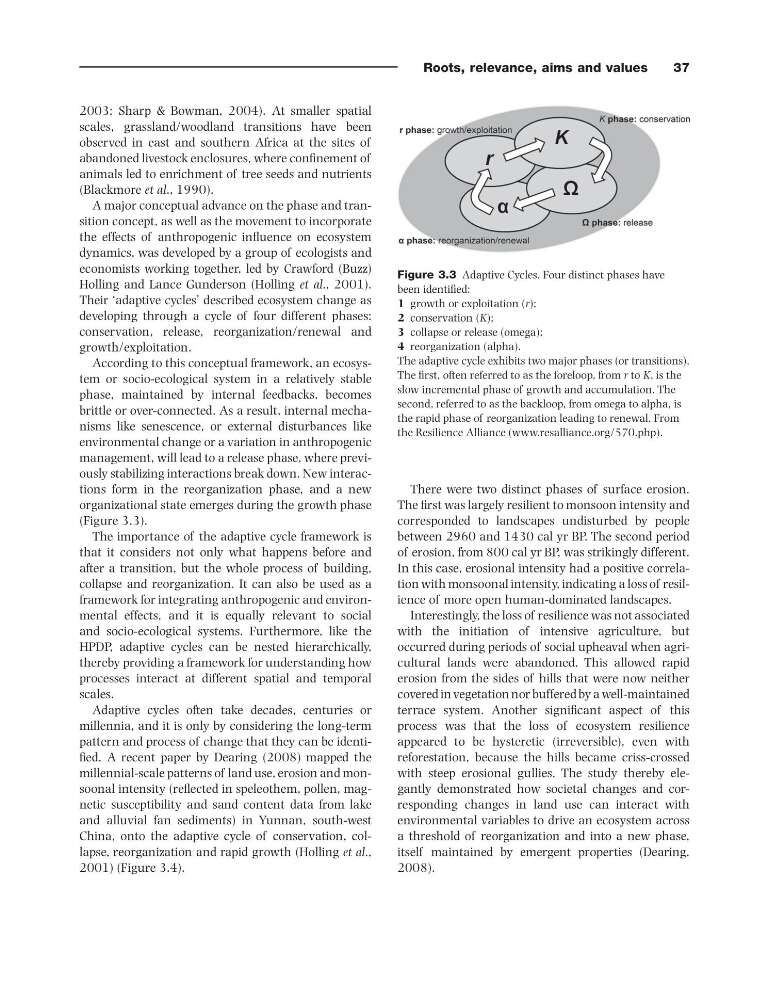
Their ‘ adaptive cycles ’ described ecosystem change as
developing through a cycle of four different phases:
conservation, release, reorganization/renewal and
growth/exploitation.
According to this conceptual framework, an ecosystem or socio - ecological system in a relatively stable
phase, maintained by internal feedbacks, becomes
brittle or over - connected. As a result, internal mechanisms like senescence, or external disturbances like
environmental change or a variation in anthropogenic
management, will lead to a release phase, where previously stabilizing interactions break down. New interactions form in the reorganization phase, and a new
organizational state emerges during the growth phase
(Figure 3.3 ).
The importance of the adaptive cycle framework is
that it considers not only what happens before and
after a transition, but the whole process of building,
collapse and reorganization. It can also be used as a
framework for integrating anthropogenic and environmental effects, and it is equally relevant to social
and socio - ecological systems. Furthermore, like the
HPDP, adaptive cycles can be nested hierarchically,
thereby providing a framework for understanding how
processes interact at different spatial and temporal
scales.
Adaptive cycles often take decades, centuries or
millennia, and it is only by considering the long - term
pattern and process of change that they can be identifi ed. A recent paper by Dearing (2008) mapped the
millennial - scale patterns of land use, erosion and monsoonal intensity (refl ected in speleothem, pollen, magnetic susceptibility and sand content data from lake
and alluvial fan sediments) in Yunnan, south - west
China, onto the adaptive cycle of conservation, collapse, reorganization and rapid growth (Holling et al .,
2001 ) (Figure 3.4 ).
Figure 3.3 Adaptive Cycles. Four distinct phases have
been identifi ed:
1 growth or exploitation ( r );
2 conservation ( K );
3 collapse or release (omega);
4 reorganization (alpha).
The adaptive cycle exhibits two major phases (or transitions).
The fi rst, often referred to as the foreloop, from r to K , is the
slow incremental phase of growth and accumulation. The
second, referred to as the backloop, from omega to alpha, is
the rapid phase of reorganization leading to renewal. From
the Resilience Alliance ( www.resalliance.org/570.php ).
There were two distinct phases of surface erosion.
The fi rst was largely resilient to monsoon intensity and
corresponded to landscapes undisturbed by people
between 2960 and 1430 cal yr BP. The second period
of erosion, from 800 cal yr BP, was strikingly different.
In this case, erosional intensity had a positive correlation with monsoonal intensity, indicating a loss of resilience of more open human - dominated landscapes.
Interestingly, the loss of resilience was not associated
with the initiation of intensive agriculture, but
occurred during periods of social upheaval when agricultural lands were abandoned. This allowed rapid
erosion from the sides of hills that were now neither
covered in vegetation nor buffered by a well - maintained
terrace system. Another signifi cant aspect of this
process was that the loss of ecosystem resilience
appeared to be hysteretic (irreversible), even with
reforestation, because the hills became criss - crossed
with steep erosional gullies. The study thereby elegantly demonstrated how societal changes and corresponding changes in land use can interact with
environmental variables to drive an ecosystem across
a threshold of reorganization and into a new phase,
itself maintained by emergent properties (Dearing,
2008 ).
37
2003 ; Sharp & Bowman, 2004 ). At smaller spatial
scales, grassland/woodland transitions have been
observed in east and southern Africa at the sites of
abandoned livestock enclosures, where confi nement of
animals led to enrichment of tree seeds and nutrients
(Blackmore et al ., 1990 ).
A major conceptual advance on the phase and transition concept, as well as the movement to incorporate
the effects of anthropogenic infl uence on ecosystem
dynamics, was developed by a group of ecologists and
economists working together, led by Crawford (Buzz)
Holling and Lance Gunderson (Holling et al ., 2001 ).
Their ‘ adaptive cycles ’ described ecosystem change as
developing through a cycle of four different phases:
conservation, release, reorganization/renewal and
growth/exploitation.
According to this conceptual framework, an ecosystem or socio - ecological system in a relatively stable
phase, maintained by internal feedbacks, becomes
brittle or over - connected. As a result, internal mechanisms like senescence, or external disturbances like
environmental change or a variation in anthropogenic
management, will lead to a release phase, where previously stabilizing interactions break down. New interactions form in the reorganization phase, and a new
organizational state emerges during the growth phase
(Figure 3.3 ).
The importance of the adaptive cycle framework is
that it considers not only what happens before and
after a transition, but the whole process of building,
collapse and reorganization. It can also be used as a
framework for integrating anthropogenic and environmental effects, and it is equally relevant to social
and socio - ecological systems. Furthermore, like the
HPDP, adaptive cycles can be nested hierarchically,
thereby providing a framework for understanding how
processes interact at different spatial and temporal
scales.
Adaptive cycles often take decades, centuries or
millennia, and it is only by considering the long - term
pattern and process of change that they can be identifi ed. A recent paper by Dearing (2008) mapped the
millennial - scale patterns of land use, erosion and monsoonal intensity (refl ected in speleothem, pollen, magnetic susceptibility and sand content data from lake
and alluvial fan sediments) in Yunnan, south - west
China, onto the adaptive cycle of conservation, collapse, reorganization and rapid growth (Holling et al .,
2001 ) (Figure 3.4 ).
Figure 3.3 Adaptive Cycles. Four distinct phases have
been identifi ed:
1 growth or exploitation ( r );
2 conservation ( K );
3 collapse or release (omega);
4 reorganization (alpha).
The adaptive cycle exhibits two major phases (or transitions).
The fi rst, often referred to as the foreloop, from r to K , is the
slow incremental phase of growth and accumulation. The
second, referred to as the backloop, from omega to alpha, is
the rapid phase of reorganization leading to renewal. From
the Resilience Alliance ( www.resalliance.org/570.php ).
There were two distinct phases of surface erosion.
The fi rst was largely resilient to monsoon intensity and
corresponded to landscapes undisturbed by people
between 2960 and 1430 cal yr BP. The second period
of erosion, from 800 cal yr BP, was strikingly different.
In this case, erosional intensity had a positive correlation with monsoonal intensity, indicating a loss of resilience of more open human - dominated landscapes.
Interestingly, the loss of resilience was not associated
with the initiation of intensive agriculture, but
occurred during periods of social upheaval when agricultural lands were abandoned. This allowed rapid
erosion from the sides of hills that were now neither
covered in vegetation nor buffered by a well - maintained
terrace system. Another signifi cant aspect of this
process was that the loss of ecosystem resilience
appeared to be hysteretic (irreversible), even with
reforestation, because the hills became criss - crossed
with steep erosional gullies. The study thereby elegantly demonstrated how societal changes and corresponding changes in land use can interact with
environmental variables to drive an ecosystem across
a threshold of reorganization and into a new phase,
itself maintained by emergent properties (Dearing,
2008 ).