

Roots, relevance, aims and values
25
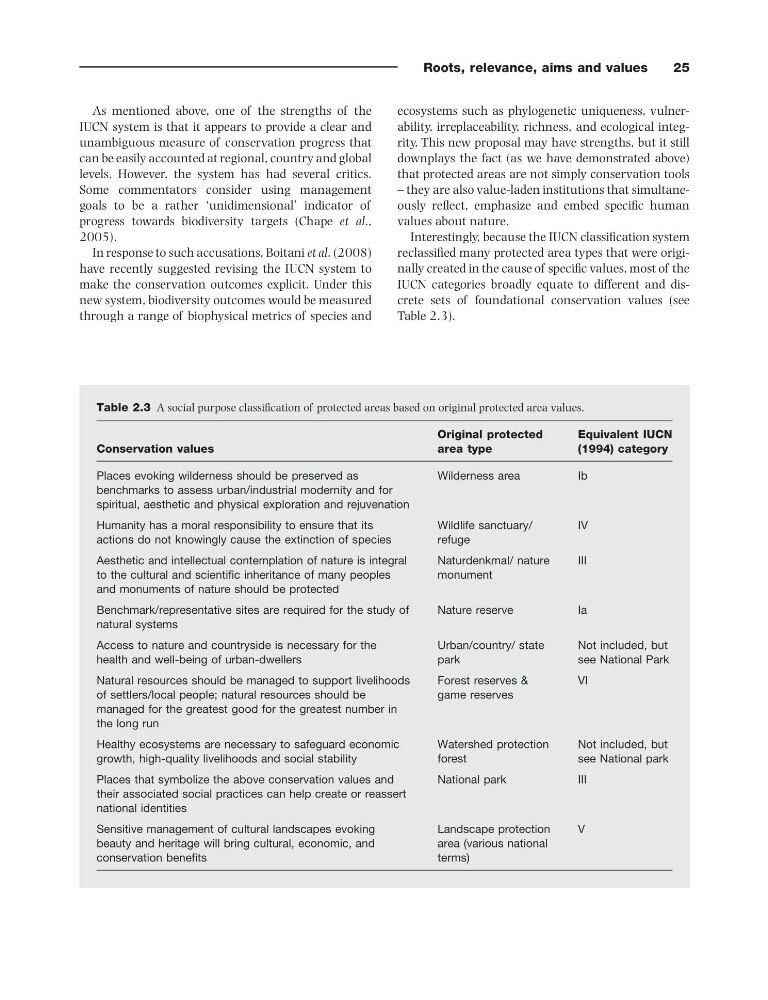
Table 2.3 A social purpose classifi cation of protected areas based on original protected area values.
Conservation values
Original protected
area type
Equivalent IUCN
(1994) category
Places evoking wilderness should be preserved as
benchmarks to assess urban/industrial modernity and for
spiritual, aesthetic and physical exploration and rejuvenation
Wilderness area
Ib
Humanity has a moral responsibility to ensure that its
actions do not knowingly cause the extinction of species
Wildlife sanctuary/
refuge
IV
Aesthetic and intellectual contemplation of nature is integral
to the cultural and scientifi c inheritance of many peoples
and monuments of nature should be protected
Naturdenkmal/ nature
monument
III
Benchmark/representative sites are required for the study of
natural systems
Nature reserve
Ia
Access to nature and countryside is necessary for the
health and well - being of urban - dwellers
Urban/country/ state
park
Not included, but
see National Park
Natural resources should be managed to support livelihoods
of settlers/local people; natural resources should be
managed for the greatest good for the greatest number in
the long run
Forest reserves &
game reserves
VI
Healthy ecosystems are necessary to safeguard economic
growth, high - quality livelihoods and social stability
Watershed protection
forest
Not included, but
see National park
Places that symbolize the above conservation values and
their associated social practices can help create or reassert
national identities
National park
III
Sensitive management of cultural landscapes evoking
beauty and heritage will bring cultural, economic, and
conservation benefi ts
Landscape protection
area (various national
terms)
V
As mentioned above, one of the strengths of the
IUCN system is that it appears to provide a clear and
unambiguous measure of conservation progress that
can be easily accounted at regional, country and global
levels. However, the system has had several critics.
Some commentators consider using management
goals to be a rather ‘ unidimensional ’ indicator of
progress towards biodiversity targets (Chape et al .,
2005 ).
In response to such accusations, Boitani et al . (2008)
have recently suggested revising the IUCN system to
make the conservation outcomes explicit. Under this
new system, biodiversity outcomes would be measured
through a range of biophysical metrics of species and
ecosystems such as phylogenetic uniqueness, vulnerability, irreplaceability, richness, and ecological integrity. This new proposal may have strengths, but it still
downplays the fact (as we have demonstrated above)
that protected areas are not simply conservation tools
– they are also value - laden institutions that simultaneously refl ect, emphasize and embed specifi c human
values about nature.
Interestingly, because the IUCN classifi cation system
reclassifi ed many protected area types that were originally created in the cause of specifi c values, most of the
IUCN categories broadly equate to different and discrete sets of foundational conservation values (see
Table 2.3 ).
25
Table 2.3 A social purpose classifi cation of protected areas based on original protected area values.
Conservation values
Original protected
area type
Equivalent IUCN
(1994) category
Places evoking wilderness should be preserved as
benchmarks to assess urban/industrial modernity and for
spiritual, aesthetic and physical exploration and rejuvenation
Wilderness area
Ib
Humanity has a moral responsibility to ensure that its
actions do not knowingly cause the extinction of species
Wildlife sanctuary/
refuge
IV
Aesthetic and intellectual contemplation of nature is integral
to the cultural and scientifi c inheritance of many peoples
and monuments of nature should be protected
Naturdenkmal/ nature
monument
III
Benchmark/representative sites are required for the study of
natural systems
Nature reserve
Ia
Access to nature and countryside is necessary for the
health and well - being of urban - dwellers
Urban/country/ state
park
Not included, but
see National Park
Natural resources should be managed to support livelihoods
of settlers/local people; natural resources should be
managed for the greatest good for the greatest number in
the long run
Forest reserves &
game reserves
VI
Healthy ecosystems are necessary to safeguard economic
growth, high - quality livelihoods and social stability
Watershed protection
forest
Not included, but
see National park
Places that symbolize the above conservation values and
their associated social practices can help create or reassert
national identities
National park
III
Sensitive management of cultural landscapes evoking
beauty and heritage will bring cultural, economic, and
conservation benefi ts
Landscape protection
area (various national
terms)
V
As mentioned above, one of the strengths of the
IUCN system is that it appears to provide a clear and
unambiguous measure of conservation progress that
can be easily accounted at regional, country and global
levels. However, the system has had several critics.
Some commentators consider using management
goals to be a rather ‘ unidimensional ’ indicator of
progress towards biodiversity targets (Chape et al .,
2005 ).
In response to such accusations, Boitani et al . (2008)
have recently suggested revising the IUCN system to
make the conservation outcomes explicit. Under this
new system, biodiversity outcomes would be measured
through a range of biophysical metrics of species and
ecosystems such as phylogenetic uniqueness, vulnerability, irreplaceability, richness, and ecological integrity. This new proposal may have strengths, but it still
downplays the fact (as we have demonstrated above)
that protected areas are not simply conservation tools
– they are also value - laden institutions that simultaneously refl ect, emphasize and embed specifi c human
values about nature.
Interestingly, because the IUCN classifi cation system
reclassifi ed many protected area types that were originally created in the cause of specifi c values, most of the
IUCN categories broadly equate to different and discrete sets of foundational conservation values (see
Table 2.3 ).