

218
Applied island biogeography
8.4.3 Landscape c ontext – m atrix e ffects
The presence of a species within a reserve will depend
not only on the suitability of habitat within the reserve,
but also on the species ’ ability to use the intervening
landscape matrix. If this matrix is hospitable, species
can also move between reserves (Gustafson & Gardner,
1996 ). Therefore, although reserves are important, an
increasing emphasis is now being placed on the role of
the quality of the landscape matrix between reserves.
For example, Baum et al . (2004) have demonstrated
that corridors and stepping stones are more effective if
surrounded by a hospitable matrix. In tall - grass prairie
ecosystem in the central USA, they showed that the
effectiveness of corridors and stepping stones for promoting dispersal of the planthopper Prokelisia crocea
among patches containing prairie cordgrass Spartina
pectinata (the sole host plant for the planthopper)
depended strongly on the intervening matrix habitat.
In a low - resistance matrix (one that facilitates high
rates of inter - patch dispersal), where both stepping
stones and corridors promoted high connectivity, the
corridors, because their specialist habitats are unlikely
to be found throughout the length of most corridors.
For some populations, corridors may even act as
‘ sinks ’ , drawing out individuals from the main habitat
area, perhaps into dangerous places with higher risks
of predation, but not returning individuals to supplement the main source area. Alternatively, they may be
fairly neutral in their ecological cost - benefi t, but
perhaps be quite expensive to purchase and set up if
not already existing in a landscape. On the other hand,
some corridors are essential in providing links between
preferred habitats for animals that undertake regular
seasonal migrations.
In the longer term, it has been argued that climate
change is likely to drive substantial shifts in the distribution of species, and that the resulting species migrations will be impeded by the human sequestration of
land to agriculture and other purposes. Therefore, on
these grounds, it would seem prudent to plan more or
less continuous habitat corridors that straddle major
climatic/elevational gradients where this is feasible
(e.g. Bush, 1996, 2002 – Box 7.4 ).
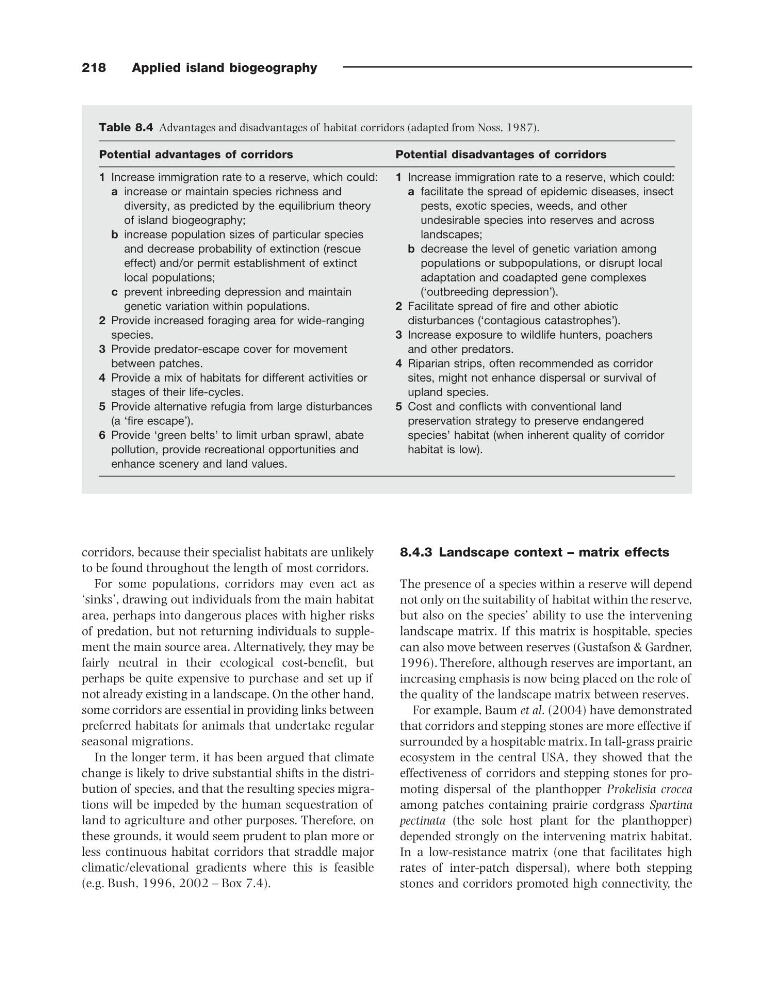
Table 8.4 Advantages and disadvantages of habitat corridors (adapted from Noss, 1987 ) .
Potential advantages of corridors
Potential disadvantages of corridors
1 Increase immigration rate to a reserve, which could:
a increase or maintain species richness and
diversity, as predicted by the equilibrium theory
of island biogeography;
b increase population sizes of particular species
and decrease probability of extinction (rescue
effect) and/or permit establishment of extinct
local populations;
c prevent inbreeding depression and maintain
genetic variation within populations.
2 Provide increased foraging area for wide - ranging
species.
3 Provide predator - escape cover for movement
between patches.
4 Provide a mix of habitats for different activities or
stages of their life - cycles.
5 Provide alternative refugia from large disturbances
(a ‘ fi re escape ’ ).
6 Provide ‘ green belts ’ to limit urban sprawl, abate
pollution, provide recreational opportunities and
enhance scenery and land values.
1 Increase immigration rate to a reserve, which could:
a facilitate the spread of epidemic diseases, insect
pests, exotic species, weeds, and other
undesirable species into reserves and across
landscapes;
b decrease the level of genetic variation among
populations or subpopulations, or disrupt local
adaptation and coadapted gene complexes
( ‘ outbreeding depression ’ ).
2 Facilitate spread of fi re and other abiotic
disturbances ( ‘ contagious catastrophes ’ ).
3 Increase exposure to wildlife hunters, poachers
and other predators.
4 Riparian strips, often recommended as corridor
sites, might not enhance dispersal or survival of
upland species.
5 Cost and confl icts with conventional land
preservation strategy to preserve endangered
species ’ habitat (when inherent quality of corridor
habitat is low).
Applied island biogeography
8.4.3 Landscape c ontext – m atrix e ffects
The presence of a species within a reserve will depend
not only on the suitability of habitat within the reserve,
but also on the species ’ ability to use the intervening
landscape matrix. If this matrix is hospitable, species
can also move between reserves (Gustafson & Gardner,
1996 ). Therefore, although reserves are important, an
increasing emphasis is now being placed on the role of
the quality of the landscape matrix between reserves.
For example, Baum et al . (2004) have demonstrated
that corridors and stepping stones are more effective if
surrounded by a hospitable matrix. In tall - grass prairie
ecosystem in the central USA, they showed that the
effectiveness of corridors and stepping stones for promoting dispersal of the planthopper Prokelisia crocea
among patches containing prairie cordgrass Spartina
pectinata (the sole host plant for the planthopper)
depended strongly on the intervening matrix habitat.
In a low - resistance matrix (one that facilitates high
rates of inter - patch dispersal), where both stepping
stones and corridors promoted high connectivity, the
corridors, because their specialist habitats are unlikely
to be found throughout the length of most corridors.
For some populations, corridors may even act as
‘ sinks ’ , drawing out individuals from the main habitat
area, perhaps into dangerous places with higher risks
of predation, but not returning individuals to supplement the main source area. Alternatively, they may be
fairly neutral in their ecological cost - benefi t, but
perhaps be quite expensive to purchase and set up if
not already existing in a landscape. On the other hand,
some corridors are essential in providing links between
preferred habitats for animals that undertake regular
seasonal migrations.
In the longer term, it has been argued that climate
change is likely to drive substantial shifts in the distribution of species, and that the resulting species migrations will be impeded by the human sequestration of
land to agriculture and other purposes. Therefore, on
these grounds, it would seem prudent to plan more or
less continuous habitat corridors that straddle major
climatic/elevational gradients where this is feasible
(e.g. Bush, 1996, 2002 – Box 7.4 ).
Table 8.4 Advantages and disadvantages of habitat corridors (adapted from Noss, 1987 ) .
Potential advantages of corridors
Potential disadvantages of corridors
1 Increase immigration rate to a reserve, which could:
a increase or maintain species richness and
diversity, as predicted by the equilibrium theory
of island biogeography;
b increase population sizes of particular species
and decrease probability of extinction (rescue
effect) and/or permit establishment of extinct
local populations;
c prevent inbreeding depression and maintain
genetic variation within populations.
2 Provide increased foraging area for wide - ranging
species.
3 Provide predator - escape cover for movement
between patches.
4 Provide a mix of habitats for different activities or
stages of their life - cycles.
5 Provide alternative refugia from large disturbances
(a ‘ fi re escape ’ ).
6 Provide ‘ green belts ’ to limit urban sprawl, abate
pollution, provide recreational opportunities and
enhance scenery and land values.
1 Increase immigration rate to a reserve, which could:
a facilitate the spread of epidemic diseases, insect
pests, exotic species, weeds, and other
undesirable species into reserves and across
landscapes;
b decrease the level of genetic variation among
populations or subpopulations, or disrupt local
adaptation and coadapted gene complexes
( ‘ outbreeding depression ’ ).
2 Facilitate spread of fi re and other abiotic
disturbances ( ‘ contagious catastrophes ’ ).
3 Increase exposure to wildlife hunters, poachers
and other predators.
4 Riparian strips, often recommended as corridor
sites, might not enhance dispersal or survival of
upland species.
5 Cost and confl icts with conventional land
preservation strategy to preserve endangered
species ’ habitat (when inherent quality of corridor
habitat is low).